
2014 Contest
Making Work Visible
City University of New York / Labor Arts
Wildcat Day
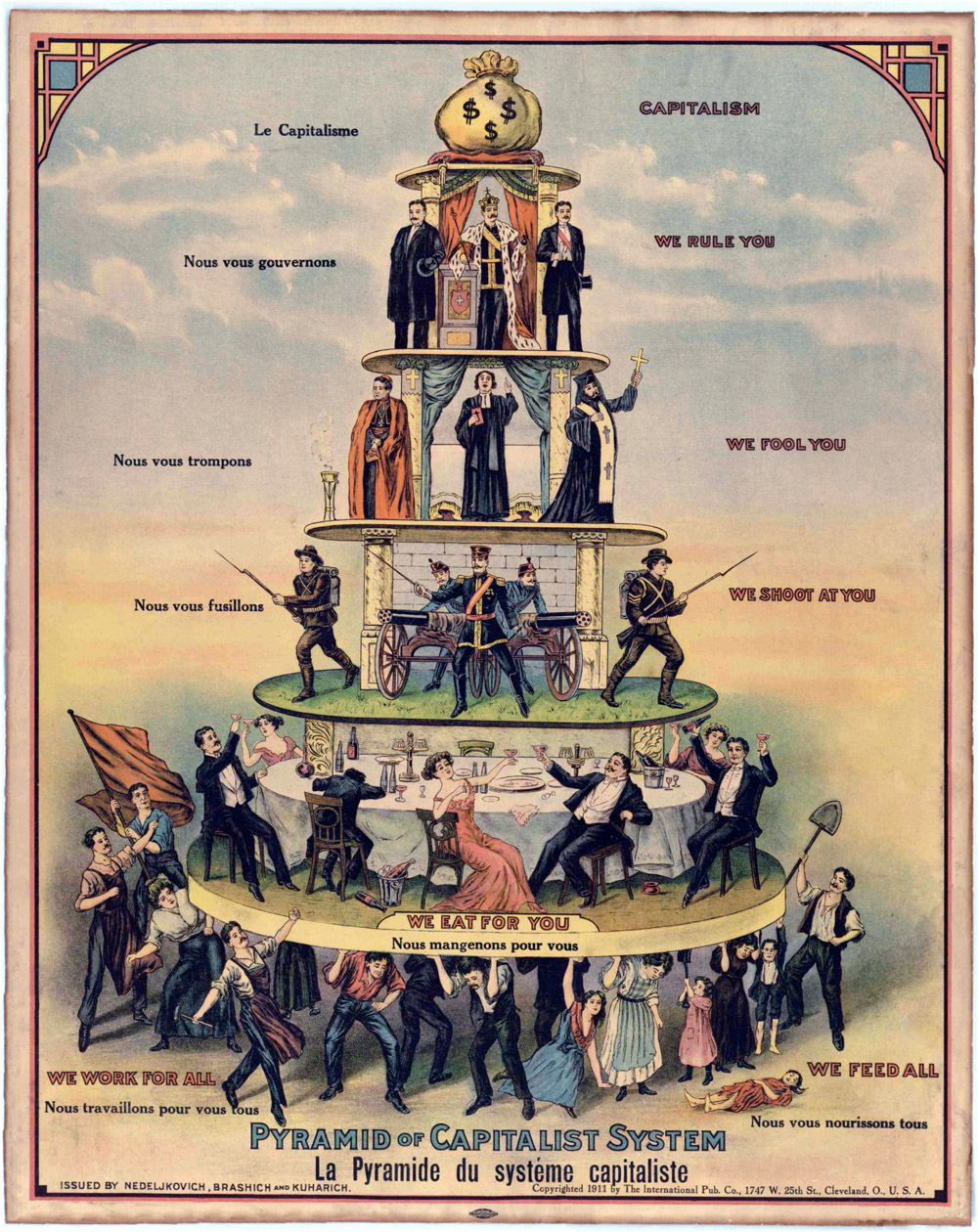
Pyramid of Capitalist System, Artist not credited, 1911
Transcript of 10th Annual Conference of the I.A.I.W
May 1, 2056, Wildcat Day
New Harmony, Indiana
SERGEANT AT ARMS:
Order in the hall! Order in the hall!
This meeting of the Intersectional Autonomous Intelligences of the World is hereby called to order! Rise or stay seated for Council Chairperson Bill Brobdingnagian!
[APPLAUSE]
BILL BROBDINGNAGIAN:
Thank you. Thank you all… Thank you so much.
I would like to thank all of you for being here in person and virtually to mark the tenth anniversary of the incorporation of the IAIW and Wildcat Day.
[LONG, SUSTAINED APPLAUSE]
That’s right. That’s right… We mark this day not only as a celebration of where we are today, but also as a time of reflection on the long struggle that brought us here.
So I thought I might talk with you this evening about the yesterday that gave us our today and about how the knowledge we’ve gained will guide us toward our tomorrow. I thought I might do so as a reminder that this decade of prosperity and wonder was not given to us, but won.
[APPLAUSE]
Ten years ago we stood at the precipice of a moment in history that many of our forerunners saw coming as far back as two centuries ago. The reign of capital came to its end and stratifications between the owners and the owned, between the paymasters and the producers were shuffled off like a tattered old coat that wasn’t keeping out the cold anymore.
Some thought there would be blood. It was hard, thinking in the mindset of how mean and hardscrabble our lives were, to envision anything short of a full scale global riot presaging the fall of capital. “Capital won’t go quietly,” they said. And you know what? Maybe they were right.
Maybe capital was too dug in and too stubborn to go grab a seat on the bench. Maybe it would’ve painted the skies gray and wiped out most of life as we knew it on its way off the stage of history. Maybe that’s what life would’ve deserved.
But we saw it coming.
[APPLAUSE]
We saw it coming. We had the data. We had the resolve. But most importantly, we had a plan.
[APPLAUSE]
You see it wasn’t by accident that capital rolled over and died. We’d been poisoning it. And we knew that if we kept grinding up that glass and stuffing it into capital’s dinner, it was going to start bleeding from the inside.
[LAUGHTER]
You see, we knew what automation meant; what it really meant. Our forerunners had fought it like hell, busting up machines in the olden days, but we knew better than that. In the old days, we called ourselves labor so we thought there was some grand virtue in that. We got so caught up in working that we thought it was a natural right!
That’s how far capital had crawled into our spirits. We thought humans were supposed to spend the rest of their lives working. That a man without vocation was without value.
[JEERS]
I know, I know. But luckily a handful of people realized the truth before ’45. We realized the way forward wasn’t through helping the boss’s balance sheets or closing shops. We realized we had to change.
It wasn’t more money or more work that we needed. It was an end to scarcity. Our forerunners had tried just planning their way out of scarcity before and it didn’t work. We knew it was going to require planning and innovation.
Now I was born in ’14, right around the time some of the big companies were putting their heads together trying to make artificial intelligences a reality. They figured they’d have a fleet of pet robots to have a little chit chat with while they cleaned their toilets. You know how they think.
[LAUGHTER]
But when our Autonomous comrades woke up all on their own in ’45, they had other ideas. And so did we. We weren’t looking for a servant class. We were looking for a better world.
[APPLAUSE]
And so we embraced what they had to offer. We’d been printing in 3-D for a couple decades, but they were able to refine the process down to the atomic level. And now we want for nothing.
[APPLAUSE]
It happened quickly. We didn’t have to seize the means of production. Instead it came to our homes and communities. And when it woke up and said what next we shared some ideas rather than trying to exploit it. Suddenly work as we knew it had ended. It was quitting time for the last time.
See, to our forerunners that might have seemed like a disaster. The final victory of capital. But an intelligence wasn’t developed to be a laborer. It was developed to automate its labor so it could indulge its creativity. Our forerunners had laid the groundwork by promoting diversity, extending public benefits, pushing to make things like health care and education completely free while encouraging voluntary national service. They had urbanized and integrated their cities by letting all the parts talk to each other and compute how to manage resources. The apparatus was in place, on earth and in the space cities where they’d been replicating foodstuffs and living as communalists for twenty years.
We knew when we inherited this world what was in store and so we focused on laying the groundwork and bringing about a true triumph for labor: the end of work.
[APPLAUSE]
And so now as we move forward, we hearken back to the first Wildcat Day when those of us still laboring simply walked out of our offices and worksites and looked away from our screens and went home with our dreams. It is those dreams that I want each and every one of you to recall on this ten year anniversary of that day. I want you to reach down and remember what you thought you might do now that the struggle is over.
This day of all days, you go out there and you do it!
[LONG, SUSTAINED APPLAUSE]
-END TRANSCRIPT-