
2025 Contest
Making Work Visible
City University of New York / Labor Arts



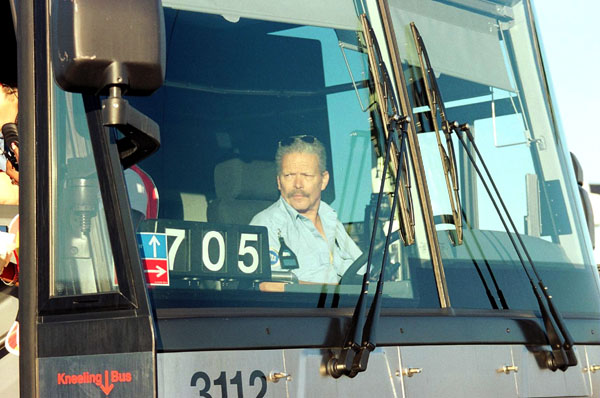
Most New Yorkers can unite under the shared experience of riding the subway. Swapping stories about train mishaps. Complaining about a particularly long delay to a stranger on the platform. Helping a tourist find what train they need to transfer to. Most of us rely on the subway and buses as our primary modes of transportation. If the subway shuts down, the city shuts down is a sentiment many New Yorkers can understand. Even one closure can significantly impact thousands of people. When the trains were partially shut down during the COVID-19 pandemic, around 11,000 New Yorkers were affected, even with ridership down 90%.1 The trains are the lifeblood of New York. Still, in 1966, New York City’s public transportation system came to a screeching halt for twelve days when the Transport Workers Union of America (TWU) and the Amalgamated Transit Union (ATU) both went on strike. At the time, this conflict was often grossly simplified into a comical slap-fight between the newly sworn-in Mayor John Lindsay and the TWU president and founder, Michael Joseph Quill. The media coverage from this time still informs how this dispute is characterized. Upon researching this topic, I found most articles and documents were concerned with Quill and his “outrageous” personality or with his association with the communist party. There was often little to no discussion on the actual demands of the union or the issues facing the transit workers. What was discussed was often done by quoting Quill directly. There was little mention of other workers or even other leaders, if they were not in some direct relation to Quill. Though anti-union sentiment had been on the rise, I believe that we can point to the reporting done during this strike as the blueprint for much of the anti-union propaganda we have seen in recent times. This strike is also the origin of the New York Taylor Law, which prevents all public employees from striking. It is important to study this aspect of New York history to more closely understand anti-union rhetoric and the origins of the Taylor Law. We must examine the subtle anti-union sentiment that was present at the time, as it has only proceeded to grow in subsequent years.
To fully understand the coverage of the strike, it is important to understand the history and public image of Mike Quill leading up to 1966, as well as the history and founding of the TWU. Quill was born in 1905 in Gortloughera. He would grow up in a time of political turmoil for Ireland and would take full part in it. Quill was only fourteen when he “became a message carrier and scout for the NO 2 Kerry Brigade of the IRA during the War of Independence” (Dwyer). Quill also “participated in the Civil War as an IRA volunteer” (Dwyer). After immigrating to New York in 1926, Quill began to work for the Interboro Rapid Transit Company. There were very few protections for the transit workers at this time. Employees had to work very long hours with almost no benefits.2 Quill would go on to form the Transport Workers Union with Thomas H O’Shea. Initially, the union had close ties to Clan na Gael,3 The Leftist Irish Workers Club’s, and the Communist Party. The TWU would go on to become the main union representing transit workers of New York City after a series of smaller protests and strikes. The TWU was a far more effective labor force than the IRT had been. Much of this can be attributed to Quill himself, who served as president. Quill became a force in politics and further expanded the TWU’s membership.4 The TWU’s founding alone would have been enough to create a media frenzy during any large-scale strike. But tensions had been high between Quill and the press for many years before the 1966 strike. In 1948, The Washington Post put out a less than favorable article on Quill. The article has a photo in which it looks like Quill is screaming at someone out of view. They also mention Quill’s past with the IRA, and they bring up his history with the communist party, “why he used to be called a Commie himself” (Stavisky), though the article doesn’t necessarily make clear that Quill had cut ties with the party by this point. The article also makes mention of Quill’s temper, though no examples were given, and it only makes mention of his political movements. Quill’s image was already less than favorable, even during these very small-scale labor disputes. It certainly didn’t help that tensions with labor unions had already been on the rise in New York. The 1900s had seen great strides in the labor movement. In 1962, only a few years before the 1966 strike, The Newspaper Guild had gone on strike for over a hundred days over low wages.5 The 1940s and 1950s had also seen a series of strikes by labor unions. Even the TWU had been at risk of striking multiple times before they inevitably did. The TWU and ATU would renegotiate their contracts at the end of every year, with the threat of a strike always looming.6 In November of 1961, The New York Times put out an article predicting a strike “The blustery president of the Transportation Workers Union wants his members on the municipal subways and busses to get wage increases, shorter hours, and other contract improvements that would force a doubling of the present 15-cent fare” (“TimesMachine: Friday November 10, 1961 – NYTimes.com”). Here we see the echoes of what would be the 1966 transit strike as these issues continued to persist. We also see how the media would eventually characterize the strike with a focus not on the workers but on Quill and the effect that the strike would have on the citizens of New York.
When conducting research for this essay, I initially had trouble finding sources to pull from. I first went to the Transit Museum to check their online database. They didn’t seem to have anything publicly available about the strike. I reached out to them through email, asking if they had any records of employees during the mid-1960s or any record of where picket lines for the strike had been set up. I unfortunately never received an answer. I checked the Hunter College Library. Initially, it seemed that only one book had been published on the topic7 that was accessible to the public, and many of the articles available in the library were reviews and reports on this book. I was able to find a few newspaper articles written about Quill in the years before the strike. I also came across a newsreel from 1966 covering the strike as it was happening. Through that archive, I found newsreels from the following days of the strike. I also browsed the Wayback Machine, but wasn’t able to find much of use. After I read about what a large role The New York Times played in covering the strike, I used the New York Times machine to find papers published during the strike. This was my most helpful tool in conducting research. I was also able to find a few archived press conferences.
As stated in the above section, I found the most helpful resources to come from archived newspapers, newsreels, and press conferences. All of these helped to paint a picture of the media frenzy surrounding the strike and the characterization of Mike Quill and Mayor Lindsey. This can be seen very clearly in The New York Times paper released on the first day of the strike. The front page of the paper has a picture of Mayor Lindsey being sworn into office. His hand raised in the air as he took his oath. His wife, Mary Anne Harrison Lindsy, stands just off to the side of him. The front page is taken up mostly by talk of the new mayor and the troubles he will face with the strike. Although the Times is not outwardly using any anti-union rhetoric, they do present a slanted view of the strike. They state that “speaking in a firm voice, the mayor asked for public cooperation to overcome the hardships of a strike” (“TimesMachine: Saturday, January 1, 1966 – NYTimes.com”). The language used here presents the strike as something that must be overcome by the general public. There is no mention of the hardships faced by the transit workers. There is no concern for the striking workers or their families. There isn’t even a clear explanation for the reasons for the strike. The Times does not present the workers’ demands or give the same amount of attention to the striking workers as it does to Mayor Lindsey. The only person on the side of the transit workers who does get a significant amount of coverage is Mike Quill, but this coverage still isn’t balanced. The Times states, “Mr. Lindsey’s move came in rapid-fire fashion after Mike Quill, the volatile president of the transport workers union, stormed out of the transit negotiations at the Americana Hotel” (“TimesMachine: Saturday, January 1, 1966 – NYTimes.com”). We see here a clear difference in characterization between Quill and Lindsey. Quill is portrayed here as brash, unreasonable, and difficult as he is described storming away from the negotiation table. Lindsey is firm, level-headed, and quick, swooping in to take over the situation. The strike itself is given a shockingly small amount of description of coverage. Though there were no picket lines formed yet, no TWU members were interviewed or even mentioned. There seemed to be no interest in describing the strike outside of the “outrageous” actions of Quill.
This lack of sympathy for the union continues into the second day of the Times’ coverage of the strike. Again, there is no clear explanation of the strike for the readers. There is no clear outline of demands. They do not provide clear reasoning as to why negotiations halted or what the union was being offered in comparison to their demands. There is a stronger anti-union sentiment in this article as the Times states, “The mayor characterized the strike of 33,000 TWU members and 1,800 Amalgamated members as illegal” (“TimesMachine: Sunday January 2, 1966 – NYTimes.com”). 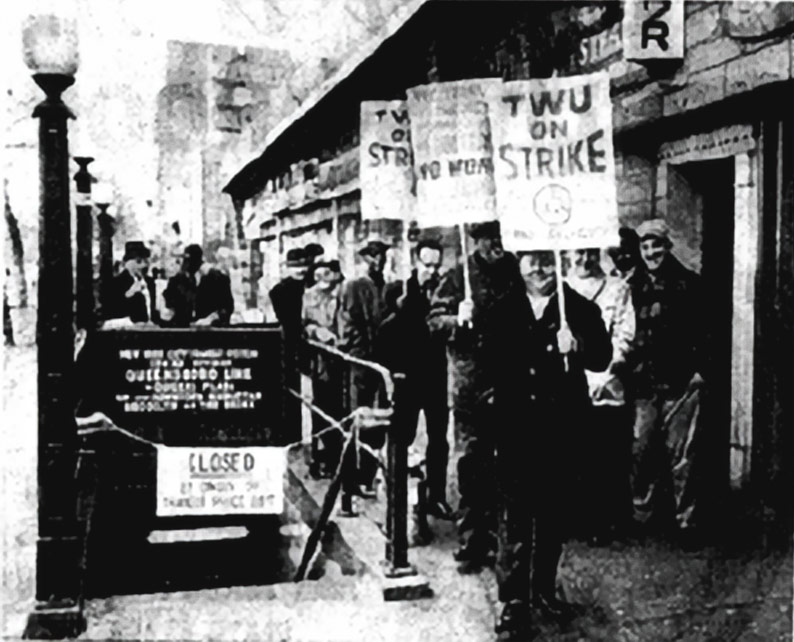 The front page contains another photograph of Mayor Lindsey. This one is less clear, but it depicts Lindsey’s inaugural address. Lindsey is surrounded by a sea of men in black business suits. He stands above them on a podium, looking out into the audience. We get our first clear image of the striking workers. The image depicts a small group of workers picketing by a closed train station. Some of the men towards the front hold signs reading “TWU ON STRIKE”. We also get our first interview with members of the union. All of them seem to be for the strike and speak positively of the action taken by Quill. One member, Mr.McGuinness, tells the Times, “Quill couldn’t dare come back with what was offered… He wouldn’t have a union if he did” (“TimesMachine: Sunday, January 2, 1966 – NYTimes.com”). Still, the section containing interviews with the members of the union is quite small on the page and could be easily looked over. Especially in comparison to the rest of the spread of the paper. Which almost exclusively contains material condemning the strike. Half of the page is taken up with the Mayor’s statement on the unlawfulness of the strike. It hardly feels like a balanced account.
This discrepancy in how the union is present in comparison to figures like Mayor Lindsey is also present in other coverage of the strike. In a Newsreel put out by Universal Pictures Company, the union is presented in an even more overtly negative light. The opening scene of the reel shows empty train tracks and barren stations. The music is incredibly dramatic as the station is shot from different angles. It is almost eerie and sounds similar to what one might find in a horror movie. The narrator states, “The transport workers’ union has almost paralyzed the city” (January 3, 1966). The newsreel presents the striking workers as malicious forces. There is no mention as to why they are on strike, only that they have stopped the trains from running. We see only very brief clips of the striking workers on the picket line, and only after being shown the effects of the strike. The narrator quickly moves to discussing Lindsey: “Mayor Lindsey has sworn in on the steps of city hall. The evening of the strike.” (January 3, 1966). Here we are shown a clip of Lindsey’s swearing-in, surrounded by men in suits smiling and clapping for him. We see Lindsey sitting and laughing with his family. We are also shown iconic images of New York City, like the Empire State Building. We are supposed to see Lindsey as being on the side of New York. He is surrounded by what looks like businessmen, the exact people who would be impacted by the strike. We see these iconic images of New York alongside Lindsey, which provides a stark contrast to the empty train lines when discussing the striking workings. This contrast can further be seen when we are shown a video of Quill. He is only shown sitting, looking somewhat aggravated, and surrounded by reporters and microphones. This contacts Lindsey’s laid-back and cheerful appearance.
The contrast between Mike Quill and Mayor Lindsay’s portrayals can be further observed in the January 6th, 1966, newsreel as well. We are first shown an image of Mayor Lindsey walking quickly down the street, shaking hands with pedestrians, and accompanied by a flock of businessmen. The broadcaster states, “Setting an example for New Yorkers is Mayor John Lindsey, who leaves gasping reporters in his wake as he walks from his Midtown hotel to City Hall” (January 6, 1966). Lindsey is again portrayed as a model New Yorker or an aspirational figure. He looks put together, walking quickly by reporters, and appears to be the picture of good health. This is in contrast to Mike Quill, who is seen being flocked by reporters. He seems to be attempting to engage with the mass crowd, but the shot is fairly chaotic. Quill seems to be getting rushed inside the building and is shown with none of the commanding presence of Lindsey. The main point that the broadcast makes on Quill again has nothing to do with the progression of the strike or negotiations taking place, instead stating “Michael Quill, head of the Transport Workers Union, was cited for contempt when he ignored an injunction against the strike and was launched on a civil jail with other Union leaders. Two hours later, he had a seizure and was taken to the hospital” (January 6, 1966). We see the discrepancy in how the two men are presented. Lindsey is someone to be looked up to and admired. Someone who is persevering despite the inconvenience the strike is causing him. Quill, on the other hand, is a criminal in poor health, cracking under the pressure of the strike.
All of this, of course, is somewhat in contradiction with Quill’s actual actions. Most of these new sources at the time did not directly quote Quill. But looking at a press conference Quill gave, it is clear that the accounts of him being brash, vitriolic, and outright unreasonable aren’t necessarily accurate. Considering Quill was aware of his impending arrest, he seemed to be overall in good spirits. He was very clear and articulate, and made his stance on the strike clear. That they would not back down, even with him and his fellow union leaders being arrested. Quill was humorous, often giving sarcastic answers to the reporters, but they were not necessarily unprompted. Many of the reporters asked him somewhat ridiculous questions. When one reporter asked what Quill was bringing to jail with him in between discussions of ongoing negotiation, Quill simply responded after a considerable pause, “A suitcase, none of your bloody business” (Quill).
Anti-union propaganda seems to be everywhere today. However, we have seen a clear increase in the labor movement with many workers making moves to unionize and other unions organizing toward historic deals. There seems to be a constant stream of anti-union propaganda that persists in our mainstream culture. Even the President of the United States acted as a union buster, forcing railroad workers to accept a deal to avoid a strike. Many states have made large-scale organization nearly impossible for workers. Even New York, which is a more pro-union state, has made it illegal for public employees to strike. A year after the 1966 transit strike, the Taylor Law was put into place, and though it did provide some protections for union workers, it made it illegal for public employees to exercise their right to strike. I believe this strike marks the origin of modern-day anti-union rhetoric and shows the start of current anti-labor talking points. This was so effective in part because the TWU was an easy group to villainize. We can not ignore that the TWU was made up mostly of Irish immigrants, many of whom had prior associations with the IRA. Many of them fled Ireland due to the troubles and the economic depression Ireland was facing at the time. The group had associations with several Irish nationalist groups, which were a movement that would have been associated with violence and terrorism. The TWU had a significant amount of power. Though this was the first large-scale strike they had organized, Quill was a significant figure in politics and had been able to avoid strikes previously due to his friendship with Wagner. This strike also had a direct impact on other middle and lower-class workers. This meant the narrative around the strike was not one of workers uniting to take on a corrupt and greedy employer, but a story of immigrant workers led by their foul-mouthed and unpredictable leader against New York City. Once the labor movement threatens the status quo for other middle-class workers, the support for their movement begins to dwindle. This could even be seen with the recent WGA and SAG-AFTRA strikes, where members were often accused of being greedy and money-hungry by studio executives and general onlookers. As Quill stated during his press conference, “The public will never be interested in our cause as long as we ask them to walk.”
1 Rivoli, Dan, and Zack Fink. “What You Need to Know about NYC’s Overnight Subway Shutdown (FAQ).” Ny1.com, 6 May 2020, ny1.com/nyc/all-boroughs/transit/2020/05/05/subway-shutdown-nyc-coronavirus-subway-shutdown-overnight-what-to-know. Accessed 3 Dec. 2023.
2 Dwyer, Ryle. “Mike Quill: The Irishman Martin Luther King Described as ‘a Man the Ages Will Remember.'” Irish Examiner, 26 Jan. 2016, www.irishexaminer.com/opinion/commentanalysis/arid-20378101.html. Accessed 3 Dec. 2023.
3 Clan na Gael was an Irish Republican group founded in the United States. The group was aligned with Irish Nationalism and had ties to the IRA.
4 White, Lawrence William. “Quill, Michael Joseph | Dictionary of Irish Biography.” www.dib.ie, Oct. 2009, www.dib.ie/biography/quill-michael-joseph-a7545. Accessed 2 Dec. 2023.
5 This strike had ended partially due to Mayor Robert F. Wagner, Jr was able to make an agreement with a labor negotiator. Wagner and Quill had been on friendly terms for most of his time as mayor.
6 Loud, Nicholas. “The 1966 Transit Strike That Paralyzed NYC for Almost Two Weeks.” Untapped New York, 7 July 2020, untappedcities.com/2020/07/07/essential-work-and-crisis-revisiting-the-1966-transit-strike/.
7 N/A.
Dwyer, Ryle. “Mike Quill: The Irishman Martin Luther King Described as ‘a Man the Ages Will Remember.'” Irish Examiner, 26 Jan. 2016, www.irishexaminer.com/opinion/commentanalysis/arid-20378101.html. Accessed 4 Dec. 2023.
January 3, 1966. Universal Pictures Company, 3 Jan. 1966, video-alexanderstreet-com.proxy.wexler.hunter.cuny.edu/watch/universal-newsreels-release-2-january-3-1966. Accessed 2 Dec. 2023.
January 6, 1966. Universal Pictures Company, 6 Jan. 1966, video-alexanderstreet-com.proxy.wexler.hunter.cuny.edu/watch/universal-newsreels-release-3-january-6-1966/transcript. Accessed 1 Dec. 2023.
Loud, Nicholas. “The 1966 Transit Strike That Paralyzed NYC for Almost Two Weeks.” Untapped New York, 7 July 2020, untappedcities.com/2020/07/07/essential-work-and-crisis-revisiting-the-1966-transit-strike/.
Quill, Michael Joseph. Salty Words from Mike Quill on the 1966 Transit Strike. www.wnyc.org/story/salty-words-mike-quill-1966-transit-strike/. Accessed 28 Nov. 2023.
Rivoli, Dan, and Zack Fink. “What You Need to Know about NYC’s Overnight Subway Shutdown (FAQ).” Ny1.com, 6 May 2020, ny1.com/nyc/all-boroughs/transit/2020/05/05/subway-shutdown-nyc-coronavirus-subway-shutdown-overnight-what-to-know. Accessed 1 Dec. 2023.
Stavisky, Sam. “PEOPLE in the NEWS: Mike Quill Takes His Turn Crying ‘Red’! Others Yelled It at Him Not Long Ago.” The Washington Post, 28 Oct. 1948, p. 2, proxy.wexler.hunter.cuny.edu/login?url=www-proquest-com.proxy.wexler.hunter.cuny.edu/historical-newspapers/people-news/docview/152071224/se-2?accountid=27495. Accessed 1 Dec. 2023.
“TimesMachine: Friday, November 10, 1961 – NYTimes.com.” The New York Times, 10 Nov. 1961, p. 34, timesmachine.nytimes.com/timesmachine/1961/11/10/issue.html. Accessed 6 Dec. 2023.
“TimesMachine: Saturday, January 1, 1966 – NYTimes.com.” The New York Times, 1 Jan. 1996, timesmachine.nytimes.com/timesmachine/1966/01/01/issue.html. Accessed 3 Dec. 2023.
“TimesMachine: Sunday, January 2, 1966 – NYTimes.com.” The New York Times, 2 Jan. 1966, timesmachine.nytimes.com/timesmachine/1966/01/02/issue.html. Accessed 3 Dec. 2023.
White, Lawrence William. “Quill, Michael Joseph | Dictionary of Irish Biography.” Www.dib.ie, Oct. 2009, www.dib.ie/biography/quill-michael-joseph-a7545. Accessed 2 Dec. 2023.
×
Day of Action. College Point Depot.
Photo by TWU member. November 2005. Courtesy of LaborArts.org