
2013 Contest
Making Work Visible
City University of New York / Labor Arts

The Linden Protests and the Emergence of Occupy Guyana
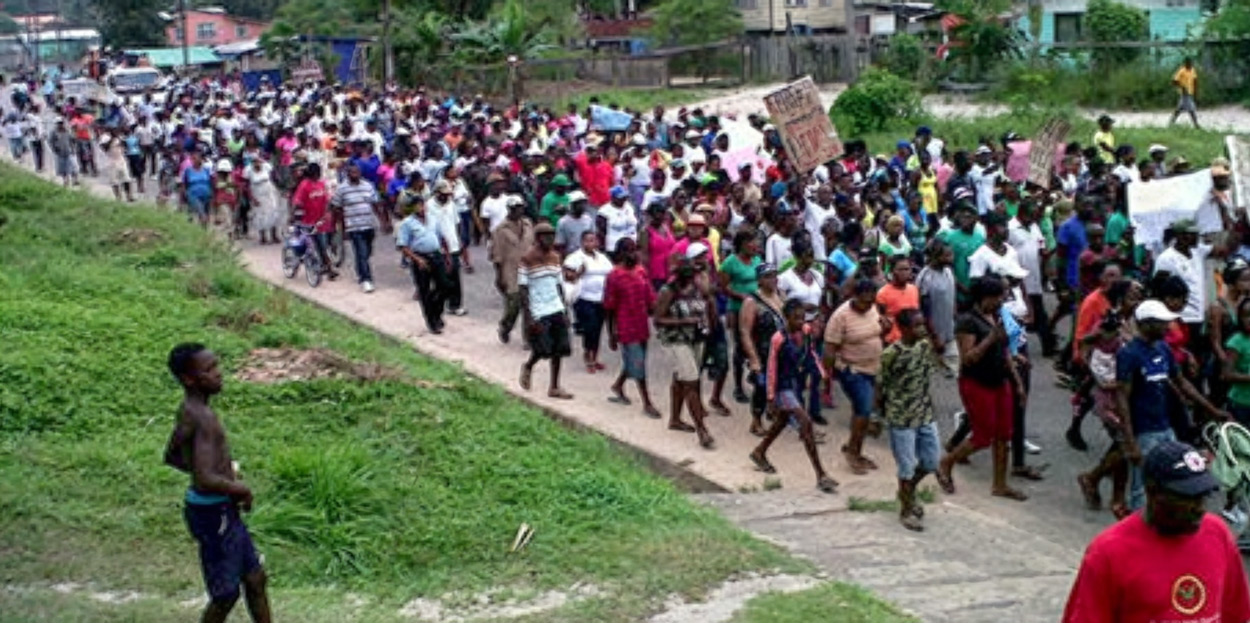
Protest in Linden, Guyana, April 18, 2012
On July 18th, 2012 in Linden, Guyana, South America, what began as a peaceful protest ended in turmoil as police officers opened fired on protestors, killing three and injuring twenty. The protesters had gathered in order to demonstrate against an increase of the electricity tariff, which had been implemented on the first of the month. The new tariff increased energy costs exponentially—from a rate of $25 month to almost $100 per month.1 Such a drastic increase would be cause for protest under any circumstances, but it was particularly devastating given the fact that Linden boasts an unemployment rate estimated to be as high as 75 percent2 (comparatively, the national unemployment rate is estimated to be around 11 percent).3 The increased tariffs were simply unbearable for the people of Linden; they took the streets to voice their dissatisfaction with the decision and were met with violence. In response to the police’s act of violence, the Linden protests raged on, becoming increasingly destructive—the office of the CEO of Linden Electric Company was set on fire, as were a number of other buildings including a primary school. Initially meant to last five days, the Linden Protest lasted well over a month—with the Guyanese government, under the leadership of President Donald Ramotar, eventually agreeing to many of the demands set by the protestors—and, perhaps most importantly, inspired the emergence of Occupy Guyana. The Linden protest and the subsequent establishment of Occupy Guyana offers an arresting case study in how social movements emerge in a post-Occupy landscape. This paper looks at the conditions that lead to the Linden protest, how the Occupy model has been adopted in Guyana and the impact of technology, globalization, and what sociologist Manuel Castells terms the “network society”4 in the adoption of this model. It also examines the prospects of success for Occupy Guyana, and the ways in which this protest movement fits in with other current poor people’s movements globally.
With an estimated population of 45,000 people,5 Linden is the second most populous town in Guyana (after the nation’s capital Georgetown). Though it is heavily populated, Linden is not a particularly urban area (it is often characterized as “rural”). Linden is primarily a mining town, and the economy is centered around the bauxite mining company. Bauxite is one of Guyana’s chief natural resources and a source of a sizeable percentage of the country’s gross national product. As mentioned earlier, the unemployment rate in Linden far exceeds the national average—the town is overwhelmed by poverty, and as such it does not come as a surprise that a poor people’s movement would emerge there. That said, the issues faced by those in Linden (such as chronic unemployment, poverty, hunger and lack of proper healthcare) are not relegated to that town alone— Guyana is one of the poorest nations in the Western Hemisphere and the ”third poorest country in Latin America and the Caribbean” according to the World Bank.6 Linden is a microcosm of Guyana as a whole. When asked about the Linden protests and whether or not the citizens’ response to the tariff hike was warranted, Guyanese Prime Minister Samuel Hinds stated that “Linden is no more depressed, no less depressed, no more prosperous, no less prosperous, than many other places in Guyana.”7 This response is telling for a number of reasons: for one, it speaks to the general disregard for and nonchalance with regards to the concerns of the people that characterizes much of the political leadership in Guyana; it also speaks to the depth and widespread prevalence of poverty throughout Guyana. If the conditions in Linden are not extraordinary in the context of Guyanese day-to-day life, what does that say about the quality of life for poor people throughout Guyana? These questions and concerns mirror those being addressed by the nascent Occupy Guyana movement, and point towards the ways in which the Linden protest has galvanized the citizens of Guyana to stand up for their rights.
A deeper look at the Linden Protests and the subsequent establishment of Occupy Guyana reveals the ways in which what occurred in Linden on July 18th falls in line with a pattern of how social movements emerge. Both the increase in the electricity tariff and the Guyanese police force’s brutal response to the protestors represent a disruption of the quotidian—or, day-to-day patterns of everyday life; “the state of being in which things are done in a taken-for-granted way… the routinization of everyday life both behaviorally and cognitively”.8 This disruption, on both fronts, “cause[d] ruptures [and] strains in the sociopolitical order and [gave] rise to tensions and frustrations which [incited] collective action.”9 The quotidian was first disrupted by the electricity tariff hike, which was implemented in part due to the government’s inability to continue subsidizing Linden’s energy costs. Before the hike was implemented, the government had been footing the costs of Linden’s electricity usage, which was at a rate of three times the national average.10 Linden’s electricity supply had been subsidized by the government since 1976, when then Prime Minister Linden F.S Burnham decided that it was necessary for the sustenance of the community.11 In 2011, the government spent a reported $2.6 billion on Linden’s on the energy subsidy—a cost that was draining the government’s resources and tax revenues at a time when Guyana’s economy is in crisis.12 According to current Prime Minister Samuel Hinds, since the energy costs were being subsidized, the citizens of Linden were wasteful, and there was “a need for conservation [since] the subsidy was becoming unsustainable.”13 The fact that the energy costs of the town were subsidized for such a long time makes it clear why the sudden change in the subsidy drove people to collective action. It is important to note that the government did not plan on abandoning the subsidy altogether—the 2012 budget provides $1.8 billion in subsidies for Linden—but the decrease in the amount allotted to the subsidy would heavily impact the finances of the residents of the poverty-stricken town.
The electricity tariff hike and the subsequent protest stands as textbook case of disruption of the quotidian due to an “alteration in subsistence routines because of a decrease in the ratio of resources”14 The state’s inability to allow money in its budget for the full subsidy, which had been in place for over three decades, represented a drastic change in “taken for granted subsistence routines,”15 and pushed the citizens of Linden to direct, collective action. The people of Linden were accustomed to their subsidized energy costs, and the sudden change in their day-to-day life—a stark increase from $25 per month to $100 per month energy costs—shocked them into action. The protest July 18th, which was the first of a planned five-day protest, represented the people standing up making their discontent with the change in policy known. The second, and arguably more notable, quotidian disruption occurred when the police responded to the peaceful protests with extreme violence. By murdering three protestors and injuring twenty, the police officers sent a shock to community and the world (the actions of the police officers were formally condemned by the Inter-American Commission on Human Rights, which called for the Guyanese head of state to “urgently adopt all necessary measures for the due protection of the protestors”). The initial act of violence disrupted the quotidian in two ways—it was both a “community disrupting” incident and a “violation of culturally defined zones of… control.”16 Police brutality acted as a second shock to the system, and galvanized the citizens of Linden—and Guyana at large—to continue their protest and lobby on behalf of other issues facing their communities. Taking to the social networking platform Facebook, Nigel Hughes, leader of the opposition political party Alliance For Change, urged the Linden protesters to continue their efforts even in the face of government pushback, and warned that the government “[wants] to deter citizens from attending protests which are anti-government [,] thereby effectively restricting the exercise of their constitutional right.”17 In the wake of the killings, activists throughout the country spoke out against the actions of the police force, and Occupy Guyana got its start. In an interview which appears on the world news blog GlobalVoices.org, Guyanese activist and founding member of Occupy Guyana Sherlina Nageer states that “We [at Occupy Guyana] were inspired most by the people of Linden. [Particularly] their strategy… to occupy the streets of their community… Our decision to occupy a public space in [Guyana’s capital] Georgetown was thus seeking to emulate the Lindeners’ peaceful protest.”18 The Linden protest, then, was the tipping point for the emergence of an organized movement around issues such as poverty, police brutality and government subsidies in Guyana. This is similar to the ways in which many of the most publicized global protests of the past few years have gained traction—most notably the Arab Spring in Egypt and the Occupy Wall Street movement in New York City In the instance of the Linden Protest, the state’s violent reaction to people exercising their right to peaceful protest lead to the organization of a widespread protest movement, giving credence to the argument that violence on the part of the state exacerbate rather than quells emerging protest movements.
Occupy Guyana is an interesting case for a few reasons: for one, as has been established, it exists as a direct result of the actions of a small group of protestors in a mining town. Secondly, like other global occupy movements, it is heavily reliant on technology and social networks in order reach out, spread the word, and gain the support of the people. Furthermore, since it exists outside of the existing political structures of Guyana and is a purely grassroots organization, Occupy Guyana can bring together people across ideological, racial, religious and class divides.
Occupy Guyana was launched on August 15th, 2012—almost a month to the day of the start of the Linden protests. Similar to the Occupation of Zuccotti Park in New York City, Guyanese activists have set up what they call The People’s Parliament at a public park on Brick and Hadfield Streets in the middle of the country’s capital city Georgetown. The stated goal of The People’s Parliament is to “engage Guyanese [people] of all backgrounds in a collective public dialogue on the [country’s] situation… in order to identify real, substantive, long term solutions to the numerous problems plaguing our land.”19 While this may seem broad, Occupy Guyana have also laid out a four point plan, which was posted on the group’s Facebook page. It reads as follows:
The role of technology in Occupy Guyana cannot be understated. Facebook in particular has been instrumental in the efforts of Occupy Guyana to disseminate its message and build broad coalitions. Using the social networking platform, leaders have posted letters, relevant news updates, meeting updates and other important information. Facebook has also allowed Occupy to foster a global community, and relay information about its intention and leadership quickly and publicly. The use of Facebook allows a level of transparency and inclusiveness that keeps the movement grounded and connected to the people. It has also been an important tool in the voicing of the concerns of the movement, and a means by which those involved in the movement can speak out and address misconceptions and criticisms. In a an open letter cross-posted on her personal Facebook in response to a critical article written in the Guyanese daily newspaper Starbroek News, Sherlina Nageer of The People’s Parliament spoke out against some of the criticisms lobbied at the movement, pushing back against the idea that a political movement has to engage in “groupthink” and have a specific ideological platform in order to be legitimate. The letter posits that the varying perspectives that exist within The People’s Parliament/Occupy Guyana are a virtue, representing the democratic process at its most pure. It also elaborates on the goals of Occupy Guyana, stating that the movement seeks to build a transformative coalition that includes all Guyanese peoples, giving particular to issues of government corruption, police malfeasance, poverty and disenfranchisement. The movement, then, wants to empower the citizens of Guyana and give them a voice within the political process. They aim to do this by fostering an environment that allows Guyanese people of all stripes and political affiliations to join in and fight for justice.
The type of movement this letter describes—the framework which has been popularized by the Occupy Movement; or, the Occupy Model—is a bottom-up, grassroots approach that is inclusive, and seeks to address a wide array of structural and socio-political issues through protest, organizing, and coalition building. Occupy Guyana is representative of the new wave of movements that are sweeping across the world in the wake of the Arab Spring and Occupy Wall Street—making use of technology and social networking alongside collective action and grassroots organizing. This model of organizing, under the umbrella of “Occupy” has been spreading around the world, with Occupy movements popping up in nations as diverse as Tunisia, the Philippines, Croatia, and Honduras. This is an example of the effects of globalization on worldwide poor people’s movements—the opening up of networks of communication have allowed ideas and models of protest to spread at an accelerated rate, and Occupy Guyana is just one example of this worldwide trend.
In the aforementioned interview with GlobalVoices, Nageer states that Occupy Guyana has “no formal connection with any other Occupy movements worldwide”21 It does not come as a surprise that Occupy Guyana is not formally connected to any other global occupy movements, and it does not make much of a difference—the beauty of the occupy model is its malleability. Much of the criticism of Occupy as a movements focuses on the lack of a well-defined purpose or goal, but the Occupy framework has proved adaptable to situations and communities worldwide precisely because of it’s lack of an established, stated goal. Occupy is a nebulous brand that can be co-opted by people around the world to fit their struggles, which is the case with Occupy Guyana. The emergence of Occupy Guyana is one instance of what can be characterized as a global mobilization of poor people. Many of the articles posted on the official Occupy Guyana Facebook page point to nascent movements in neighboring countries such as Trinidad & Tobago. Postings such as these place the Occupy Guyana movement in a broader global context of poor people’s movement, and see the issues facing the Guyanese people as emblematic of issues with the capitalist world system (as opposed to issues specific to the Guyanese government).
There are a number of potential obstacles to the success of Occupy Guyana. The success of this movement is contingent upon the participation of the people, and the building of broad coalitions that cross partisan boundaries and racial and ethnic lines. This will be perhaps the hardest obstacle for Occupy Guyana to overcome. For much of its post-colonial history, the politics of Guyana have been marked by tension and strife between the nation’s two dominant ethnic groups—those of black African heritage (who make up 30 percent of the population), and those of East Indian heritage (who account for 44 percent of the population). The country’s current parliament is split along those lines, with the People’s National Congress (PNC) being primarily comprised of and supported by blacks, and the opposition People’s Progressive Party (PPP) being composed of and supported by East Indians. Racial politics in Guyana have been the source of intense violence and upheaval, and “voting patterns… occur along strictly racial lines.”22 Since 1968 there have been a number of efforts—by the Working People’s Alliance, Labor party and others—to form a “multi-racial support base”23 that have not yielded great results.
Another obstacle that Occupy Guyana will face is internal opposition from the government. As the protest in Linden that sparked the movement proved, the Guyanese police are not above using lethal force in their efforts to quell protests. Occupy Guyana can expect a lot of pushback and repression form the state as their movement begins to gain traction. Sherlina Nageer has gone on record as stating that “less than twenty-four hours after we set up our tents in the park, the authorities showed up and started harassing us.” This harassment will only continue—though Guyana is a weak state comparatively, they still make use of repressive tactics. Government corruption is rampant in Guyana, and those in power will make use of all the means at their disposal in order to retain that power.
Yet another massive obstacle that Occupy Guyana will face has to do with the prospects of successfully organizing and motivating poor people to stick with a sustained protest movement. Mobilizing people in the throes of poverty, as Frances Fox Piven and Richard Cloward state in Poor People’s Movements, “entails a transformation both of consciousness and of behavior”24 which takes a long time to occur. After the initial bursts of interest people lose interest in a movement that doesn’t have an instant payoff, and they become preoccupied with the hardships and struggles of their day-to-day lives. It is extremely difficult to sustain a movement for radical change for a prolonged period of time, and the fact that the people being organized are in the throes of poverty and don’t have access to means limits their ability to made a substantive impact on the structural level. Furthermore, “the occasions when protest is possible among the poor, the forms that it must take and the impact it can have are all delimited by the social structure in ways which usually… diminish its force”25 —so while organizing the poor is a noble goal, the ultimate effect that their mobilization can have on the structural level is questionable.
In closing, the prospects for the success of Occupy Guyana depend on how one defines success. Since Occupy Guyana does not have specific legislative goals or policy changes it wants to enact, success can be measured on a number of levels. There will be obstacles, but if Occupy Guyana can continue to keep citizens interested and build a broader cross-racial coalition then success on some level is very possible.
Endnotes
AP News. (2012, August 18). Guyana makes concessions to end monthlong protest. Retrieved from http://www.businessweek.com/ap/2012-08-18/guyana-makes-concessions-to-end-monthlong-protest
Kaiteur News. (2012, August 14). Ramotar explains govt. inability to maintain $2.2b linden subsidy. Retrieved from http://www.kaieteurnewsonline.com/2012/08/14/ramotar-explains-govt-inability-to-maintain-2-2b-linden-subsidy/
Guyananese Bureau of Statistics
Castells, M. (1996). The rise of the network society. Malden, MA: Blackwell Publishers.
Guyana Population & Housing Census
World Bank. (n.d.). Guyana.
(2012, July 19). BBC News. Retrieved from http://www.bbc.co.uk/news/world-latin-america-18918839
McAdam, D., & Snow, D. A. (2010). Readings on social movement: Origins, dynamics and outcomes. (2nd ed.). New York, NY: Oxford University Press. Pg. 17
Ibid, Pg. 15
Kaiteur News. (2012, August 14).
Guyana Chronicle Online. (2012, April 13). Pm hinds explains reform of linden electricity supply. Guyana Chronicle. Retrieved from http://www.guyanachronicle.com/site/index.php?option=com_content&view=article&id=42066:pm-hinds-explains-reform-of-linden-electricity-supply
Hunte, M. (2012, September 04). [Web log message]. Retrieved from http://globalvoicesonline.org/2012/09/04/guyana-the-occupy-movement-supports-linden/
Ibid
Hunte, M. (2012, September 04).
Westmaas, N. (2009). 1968 and the social and political foundations and impact of the “new politics” in Guyana. Caribbean Studies, 37(2), 105–132. pg 124
Ibid pg. 124
Piven, F. F., & Cloward, R. A. (1977). Poor people’s movements: why they succeed, how they fail. New York: Pantheon Books. pg 3
Ibid.
Works Cited
AP News. (2012, August 18). Guyana makes concessions to end monthlong protest.Retrieved from http://www.businessweek.com/ap/2012-08-18/guyana-makes-concessions-to-end-monthlong-protest
Castells, M. (1996). The rise of the network society. Malden, MA: Blackwell Publishers.
Guyana Chronicle Online. (2012, April 13). Pm hinds explains reform of linden electricity supply. Guyana Chronicle. Retrieved from http://www.guyanachronicle.com/site/index.php?option=com_content&view=article&id=42066:pm-hinds-explains-reform-of-linden-electricity-supply
Hunte, M. (2012, September 04). [Web log message]. Retrieved from http://globalvoicesonline.org/2012/09/04/guyana-the-occupy-movement-supports-linden/
Kaiteur News. (2012, August 14). Ramotar explains govt. inability to maintain $2.2b linden subsidy. Retrieved from http://www.kaieteurnewsonline.com/2012/08/14/ramotar-explains-govt-inability-to-maintain-2-2b-linden-subsidy/
McAdam, D., & Snow, D. A. (2010). Readings on social movement: Origins, dynamics and outcomes. (2nd ed.). New York, NY: Oxford University Press.
Piven, F. F., & Cloward, R. A. (1977). Poor people’s movements: why they succeed, how they fail. New York: Pantheon Books.
Westmaas, N. (2009). 1968 and the social and political foundations and impact of the “new politics” in Guyana. Caribbean Studies, 37(2), 105–132.
World Bank. (n.d.). Guyana.