
2013 Contest
Making Work Visible
City University of New York / Labor Arts
Shackled Freedom
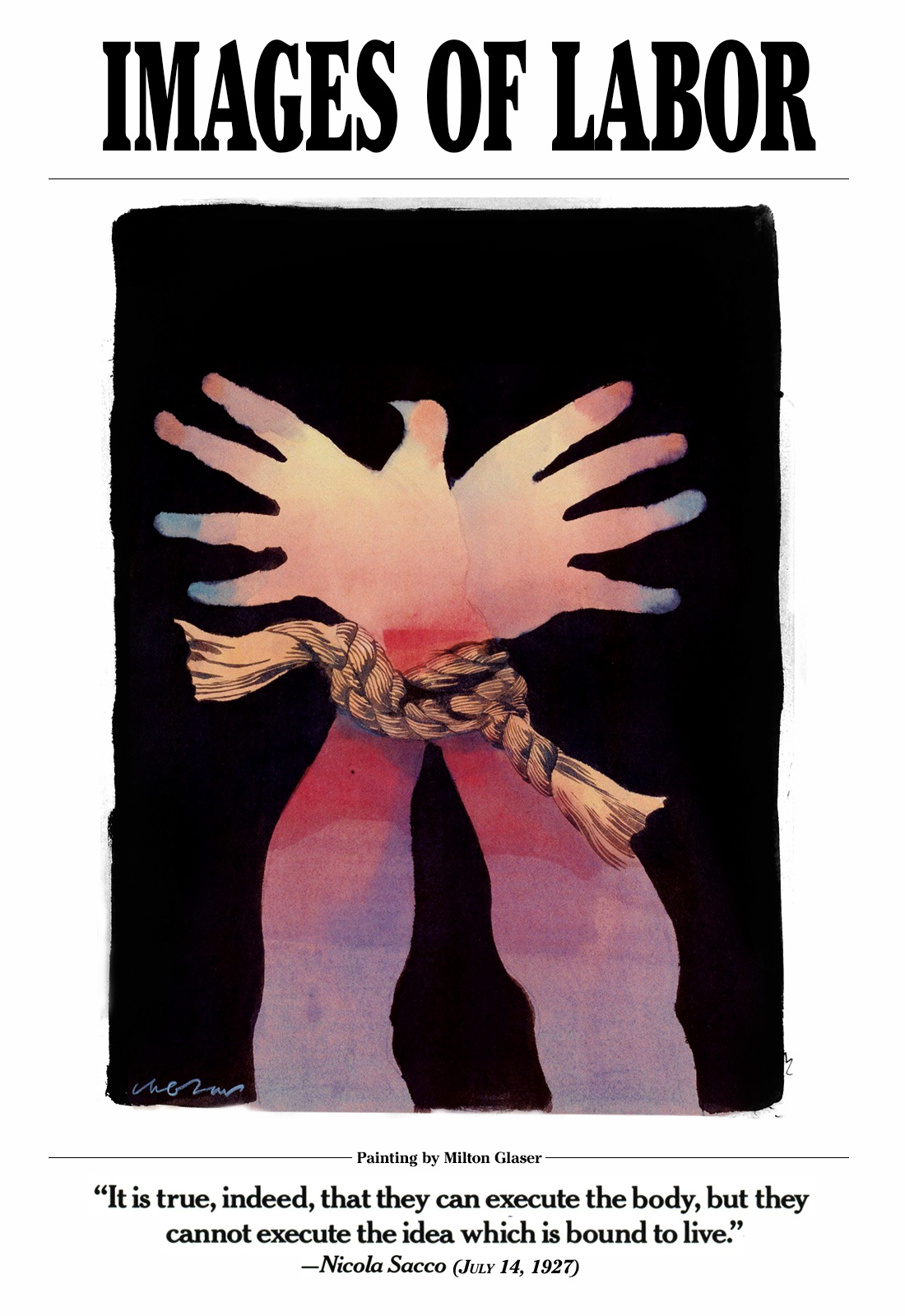
Poster from the Bread and Roses series; painting by Milton Glaser, 1980
It is often said that America is a melting pot and that New York is the most diverse state. Since the post-civil rights days, people have noted that there has been a significant drop in racism and discrimination and it is widely assumed that it has all together disappeared in the work force. In Devah Pager and Bruce Western’s article “Race at Work” they note that according to a recent Gallup poll, more than three quarters of the general public believe that blacks are treated the same as whites in society. Although New York is strikingly diverse, people should not confuse diversity for integration. It might not be as outright as it was in the past but there is still a lot of segregation and discrimination based on race in the labor force.
Tarry Hum’s article “Persistent Polarization in the New York Workforce: New Findings of Labor Market Segmentation” quotes the December 2010 Community Service Society Policy Brief titled, “Unemployment In New York City during the Recession and Early Recovery” stating that, “young Black men aged 16–24 have endured exceptionally high unemployment rates, exacerbating an alarming level of detachment from the formal labor market.” Although the recession caused numerous challenges for economic development for everyone, this statement indicates that Black men were hit significantly harder. The “Race at Work” article supports this by showing that if given a choice of hiring a Black, Latino or White man, the White man wins every time followed by the Latino. And even if the Black or Latino man is chosen, he is often offered a lower position undoubtedly with a lower pay. This might be a good explanation for the exceptionally high rate of unemployed among young Black men in New York and the low per capita income for Black and Latinos.
There are five main private sector industries in New York, namely professional or financial services, retail, medical services, and entertainment which collectively employ 64% of New York City’s private sector work force. Those who work in the professional or financial services—positions which are mostly held by Non-White Hispanics—have incomes that exceed the city-wide average while those in, retail, medical services, and entertainment—positions mostly held by people of color—have earnings that range from $28,000 to $39,000 which is well below the city-wide average. The numbers show just how dire the situation is, approximately 48% employed in professional and 51% employed in financial services are Non-Hispanic whites, this means they take up the majority of the well paying jobs while the lower wage jobs are left for the other races. This phenomenon can be explained by what the “Race at Work” article calls ‘channeling’. Downward channeling occurs in three forms, the first may involve being moved from a job involving contact with customers to a job without contact, the second form may involve a move from a white collar position to a manual job and the final is a move where hierarchy is obvious, for example, from a manager to a server. In the tests carried out, the testers were given similar credentials and were applying for similar jobs, it turned out that more Black applicants were channeled down, Hispanics were also channeled down but not as much as their Black counterparts and neither were ever channeled up. In comparison, their White counterparts were channeled down only when they showed a criminal record, and in at least five cases, they were channeled up and were even encouraged to apply for better/higher positions. This might explain why Blacks and Latinos have a lower per capita income as they are always offered lower paying positions. Although Blacks and Latinos have a difficult time finding employment, the situation has become increasingly dire with the rise of Blacks and Latinos with criminal records. This rise has further impeded the chances of young Black and Latino men in their pursuit of employment as the implementation of policies such as the stop and frisk has led to the sharp rise of their arrest and criminalization.
The stop and frisk policy has been in effect in America since 1968 when the United States Supreme court ruled the Terry vs. Ohio case, giving officers the right to search and seize individuals based on reasonable suspicion as opposed to probable cause. In the mid-1990s when Rudolph Giuliani became the New York City mayor with William Bratton as his police commissioner, they emphasized the incorporation of the stop and frisk policy by the New York Police Department as one of their key strategies in the fight against rising crime, and so began the widespread use of Stop and frisk on New York streets. This law was supposedly passed to protect police officers from potential danger and aid them in preventing crime by giving them the right to stop anyone on the street and proceed to frisk them primarily based on the suspicion of criminal activity or suspicious behavior exhibited by the individual. Stop and frisk gave police officers the flexibility to determine what constituted suspicious behavior and in effect who would be stopped and frisked and who would not. This flexibility created controversy as people from certain ethnic groups claimed to be singled out and disproportionately targeted by the police officers who could stop and frisk them at any time for no apparent reason.
In theory, the stop and frisk policy sounds quite effective; well trained police officers would patrol the streets, stop any and all reasonably suspicious individuals, proceed to question them and if the answers given are not satisfactory, detain the individuals or if prompted by additional suspicion that they may possess a weapon or other paraphernalia frisk them. Although this was the main idea, the numbers and statistics tell us other wise. The policy, although controversial to begin with has been further criticized because it has been used to target minority groups and criminalize their activities and neighborhoods. In Jeffrey Fagan and Garth Davies article titled “Street Stops and Broken Windows: Terry, Race, and Disorder in New York City” in Fordham Urban Law Journal, they state:
When it comes to debating theories of crime and law, some people pretend that race does not matter at all, while others accord it undue, if not determinative, significance. Unfortunately, recent events in policing seem to tip the balance of reality toward the latter view. There is now strong empirical evidence that individuals of color are more likely than white Americans to be stopped, questioned, searched, and arrested by police. This occurs in part because of their race, in part because of heightened law enforcement intensity in minority communities, in part because of the temptation among law enforcement officers to simply ‘play the base rates’ by stopping minority suspects because minorities commit more crimes, and in part because of the tacit approval of these practices given by their superiors” (458).
This statement indicates that the police officers not only target black or minority youths, but go to the extent of placing a high number of patrols in the areas where these youths reside and in turn ensure they are able to monitor their every activity and increase the chances of encounter between the police and residents.
The high policing in poor neighborhoods that are mostly inhabited by minority groups including African Americans and Hispanics have led to a drastic rise in minority youth who are stopped and frisked. The police presence and their hostility towards the residents has created tension within these communities as they try and avoid any contact with the police who have the power to forcibly stop and frisk them. In his article “Factors for Reasonable Suspicion: When Black and Poor Means Stopped and Frisked” Professor David A. Harris of the University of Pittsburgh School of Law formulates the term “location plus evasion” and explains it as a tool used by the justice system to criminalize minority activities. He explains that as the tension between the minority groups and police rise in their neighborhoods, the residents in the area make a conscious effort to avoid the police and this in turn give the police reasonable suspicion to suspect the individuals as they are behaving reasonably suspicious by attempting to avoid the police. He writes:
Police use Terry stops often in crime-prone areas, making people in these areas recurrent targets. When residents react by attempting to avoid the police, ‘location plus evasion’ cases supply a ready-made basis for more Terry stops. This begins and perpetuates a cycle of mistrust and suspicion, a feeling that law enforcement harasses African Americans and Hispanic Americans with Terry stops as a way of controlling their communities (660).
With the widespread War on Drugs and harsh mandatory sentences implemented on drugs mostly used by minority groups, the stop and frisk took on a new life as it became a gateway to prison for minority youth who were repeatedly stopped and found in possession of these drugs. In “The Real Cost of Prisons Comix” by Lois Ahrens, she documents the plight of minority groups as they are repeatedly stopped for no reason in their own neighborhoods and the growing number of African Americans and Latinos in prison is due to the War on Drugs in relation to stop and frisk. She emphasizes, “Policing targets inner cities where poor people of color do business and socialize out on the streets.” Ahrens also mentions that once caught with drugs, African Americas and other minorities are more likely to be sentenced to prison time while Whites have the option of rehabilitation as opposed to serving time; this brings to light the role of stop and frisk in building the Prison Industrial Complex. By targeting people of color and avoiding whites, the chances of finding people of color in possession of weapons and drugs increases and that of whites decreases even though that might not be the case. This phenomenon leads to more people of color being arrested and imprisoned in comparison to whites and hence the stark difference of the people of color in prison as compared to that of whites. In research done on the NYPD stop and frisk data for 1998 by Columbia University and documented in another one of Harries’ article titled “Stop and Frisk Practices in the US: Where Are We Now?” Harris writes:
The researchers’ report, released by the Attorney General in December of 1999, revealed that both blacks and Latinos in New York were “overstopped” relative to their presence in the city’s population; the proportion of persons stopped and frisked who were black, was twice as large as the proportion of the city’s population that was black. Whites, on the other hand, were “understopped”; they made up 40 percent of the city’s population, but were only about 10 percent of all of those stopped and frisked (21)
These statistics indicate the racial injustice involved in the implementation of the stop and frisk policy.
Another controversial aspect of the stop and frisk is the quota system where officers are rewarded based on the number of stop and frisks they make and the number of people they find with drugs or weapons. This quota system requires officers to make a certain number of stop and frisks and the refusal to do so might prove detrimental to their advancement or position in the department. In the article titled “The New Jim Crow” by Michelle Alexander, she writes:
Federal funding flows to those agencies that increase dramatically the volume of drug arrests, not the agencies most successful in bringing down the bosses. What gets rewarded in this war is sheer numbers of drug arrests. To make matters worse, federal drug forfeiture laws allow state and local law enforcement agencies to keep for their own use 80 percent of the cash, cars and homes seized from drug suspects, thus granting law enforcement a direct monetary interest in the profitability of the drug market.
This sentiment is repeated in “The NYPD Tapes: Inside Bed Stuy’s 81st Precinct” article written by Graham Rayman where he documents conversations in recordings made of a police Sergeant threatening the officers to keep their numbers up. In one instance regarding the quotas, the Commanding Officer says, “If you don’t want to work, then, you know what, just do the old go-through-the-motions and get your numbers anyway; He’s taking this very seriously, looking at everyone’s evaluations. And he’s yelling at every CO [commanding officer] about ‘Who gave this guy points?’ or ‘This girl’s no good.’” This disregard to justice and the focus on numbers is an indication that the stop and frisk has progressed into a tool used by the NYPD for their own personal endeavors, and the groups that suffer the most for this are the poor Black and Hispanic youth who are the easiest target.
Gentrification is another factor that contributes to the segregation of poor African-Americans and people of other minorities from wealthier more affluent populations as it determines where they live and who they associate with. Gentrification is the process whereby wealthier, more affluent people choose to move into a lower income, more rundown area with the aim of renovating it; this eventually causes the poorer residents to move out due to the rising housing prices and cost of living. The influx of money from the wealthier residents who move in cause the property values in the area to rise which in turn attracts other affluent residents while poorer residents are forced to leave, this shift ultimately causes the character of the area to change. Gentrification is a phenomenon that has been reciprocated in many neighborhoods in New York and I believe the main factors that contribute to it are race, economic ability and social status. Race is a major factor as most of the poorer neighborhoods that are prime areas for gentrification are usually inhabited by poor or working class blacks, Hispanics and other nonwhite residents while the wealthier residents who move in and cause a rise in property values are middle-class and high-income whites.
The Broken Windows theory presented by George Kelling proposes that the act of fixing a broken window in a neighborhood will prevent more broken windows in that neighborhood. In essence, by addressing and stopping small crimes, bigger crimes will be prevented; this will lead to the creation and maintenance of social order. The problem with this theory is that it does not take into account the results of these actions. By fixing broken windows, removing graffiti, cleaning up a neighborhood and maintaining social order, the overall aesthetics of the neighborhood is increased. The presence of police and the improvement of housing, facilities and removal of disorderly people will cause an eventual increase of property prices and this increase will force poorer residents out as wealthier ones move in. The identity of these disorderly people who need to be removed and the actions that are deemed disorderly are controversial as disorderliness or orderliness could be based on behavior, culture or even race. Although not directly addressed in Kelling’s article, Leonard Pauline in Chapter five of her book “Articulating White Identity in Space: The West Bronx, Neighborhood Change and Riverdale” writes:
In stories about neighborhood change people of color and their social pathologies were diseases that infected a healthy white West Bronx. Within this framework, my participants consistently asserted their white identities by racializing the built environment, ultimately tying whiteness to cleanliness and neighborhood health. In this respect, blackness, black space, and black culture became disorderly, chaotic, and (un)clean.
This statement suggests that the mere fact of being black marks someone as disorderly, and by removing the black “disorderly” people, a neighborhood attains a level of cleanliness and orderliness. Gentrification is propelled by this reasoning because by removing the black people from their neighborhoods, white people perceive the neighborhood as becoming safer and begin moving in and pumping money into the neighborhood by facilitating renovations which forces the other low income black residents out.
Statistical analysis also proves that race is a major factor in gentrification. In his New York Times article titled “Striking Change in Bedford-Stuyvesant as the White Population Soars,” Sam Roberts writes, “In the past decade, the black population of Bedford dropped to 34,000 from 40,000 or to 49 percent from 69 percent. Meanwhile, the number of whites grew to more than 18,000, up from just over 2,000, or to 26 percent, up from 4 percent”. This is an indication that the increase of white residents eventually leads to the decrease of black residents; one of the main reasons for this is an increase in housing prices. Although an increase in housing prices would be beneficial to the original black residents of Bedford, most of them were poor and renters not home owners, hence they were displaced by the hike in prices. In the same article, Henry L. Butler, the chairman of Community Board 3 in Bedford-Stuyvesant is quoted saying, “You’re getting new money, new people, you get different types of services and stores, and you get more police protection. Homeowners are doing well, but if you’re a renter, those prices have gone up also and that has pushed some people into moving out.” Even though some young blacks are being attracted by the revival of business brought on by gentrification in these areas, the number of young blacks moving in cannot compete with that of those being displaced.
Richard Florida coined a socioeconomic class known as the Creative Class. This creative class is a group of young, innovative, well-educated people who aim to create ideas and innovations as opposed to products and deem themselves as being the new driving force of economic development. These groups of people receive low rates facilitated by the government to open studios and galleries with the hope of jump-starting lagging economies, by opening a studio or gallery in areas like Williamsburg, they attract people who aim to be in the creative class or just want to be associated with them. The surges of people following the creative class into these areas are usually wealthier people and their presence and settlement in the area causes a rise in property prices. The rise of property prices force residents who cannot afford the new cost of living out and people attracted by the creative class replace them. Their presence and the new money in the area also causes increased policing as there is a need to create the feeling of safety and security and in turn attract more people. This eventually changes the character of the neighborhood as fancier, hipper cafes and restaurants move in to serve the new gentrified area.
The creative class are attracted to areas with a lot of diversity and technological opportunities for advancement making New York an ideal location. The problem with this is African Americans and minority groups do not usually have the financial ability to stay in these areas or be a part of the technological boom due to their high rate of unemployment and underemployment. In his book The Creative Class, Richard Florida writes, “The Creative Class favors openness and diversity of elites, limited to highly educated, creative people” (134). He goes on to write, “U.S. blacks are under-represented in many professions, and this may be compounded today by the so-called digital divide—black families in the United Sates tend to be poorer than average, and thus their children are less likely to have access to computers” (134). So although the creative class is moving into areas like Williamsburg, which were traditionally inhabited by African Americans, they eventually push the poor blacks out and exclude them from benefiting from this new socioeconomic class as the area gentrifies.
The stop and frisk policy has in no doubt contributed to the rampant growth of the Prison Industrial Complex as well as played a part in the progression of gentrification in New York. Both processes have negatively affected Blacks and other minorities in their pursuit of employment and financial growth as the growing number of African Americans and Latinos with criminal records has increased rampantly and created a new hurdle to overcome in the race for employment. Although both stop and frisk and gentrification have had a long history in New York and are in fact still in effect today, there has been a strong resistance by groups negatively affected. Groups affected by the stop and frisk have taken it upon themselves to document the injustice they face everyday by recording their stop and frisk experience and publicizing the abuse and unfairness of law enforcement officers. These recordings have caused uproar in the community and this has caught the attention of the media and government who have been left with no choice but to address the issue. One such recording is titled “The Hunted and the Hated: An Inside Look at the NYPD’s Stop-and-Frisk Policy” and was aired by VideoNation. It documents Alvin being harassed by police officers multiple times on the basis that he looks ‘suspicious’. Apart from members of the affected communities speaking out, members of law enforcement given the responsibility of conducting these stop and frisks have also began speaking up about the unfairness and injustice of the practice. Adrian Schoolcraft of the 81st Precinct in Brooklyn recorded roll calls, street encounters as well as other activities inside the police station and in an article titled “The NYPD Tapes: Inside Bed-Stuy’s 81st Precinct.” In the article Graham Rayman writes, “They reveal that precinct bosses threaten street cops if they don’t make their quotas of arrests and stop-and-frisks, but also tell them not to take certain robbery reports in order to manipulate crime statistics. The tapes also refer to command officers calling crime victims directly to intimidate them about their complaints.” These recordings bring to light the intentional targeting of minority groups, which is the essence of the problem with the stop and frisk policy.
Action has also been taken to try and reduce the negative effects of gentrification disproportionately experienced by minority groups. Seeing the gentrification in neighboring communities, D.J. Kool Herc of 1520 Sedgwick Avenue sought to have the building he began DJing in turned into a historic landmark, as he believes it is a significant part of American popular culture. The residents in the building who are low-income African American families agree with this suggestion and in his article “Will Gentrification Spoil the Birthplace of Hip-Hop?” David Gonzalez writes, “They want to have the building placed on the National Register of Historic Places so that it might be protected from any change that would affect its character—in this case, a building for poor and working-class families.” Such action by communities aims at keeping gentrification at bay and is a sign of the continued resistance by residents. By addressing the faults and results of unjust practices in our society, perhaps we can begin to understand and rectify the problems they have caused.
Works Cited
Ahrens, Lois. The Real Cost of Prisons Comix. California: PM Press, 2008. Print.
Alexander, Michelle. “The New Jim Crow” N.p. 9 March 2010. Web. 15 Nov. 2012.
Fagan, Jeffrey and Davies, Garth. “Street Stops and Broken Windows: Terry, Race and Disorder in New York City.” Fordham Urban Law Journal Vol. 28: (2000). P. 457. Web. 28 Nov. 2012.
Florida, Richard. “The Creative Class.” N.p. [2002]. PDF File.
Gonzalez, David. “Will Gentrification Spoil the Birthplace of Hip-Hop?” N.Y./ Region. The New York Times, New York Times. 21 May 2007. Web. 22 Nov. 2012.
Harris, David A. “Factors for Reasonable Suspicion: When Black and Poor Means Stopped and Frisked.” Indiana Law Journal: Vol. 69. Iss. 3 Article 1 (1994): 659-688. Web. 22 Nov. 2012.
Harris, David. A. “Stop and Frisk Practices in the US: Where are We Now?” N.p. University of Pittsburgh. PDF file.
Holder, Michelle. 2010. “Unemployment in New York City During the Recession and Early Recovery-Young Black Men Hit the Hardest” Community Service Society. PDF file
Hum, Tarry. 2011. “Persistent Polarization in the New York Workforce: New Findings of Labor Market Segmentation.” Regional Labor Review, Center for the Study of Labor and Democracy, Hofstra University, Spring-Summer 2011. PDF file
Kelling, George L. and Wilson, James Q. The Broken Windows. Atlantic Monthly 1982. New York. PDF file.
Leonard, Pauline “Articulating White Identity in Space: The West Bronx, Neighborhood Change and Riverdale.” n.d. Microsoft Word file.
Pager,Devah and Western Bruce. “Race At Work-Realities of Race and Criminal Record in the NYC Job Market”. Atlantic Monthly 1982. Department of Sociology Princeton University. 2005. PDF file.
Rayman, Graham. “The NYPD Tapes: Inside Bed Stuy’s 81st Precinct” The Village Voice. N.p 4 May 2010. Web. 29 Nov. 2012
Roberts, Sam. Striking Change in Bedford-Stuyvesant as the White Population Soars. N.Y./ Region. The New York Times. 4 August 2011. Web. 29 Nov.2012.
Tuttle, Ross “The Hunted and the Hated: An Inside Look at the NYPD’s Stop-and-Frisk Policy.” (2012) VideoNation. Digital file.