
2013 Contest
Making Work Visible
City University of New York / Labor Arts
Cart
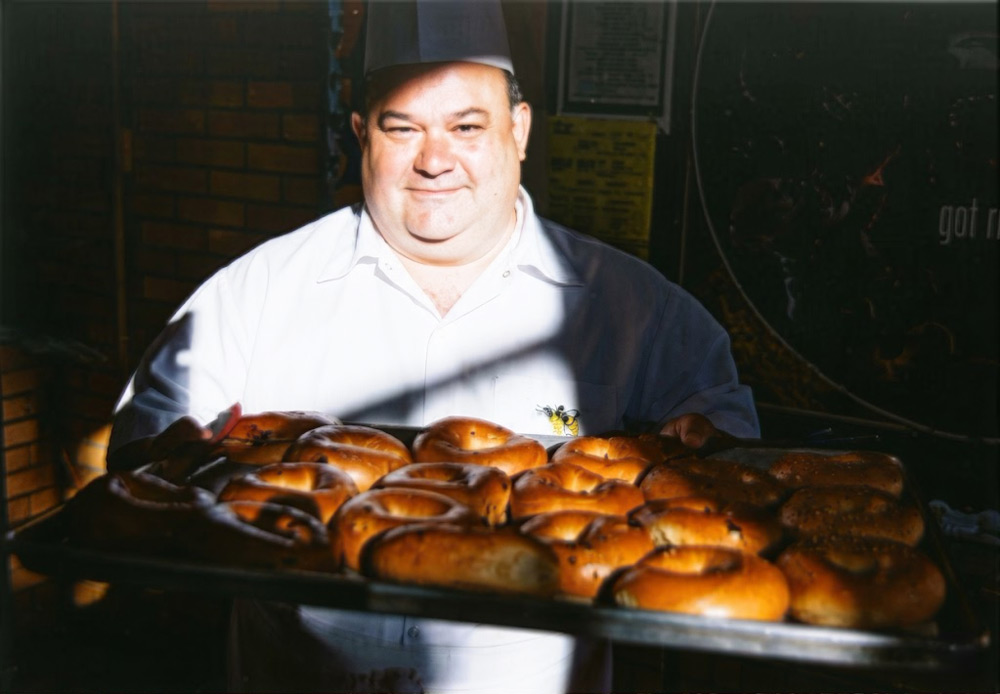
Nestor Gonzales, school cafeteria cook, DC 37, photograph by George Cohen, 2001
I want to see stars when I drive out at five a.m., but you can never see stars here, maybe one or two. Maybe three or five. I remember them being so vivid in Minsk and later in Vilnus, when I couldn’t take Belarus anymore because of otetz. There were millions. No need for street lamps, the stars would guide your way to the small shack bars where the Piva and vodka could kill you a little, if you wanted them to. But you can’t be a bagel cart man in Minsk, or Vilnus or even the Mojave, which I have heard so much about, and its stars, so far up in the sky like a cathedral’s huge ceiling. My girlfriend Rita tells me one day in spring we will drive up to the Mojave and lie on the roof of the car and smoke cigars and look at the desert sky and see all the starts in the universe.
I drive from the Bronx to Brooklyn and buy sesame bagels, wheat bagels, blueberry bagels, poppy bagels, plain bagels and everything bagels. I buy tea bags and water bottles and cream cheese and butter. I buy eggs and bacon and blueberry muffins and also chocolate muffins. Usually I have enough coffee powder and napkins and forks and spoons and sugar and straws for a couple days but when I need them I buy them too. Today I do not need them. I drive to Madison Avenue. I feel somewhat without weight.
The cart gets very warm so even when it is cold like now I wear only a shirt or two. I park the car behind the stand and heat the water and get the coffee ready and then I eat a sesame bagel with bacon and eggs and black coffee while the cart is still closed. I eat inside the tiny closed cart. Sometimes I feel very empty and small, but this is only sometimes and it goes away when many people come to my cart and I feed them bagels and sandwiches and coffee and tea. Rita once told me I should never feel small because every single one of those people would starve without me. This I don’t argue with.
While I was young and still in Belarus grandmother told me that Vlad—my otetz—was very different after the Second World War. He became distant and angry, and very sad. This is before he married my mother. It was grandmother’s way of saying sorry for him because he could never do so himself. He was not that kind of man. Piva for breakfast and vodka for lunch. Asleep by seven at night and awake by four or five a.m. to bother me with worries or beat his frustrations into me. Maybe this is why it is so simple for me to get up so early.
I look at the dusty greasy metal floor of the cart and softly kick a green penny with the toe of my boot while I bite the bacon and egg and sesame bagel. I kick the penny and think about my big beautiful dog, Volk, who is now with my ex-wife in Brooklyn. She said he is her baby, her only happiness, and who am I to argue with the law of the court and the law of nature, against a woman who cannot have her own children? I kick the green penny into the street and it rolls in a curve under the front tire of my car.
The sky turns red and yellow like orange juice and blood mixing together on an empty canvas and the sounds of hurried footsteps begin to drum the asphalt and I open the front awning-piece of my cart and start my day.
The first customer is a traffic officer. I see him on all the weekdays. He told me some weeks ago that his daughter is in the 4th grade and she is ashamed of her father because he is a traffic officer. He said it made him mad enough to want to hit her, even though he loved her and still would do the twelve hours daily just for her. I repeated what Rita told me and I told him without people like us, everyone would starve and get into car crashes. I told him to tell his little girl that. I told him my ex-wife could not even have a daughter and he should consider himself lucky. He was indeed lucky.
The traffic officer is dark skinned and has a round stomach like a basketball but his legs are small and thin like pine branches. He is very nice. He always gets a cold everything bagel with cream cheese—he is eating one now, telling me his daughter Anita turns eleven tomorrow and he has been saving up for a new phone to give to her. I ask him why not a doll or a dress and he tells me she doesn’t want to look poor and if she has a new phone she will not look poor in front of her friends. In my head I think: his daughter reminds me of my brother. In Minsk my brother Marat went to stores to buy rich-seeming clothing and sometimes he would have very little money for food left because it would all go to a new fur coat or a German watch or a new chain for the gold cross our otetz gave him around the time when mother left. As long as people knew Marat had money and he looked important, he was happy. But I don’t tell the traffic officer about Marat because Marat is gone and you don’t make examples of the dead.
Around seven a.m. many people I do not recognize come to buy my bagels and coffee and get their sandwiches made and maybe get a muffin with tea. I cannot talk to them like I talk to the traffic officer because I cannot tell most of them apart and they are always hurrying and gazing into their phones or their watches as if they were looking at their future in magic crystal balls. Some of them avoid my eyes and watch the grazing Madison traffic. Sometimes I imagine them as my loyal cows, feeding from a mutual trough, unaware of the humble farmer who lays their food before them every morning. It is a calming thought.
I began to feel a feeling of no weight, like as if I was going to float up and get lost in the night sky unless I tied myself to the earth with a rope, when otetz lost his legs to gangrene. I could not look at him, despite him not lacking energy due to his continued drinking. I couldn’t stay anywhere in that city without thinking of those legs. I moved to Lithuania and I met my ex-wife there and on the day I had met her I got a call from my mother and she told me otetz didn’t wake up. That is when I began to feel weightless, and I still do sometimes, when I am away from Rita.
At nine a.m. it gets even busier and I cannot even imagine anything or think because I must get into my machine mode where my head is clear and only my body works because there are many people and many bagels to spread with cream cheese and much coffee to pour. Only one phrase sometimes gets into my head and that is a phrase of Schopenhauer: A man can do whatever he wants, but he can’t want what he wants. What do I want? If I knew this precisely maybe I would not have the feeling of no weight. Maybe I would be, as Rita tells me, grounded.
I can tell the sun is at the peak because the tall building across my cart has windows that shimmer very vividly now, like a tiny very bright star shining across the road. Rita called in the morning and told me to meet her at The Gentle Cannibal tonight for dinner. A very nice place, so I was surprised, but she would not tell me why she chose the Cannibal. Rita is very young, much younger than I. She is in the university, so I expect her to be childish sometimes and want to make surprises.
I see a sick man walk by my cart. Those with his sickness, they do not have it on the face or the skin, but in the eyes, and how they walk and how they bend their back. They are sick in what my grandmother had called the ousia. The essence. They can be bankers with nice suits or women with tall shoes and fur coat like Marat had worn in Belarus. Or they can be young university men or women. They walk as if they are sick and their eyes are downcast and solemn and they try to hide it. It is a true illness because it is able to be felt by the body. I know this because I feel this sickness of the ousia now. It is the no-weight feeling. As if I am full of helium like those balloons at the carnivals, or like a corn stalk that is pulled out by strong winds and is floating in the air, with no balance or direction.
Uprooted, Rita says.
There is not many people at my cart at two p.m. and I begin to fidget on my right foot and then after this my left because I do not stop wondering why Rita told me to meet her at The Gentle Cannibal on a small day such as this one.
“Here. This enough?”
It is a homeless man who always gives half the money for plain bagel and coffee around this time. He gives one dollar and fifty cents instead of three dollars.
“If you count so well, why you do not have a job, eh?” I laugh and give him many napkins with his bagel and coffee. He says no words and walks away. He is also sick in the ousia.
Rita is a student of psychology at the university. She asks me family questions, and asks much about otetz. She “analyzes me” sometimes as if I was a chemical sample. She also believes I may be “floating” because my mother had left when I was a young man. I tell her I had grown into a man before I was even twenty years old because of otetz. Mother has nothing to do with this.
The sun shimmer across the building is dying dramatically like a weak fire. An old Spanish janitor with long hair like an American Indian comes out from the building at five p.m. every day and this is when I get my opportunity to urinate. When I see him today I hail him, whistling with my fingers in my mouth as if I am calling a taxi, and I give him a bacon and egg sandwich and coffee and he watches the cart as I run into his building with his keys and open the private bathroom at the back of the lobby where there are mops and cleaning sprays and many very thin brown paper towels. It is a deal I have with him.
When it is six, I begin to close and pull down the awning of the cart as the sky pulls down the shades on the sun. I attach the cart to the parked car and leave to meet Rita. I am fidgeting more so now because I am not keen on surprises. Rita sure knows how to “screw” with my head.
The Gentle Cannibal is no more than several avenues and three blocks away and I take my time and try not to think of Rita and what she could say. The Cannibal is below street level, and it is made to look like a basement. Only ten people may fit in it. It has the atmosphere of “chic” as Rita says and a good charm that is held well by the name. The lighting is usually low, dim, and very cozy, and it is all done by very large yellow candles that are put on many shelves and many sills. Rita calls it a “posh speakeasy” and it is where we went to first as a couple.
When I walk in there, there are not many people, only staff and very few patrons, one of them Rita who sits in a small corner table by the door with her young face in the menu. I sit down and when her menu comes down to the table she seems to be glowing with the candles and her smile appears to be a flickering flame.
“Kenny, I ordered cinnamon ribs for you already, your favorite.” She smiles warmly.
“I am too tired for surprises. Out with it, Rita,” I try to smile.
The strange waiter comes over. He always wears on him the same herringbone shirt and brown glasses for reading that have no glass in them. He is also bald.
As he pours sparkling water from a pickle jar, Rita plays with her hair. When the waiter comes out he brings the glazed ribs on a small heavy plate and pours more water.
“Kenny?”
I remember in my head the first night we went out. We went here and ordered ribs. Why did Rita order ribs today? It was not our anniversary or any such date. The light from the candle is dancing on my plate, and it reminds me of a desert sunrise I had seen on television.
“Kenny you look tense.”
I do not want to tell Rita that surprises make me and my feet fidgety. She laughs at this but she does not know how bad surprises can be.
“I was just thinking of a desert sunset I had seen on television,” I say to her.
“Oh that’s nice.”
She glows bright like a star. I feel the fork I am holding dig unpleasantly into my palm. She peers at her food and then to me.
“Well I wanted to talk to you about the grounding thing. You see, I wanted to ask you if you ever considered me, you know, as an anchor.”
Rita here means as a supplemental mother, since my mother had left. She is doing that head doctor stuff on me again. It is mildly displeasing.
“Rita, there were no problems with the mother, you know of this. It is not why I feel like I am losing myself in time and space, floating. And before you say a word, this is not an ‘existential dilemma.’ This is in the body, physical. I feel it like I feel sickness.”
Rita is now smiling, her eyes are watching her food. It is something about this way she is looking down that makes me feel as if there is a hot storm inside my ribs and chest, and this storm passes inside me so ferociously, like an angry snake, that I need to grip the table to get myself level. It is the way she smiles so quietly, like she is in the black space of the sky. It is as if she has the biggest secret in the world.
“Well,” she raises her eyebrows, “I do, in fact, have a physical solution. I’ve had it for some days now, actually. It’s something that may very well keep you rooted for a long time. And this probable solution,” she winks, “is only two words.”
I am waiving to the waiter to approach and pour me the water from the pickle jar. I cannot help but hold the table very hard and my hands are shaking the table very slightly. The Gentle Cannibal feels too large and I wish to be confined inside my small bagel cart. The waiter comes to pour water.
“I was going to tell you earlier today but I got a little sidetracked.”
The waiter finishes pouring the water.
“Kenny, I’m pregnant. Three words, sorry.” Rita is trying to smile.
When the waiter hears this he very quickly goes back into the kitchen at the back of the restaurant. What a coward. I see that I cannot let go of the table. I am floating in a sea of candles. I feel seasick.
The waiter comes out with wine and a fancy long glass.
“For you,” he says, with his teeth showing.
***
I drive out at five a.m. and look out the car window and only see two stars. I smile and think in my head, it will have to do until me, Rita and Vlad can go to desert and watch the stars on the roof of the car.