
2016 Contest
Making Work Visible
City University of New York / Labor Arts

The Art of the Speedup
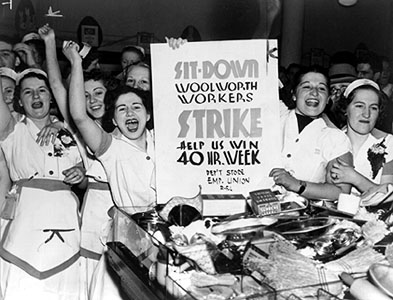
Sit-Down Strikers, 1937, LaborArts.org
The forty-hour week is dead. Management has killed it. I can only speak from my own experiences working in the New York City restaurant industry over the past ten years. Maybe it is different in other cities or restaurants that I have not labored in, but I doubt it. It died when management learned how to manipulate in times, breaks, and on- call shifts to avoid overtime. It means many workers must spend entire days in or around their workplaces without a reward for overtime pay. While the forty hour week withers away, an older American value is being revived: the speedup. A speedup is when management gets more production with less labor, and restaurant managers have turned it into an art form. It may not be what you imagine. It does not involve managers hollering at workers to go faster. It is not as physical as it is emotional. The modern speedup involves corporate brainwashing. Managers slyly perfect their craft while convincing employees to work off the clock for “their own benefit,” and manipulating the staff into doing work outside their job description in the name of “teamwork.” There are many ways restaurant managers create speedups, and some include cutting staff, creating disdain among coworkers, and encouraging employees to work off the clock.
The most obvious way the managers create speedups is through cutting staff on individual shifts in the restaurant. The restaurant I work in gets very busy, and I do not mind assisting my coworkers when they need help. This can mean clearing plates off a table if they are too heavy for one person to carry or helping a food runner deliver dishes to a large party, but the idea of “helping out” in a speedup is a more sinister form of teamwork. I know a speedup shift is coming when I hear the hosts wonder out loud about how they will pay their bills and complain about their hours being cut. The shift will begin with a speech by one of the mangers about how we are all a “family” and need to be “team players.” It becomes obvious when I see that there are only two or three hosts working when there used to be four or five. I try to avoid the host stand where they ask me to seat the tables, and the managers wander around the restaurant asking everyone to seat customers once the rush begins. With hosts being the only front-of- house position that does not qualify for the tip credit (a rule that allows restaurants to pay tipped employees less than the minimum wage), management must get a nice savings by cutting shifts from the hosts and having tipped employees seat most of the tables. While this is the most common shift-cutting speedup, it is not the only one. Management will cut bussers, food runners, bartenders, and many other positions and with the expectation that everyone else who is working will pick up the slack. It does not always work out. Customers get poor service when the restaurant is not properly staffed, but the management is never to blame and we are often encouraged to believe it is our coworkers who are the real problem.
A friend I waited tables with for many years would always say “servers and bussers are natural enemies.” It was funny, not only because it seemed so true, but because “busser” was interchangeable with any other position in the restaurant. Servers have many enemies including hosts, rood runners, bartenders, or any other position you can think of. It took me a while to realize management’s role in this train of thought. An example of this can be seen in something as simple as bringing bread to a table. It is the bussers’ job to bring each table bread in the restaurant I currently work in, but there are certain periods of time where this never happens. I will sometimes have four or five table asking for bread, but the busser is nowhere to be found. This usually results in me telling a manager I need bread for all my tables, and the manager’s response is generally one of contempt for the bussers. The manager will apologize and tell me how the bussers are lazy or need to be kept on top of like kindergarteners, but laziness is not the problem. The problem is management forcing all the bussers except one to go on extended breaks in order to save labor. The one busser left working is often told to do work in the back of the restaurant and is not available to bus tables in the dining room or bring customers bread. I once complained about this policy and about the shift being short staffed in general to one of the managers. My complaint prompted a call in to the office with the general manager, and he told me that I was wrong. He informed that the restaurant was not understaffed, but overstaffed. It was not the quantity of workers, he said, but the “quality of workers.” He then went on to give examples of how each busser was personally incompetent. I saw right through his manipulation, but unfortunately, most of my coworkers do not. My fellow servers blame the bussers for management’s speedup policies, but their anger is in the wrong place. It is management’s fault that customers do not get the service they deserve. This can mean lower tips and less money for the servers and bussers, but the servers and bussers are too busy arguing with each other to see who is really to blame. Management helps create a culture of disdain among coworkers, and management also leads the way for employees to work without proper compensation.
A great way for management to cut costs is by creating a culture in the restaurant where working off the clock is perfectly acceptable. The managers are quick to point out that it is not the wage that tipped employees are working for, but the tips. They let the workers know that they would love to let them pick up more shifts, but they just cannot afford the overtime. Then again, “going over” is up to the worker, the managers love to point out that you can always just clock in a few hours late or a few hours early. It is not management’s fault that New York State has “silly” labor laws, and the managers have no problem turning a blind eye to a worker who needs a little more money to pay their bills and is willing to work off the clock. Even the workers who do not spend shifts cheating themselves out of overtime pay are encouraged to work off the clock. Each shift we are required to take a thirty-minute break after we are done setting up the restaurant, but sometimes management does not schedule enough servers to get everything done in time. These are the days when the general manager decides to tell everyone his stories about people who refused to do things because they were clocked out. He points out that they were not “team players,” and that they did not last very long in our restaurant. He barely has to say anything though, because he has an army of employees who attribute their work ethic to getting things done whether they are on the clock or not. They chime in with things like “if you start something you need to finish it” and “sure I am not clocked in, but that does not help the team very much.” It is even worse for other positions in the restaurant who have had their start times cut back in order to save on labor cost. For example, the baristas comes in at 12pm instead of 11:30am like they used to, but are always encouraged to come in early, before clocking in, to set things up. Working off the clock has not nothing to do with work ethic or a worker’s willingness to be a team player, it is simply another way for managers to speedup their employees.
The speedup is alive and well in New York’s restaurant industry. As an art form, it is constantly being perfected by managers all over the city and too many workers are following along. I try to do everything I can to stop speedups when I am at work. I avoid doing other workers’ jobs, I point out management’s careful manipulations, and encourage my coworkers to never work off the clock. I have made some progress, but I fear it is not enough. Many of my coworkers listen to me and see through the artful speedups that the managers have crafted, but I am only one server in one restaurant. We need to start a movement. We need to unionize the service industry in New York, and I want to be on the front lines of the battle for organization. If we band together workers in the service industry can end these ridiculous speedups and truly get compensated for the hard work we do every day serving the people of New York.