
2016 Contest
Making Work Visible
City University of New York / Labor Arts

Labor Movements 101
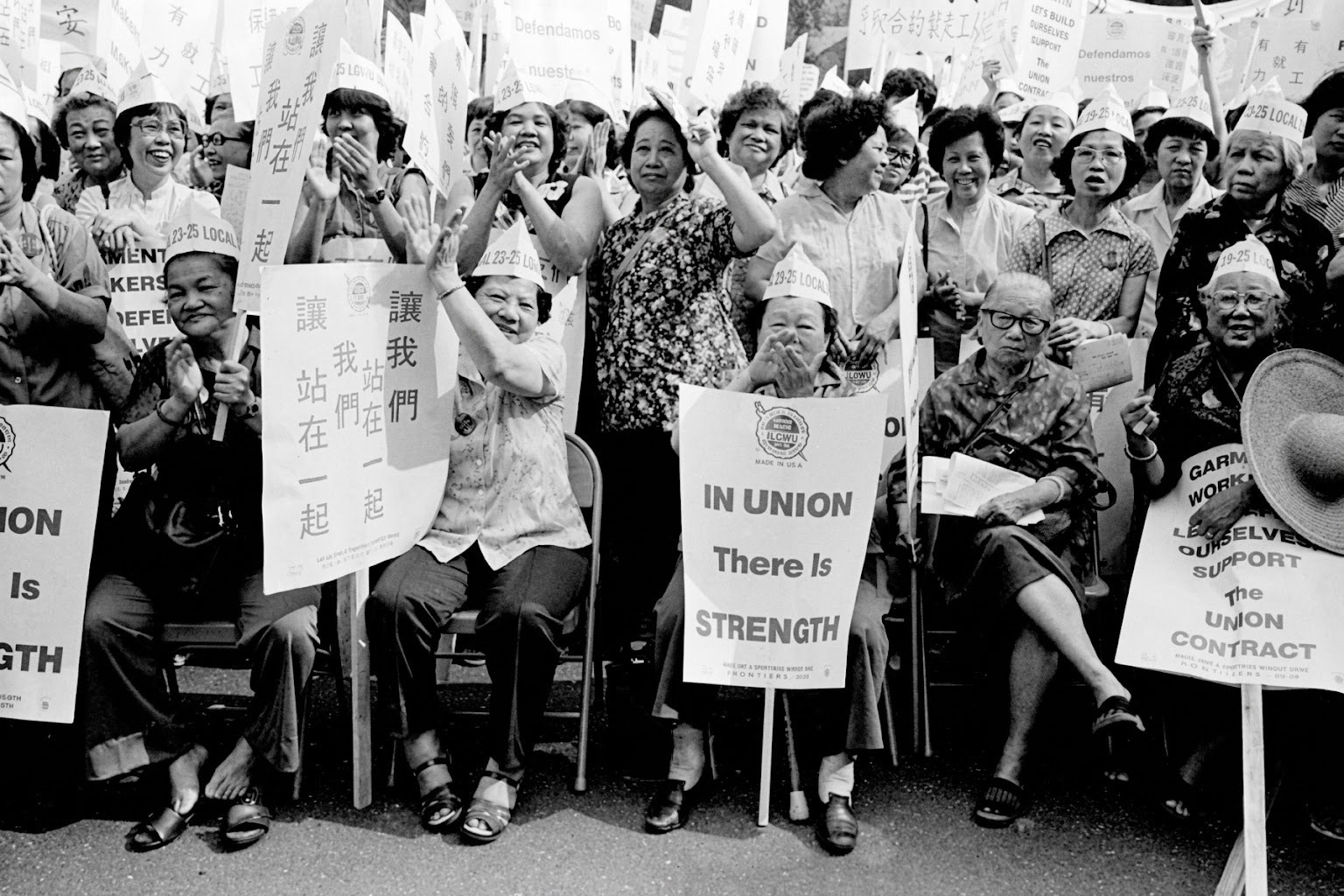
Members of ILGWU Local 23-25 on strike, Robert Gumpert, June 1982
In June 1982, immigrant Chinese women workers struck for a good contract, marching through Chinatown New York.
I comb through the black and white cropped hair and smiling faces, beige hose and flowered blouses, looking for a relative, my grandmother, even my own face reflected mother, a small girl solemnly snipping threads playing in heavy draperies of fabric.
Fine toothed, I casually ask her in the car. We wait for my father to return with plastic cartons of duck and chicken. Do you remember working in the factory? Mom turns to dad in the front seat. He thinks, My first job was snipping threads and making the rice
The rice? Pull out my notepad and pen click
Yes, we brought our own sides and the foreman served us rice
I unclick and persist. Was it unsanitary, to eat in the factory? No one got sick, mom points out, It was okay, dad agrees. He pulls out of parking into drive.
That semester I sail through labor studies on gilded waves of hot-headed justice, 1930s for the compensation of workers, the fire still named for product production and not for the worker women who died making them in 1911.
The strongest stench in the way our professor lectured Five Points without mentioning Chinatown Columbus Park. I grabbed my comb and unleashed the nuggets in the fine tooth.
1982 ILGWU Strike in New York Chinatown.
When labor conflates Chinese, busy squabbling lines of division, we do not notice them smearing us into blurry faces wearing army green jumpsuits, my arm and leg a lever in the equation for optimal productivity.
1910 Taylorism.
The hand is not a lever, And the joint is not a bolt. I watch the aftermath of Rana Plaza 2013, infamous pictures plastered on screens, dust turning the whole collapse into some freak sandstorm, turning workers into an exhibition of matyrs. It is easy to pretend they have always been there, easy to bury and tuck away.
In solidarity and celebration of workplace and strike, of combing through history and finding small Gold Mountain nuggets in our 1882 Exclusion, blinded in the dust of history which remains settled long before we can tie them together with thread snipped among heavy draperies of fabric but we cast our nets wide and chase secretly and imperceptibly, like a compass vibrating left of north, a comb running through the smooth and untangled.
The hand that shifts park into drive is the hand that cheers the picket is the hand that Taylor broke into a lever and a bolt is the hand that embraces a loved one in a factory doomed to become static in history.
On June 1982, Chinese American women workers struck for a good contract, the least of all they had to accomplish that day.