
2018 Contest
Making Work Visible
City University of New York / Labor Arts
Hidden from Outsiders: Home Care
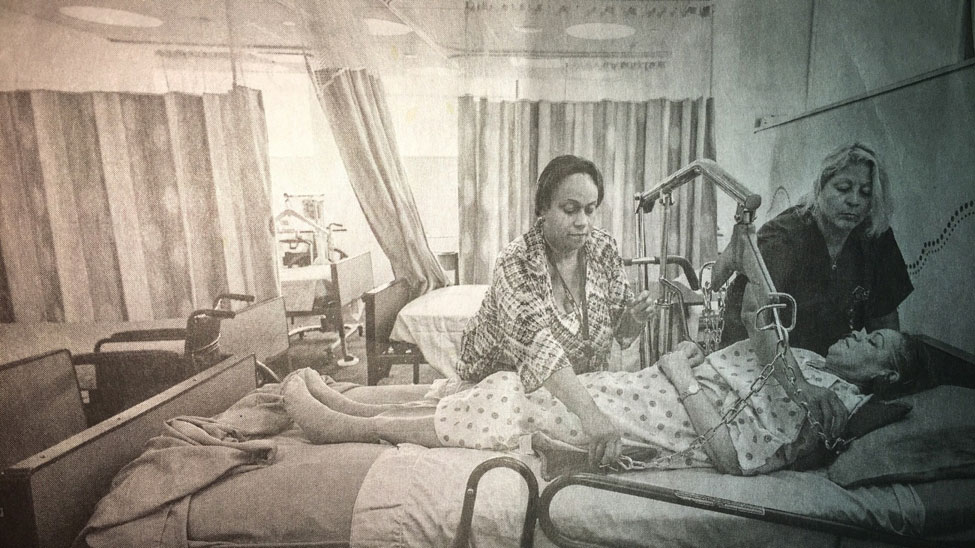
Image taken from The New York Times Business August 30, 2017
I work in the five boroughs, in private homes, apartment buildings, and on a few occasions in assisted living facilities and nursing homes. Most institutionalized homes are large multistory buildings fully equipped and staffed to provide care for the residents who need long term care or help to recuperate. Private rooms on each floor accommodate one or more residents simultaneously. The rooms have adjustable cloth screens installed in the roof or ceiling. They provide privacy, especially when the residents are being taken care of by a nurse or doctor, or even during a family visit. Each resident is provided with a bed, chair, TV, closet, chest of drawers and table. Each room has a toilet and sink. Residents who have to be showered are taken to a shower room. The dining areas, recreational facilities, and medical rooms or clinics are shared by all residents on their respective floors. These buildings have security desks as soon as you enter them. Persons using the building have to sign in and out, so there is a record of the name, date and time anyone uses the building. I always work one on one with a particular resident that I am assigned to by my agency. My job is to assist the resident whenever my help is required.
Unlike the standard institutional setting, the private homes and apartment buildings vary in size, neighborhood, and safety. Just a few of these buildings have a security desk. The superintendents of the apartment buildings are only visible when there is a need that warrants their presence. These buildings house multiple families, some of whom share the same kitchen and bath. I work with patients in their homes, helping them with personal care, sometimes with assistance from them or a family member or at other times depending on the situation, alone. My presence in the home also allows family members who are restricted with bed bound parents or children to have some time for themselves. My ultimate goal is to keep the patient clean, fed, comfortable, and safe during my tour of duty. I report any unusual changes in the patient’s behavior or illness and any incidents relating to my safety and that of the patients. If required, I would also help with other daily activities, like laundry, shopping and accompanying patients to doctors’ visits when authorized by the nurse. My job proves to be both rewarding and challenging at the same time. As a human service major, I get firsthand experience to work with people of different ethnic, cultural, and religious backgrounds, and am able to practice the code of ethics of the agency, which coincides with what I learn in the class room. Such valued opportunities never come without challenges, but to a large extent, give me the chance to make rational decisions.
One of the many things that I have learned from working in different homes is that many things that seem glorious from the outside are just an illusion. The truth is hidden behind the walls of those concrete or wooden structures, painted or not. The reality is what the family dynamics are and the experiences the patients and their care givers go through collectively or alone. Socio-economic status, race, culture or educational level for most part does not distinguish their pain and suffering. What may be different is the extent of certain problems that patients go through. At some point some of them come face to face with one or a combination of occasions of helplessness, abuse, and neglect at the hands of close family members, who in some cases even cause them to die before death would occur on its own. This can be painful to behold when there is not much I can do about it in my scope of practice. But sometimes I am tempted to take matters into my own hands to change the pattern of behavior when I feel family members are being unreasonable towards the patients, although of course they have a right to do the things they want to do in the privacy of their homes. Similarly, I have control over what I will accept or not accept and can remove myself from danger when it is immanent. I have had to make subtle escapes, under the pretense of going to get myself something to eat.
One particular patient was suffering from a gunshot wound, and was restricted to a wheel chair. The patient had not reached the age of majority in the state where he lived. The gun shot was gang related but at the time of my starting to work there, this fact was unknown to me. I only knew about it from eavesdropping on a conversation between the patient and some visitors, a group of young people around the same age group and perhaps a little older. Their conversation started off as normal as one would expect from young people. As the conversation became intensified, a lot of emotions were expressed. The tone was loud enough but at times sounded like whispers. One thing for sure, I heard the mention of guns and expressions of defiance of gun laws, and those who are pursuing those laws, and of retaliation against those who were responsible for the patient’s dilemma. What I heard made my jaw drop, as fear gripped me all over. Soon the visitation was over, so I thought. I felt relieved; after all I had nothing more to be afraid of; they are all gone, I mused. It was my third day working with that patient, but during the previous two days, I had observed the uneasiness the young female member of the home displayed when the phone rang or when the doorbell echoed. She would make sure she secured the door locks after someone entered or left the apartment. She was more like a house detective than a companion to the patient. The horror of the day was not over; about fifteen minutes after the group left, they returned. This time, they did not make their utterance known, but sat around in the living room, adjacent to the dining table where I was sitting. I could not see if they were gesturing to each other, because they were behind me. One thing I know for sure was that they had made use of marijuana. The silence was so obvious, so intense, that if a pin had dropped to the ground, it would have echoed in such hush. In the meantime the smell of the marijuana was intense and the effect it was having on their thinking I did not wait to find out.
I remember, it was the cold season and all the windows were shut tight. So imagine what that smell was doing to my hypersensitive nose. I was never diagnosed with hyperosmia, but I can relate to the symptoms. I gasped for breath; I thought I don’t like the silence coming from those drug users, whom I might never be able to identify later. I had heard so many similar stories before. I felt a sudden urge to remove myself from this situation and so I did. My tour of duty was not ended yet. I was just two hours into my four hours work schedule for that patient. But I did not mind losing the last two hours pay for my own safety. Without them realizing that I was scared and leaving not to return, I feigned going to the corner store to get something to eat. I presumed that my absence would have allowed them the opportunity to review their plans, whatever they were. To this day I still smile when I think of my subtle escape, but the thought of what could have happened if I had stayed, is cause for concern. Not all cases I am assigned to offer that kind of challenge, but there are other challenges that differ based on the type of patients, their family dynamics, and their social circle. The agency provides personal protective equipment against contracting transmittable diseases, but would not give any information to forewarn the workers of the type of medical conditions the patient is suffering from. It therefore behooves the workers to make full use of the equipment and to initiate any other reasonable actions for personal protection and protection of the patients.
As a young girl growing up in a small village in my country of birth, I had witnessed the care and respect that was given to the elderly. Even as they continued to advance in age and become feeble, they were treated as jewels that needed to be preserved at all cost. A person living to a ‘ripe-old-age’, as extended old age was referred to, was considered a blessing by the family members, who most of the time were the care givers. Everyone wanted to share in that blessing. People would brag about how long their parents or grandparents lived, and would make predictions that they would reach their 100th birth anniversary and beyond. So when for the first time, on my job here in the US, I encountered patients whose family members were eager for them to be gone, I was saddened. This was evident by the way some of them treated their older relatives. It was very difficult for me, thinking how children can be so cruel to their own parents. The story I am about to tell happened in an apartment building in a middleclass community overlooking a nearby park.
My patient was about 85 years old, and was diagnosed with a health condition which limited her activities. She was able to get out of bed with assistance of a walker which she also used to get around the house. Sometimes, however, she would need manual help to get around. I would take her to the verandah and we would sit there and enjoy the scenery and busy traffic passing by. While we conversed, I could hear her love for life and a desire to experience future events; one of which was to visit her brother in another state. It was late in the spring and she was anticipating visits from friends in the summer. She lived with one of her three off-springs, and a pet animal that was all over her, and she loved it. It was a two bedroom apartment, but she slept in a hospital bed in the sitting room. The bedrooms were situated beyond the kitchen, which was closer to the sitting area. She was always so eager to see me and would give me secret signals with her eyes and thumb, and was very reserved when the other occupants of the home were in close proximity. I came to the realization that my patient had been given little or no attention in my absence because when I arrived at 12:00 noon there was always an unpleasant odor coming from her. Dried feces were visible on her skin and under her finger nails. Before I get to her I would make sure to put on my gloves and apron. She would always greet me with outstretched arms wanting to give me a hand shake or a hug. Once I was in her arms she would plant a kiss on my cheek, forehead or on my head, which ever was comfortable for her. Even if I wanted to refuse her gestures under the circumstances, my heart would not allow me. But I would quickly relieve myself of her, explaining that I have to get busy before the nurse comes, that is, if the nurse was expected to visit her that day. Otherwise I would always have to find an excuse not to linger in her embrace, not until she was cleaned. When I was finished tidying her, she would express how good she felt.
Her situation would be worse during the weekends. It was much evident on Mondays, until one Friday when I was preparing to leave she asked if I could stay over the weekend. She told me I could stay in the bedroom that used to be hers. Her offspring was quick to interject that that was not possible. Even though I knew that was not possible, neither did it surprise me how quickly the response came. My patient would whisper to me, “Excuses, Excuses.” Whenever I was there, one thing was strange about how the off-spring was relating to the mother’s eating. The first two weeks I made whatever the patient wanted to eat according to her doctor’s specifications. The patient had been gaining strength since I started to take care of her. I was preparing good food, and whenever her hands felt weak or tired, I would spoon feed her. There was never a shortage of food stuff in the home, yet there was a sudden restricting of what the patient could be given, when there was no adjustment made to her diet by her physician or dietitian. The pet walk time shortened gradually, always with an excuse, like the dog did not want to walk or because his friend was not out today. By shortening the time the offspring spent walking the dog, or even going on errands in the community more time was available to her to monitor the patient’s conversations and restrict her eating. I had no idea about passive euthanasia. It all unfolded only recently when I was in the Health Care Ethics class last semester. I became very angry when I realized that my patient could have been the victim of such a barbaric act by a close family member. I left the patient on a Friday, the same Friday she requested that I stay over, and was scheduled to go back on Monday at noon as usual. About 9:00 a.m. on Monday my supervisor called to inform me that the patient’s off-spring did not need services that day. Knowing the condition I usually meet the patient in on Mondays, I was concerned as to why the request for no services, when I knew the person who cancelled the services does not show much interest in the patient’s comfort.
I made several calls to the patient, on both the house and cell phones without getting any response. After 2.00 p.m. I decided to call again. The person on the other end called me by my first name and said, “Mom just passed.” Confused at my end of the phone line, I enquired what happened. I was told that the patient was not doing well over the weekend. The off-spring further said that there was evidence that the patient soon would pass and the time was needed to be alone with her. Appalled at such a revelation, I could not even offer my sympathy before I terminated the phone conversation. So she was alive when the call was made to cancel the services of the aide. My thoughts were racing; why would anyone want to be alone in a house with a mother who is dying? Now as if conversing with another person, I was saying, oh, that is why you did not want me there to witness the state in which she died. Did you starve her all weekend so when she made it to Monday you were disappointed? Did you administer a lethal dose of morphine? What did you do? I left her sitting up on Friday. She spoke with me and was expecting me back on Monday. What did you do? I can only imagine what you did, but it is not ok, she was a fully autonomous human being, did you take that away from her too? I must say, this is not an isolated case, and these are memories I will carry for a life time.
This other patient was living alone. His apartment was cluttered, messy clutter, worse than I had ever seen in any patient’s home. I was just the substitute aide for that day. So it was my first time going to this patient’s home, in a low income neighborhood. The building was a four storied brick building, located at the corner where the main street intersects the cross street. The yard was unfenced. I was standing on the parapet just outside the patient’s window in the cross street. I was doing exactly what the supervisor told me to do, since it was usual for the patient to throw the house keys onto the ground for the aide. On my arrival I called the patient’s house phone to inform him that I was outside, and he said ok. After about ten minutes and there was no sight of the keys, I called the patient again and got the same response as before and still no keys. I became concerned for the patient and called the supervisor to report. She got back to me shortly after and told me to hold on and the patient will throw the keys. I know some patients are not keen on having different aides; they prefer to have one permanent person. It was more than thirty minutes and I was still standing out there, so I was wondering if that was the case with this patient. I thought he had looked out through the window and saw it was not his regular aide and decided not to throw me the keys. But that was not so, he was gravely ill. It was after I got into the apartment that I realized he was so weak, that he could not get off the bed to get to the keys, much less, to get to the window to throw the bunch.
A woman in the building on the third floor saw me standing outside talking on my cell phone and looking up to the building. She presumed I was seeking access to the building and she enquired if I was the aide. She said she was also an aide, and that my uniform was what drew her attention. She opened the door to the building and I made my way up the stairs to the fourth floor. I knocked on the door and a voice from inside the apartment beckoned me enter. I opened the door which was unlocked and was confronted with the most horrifying scene. I looked around hesitantly to find a clean spot to put my hand bag but there was none. I observed the patient, who appeared to be in his late fifties, displaying a tall frail body, stretched out to full length on a hospital bed, with desperate eyes staring at me. I stepped back out of the door and called the supervisor to tell her of my gruesome discovery. I further told her my first inclination was to leave, but I would not. I knew I could not, not when a lonely sick person needed my help. Supervisor thanked me for the information and for deciding to stay. She said she would communicate my finding to the nurse, immediately. The nurse arrived within half an hour, and experienced the same shock that I had gone through earlier. He too looked around for a safe place for his bag. Luckily, before he arrived I had opened a cardboard box and put my bag on it behind the door. I told him he was welcome to put his there too, and he was relieved. I remembered all I was saying was, “Oh my God” repeatedly. I could not believe what I was seeing. The patient had soda and juice bottles filled with urine on the floor near the bed, on the fridge, and feces on every piece of bedding on the bed and clothes on the floor. There was no distinction of what was clean or dirty strewn across the floor. There was a commode overflowing with feces, paper and some pieces of clothing in it. I kept saying, “Oh my God”, as I tried to clear away the clutter. I was saying Oh my God for more than one reason. There was an aide there the day before, I could not understand. In the meantime the nurse was trying to calm the patient who was cursing hopelessly, I wold say. Finally we managed to tidy and stabilize him. The nurse was frantically making phone calls to arrange for the patient to be removed from the apartment to an institution. In between intervals of his calls he was assisting me to clean the room. It took some time before everything was finalized. My three hour work schedule turned out to be six hours, because I had to wait until the paramedics came, and to close up the apartment after the patient left.
A few months later, I was at another patient’s home when the same nurse visited. As soon as he saw me he immediately remembered my name and where we first met, at the home that had so shocked us both. He again thanked me, and said he had told my supervisor what a great job I did for that patient. Then he said, “You know what, that patient died the same night, but the good thing is he died with dignity”. Before the patient had left for the institution, he requested that I go to the corner store to get him something to drink, which I did. When I returned with the item he then requested that I go back to the shop to get him a different drink. I told him it was difficult walking up the steps to the fourth floor, but I obliged. During conversations with him I noticed a family portrait on one of the four walls of the room, yes it was just a room. Kitchen and bathroom were located in another part of the building and it was shared by the other residents on that floor. If I can remember clearly, all the furniture he had in the room was the bed, a refrigerator, a center table and the commode. He was short of undies which were badly needed at the time, luckily a neighbor helped out with that. Concerning the family portrait, he told me that his wife and one son died a few years prior, and his only surviving son was deployed. At some point I heard him mention God, so I asked him if he believes in God and he said yes, I asked him if he would like me to pray with him and he answered in the affirmative. So I prayed with him. Before he was taken away from his apartment he told me thanks, and that he loved me.
Most of the supervisors are not familiar with the locations where they assign workers. One can tell by the travel directions they give, which are always the longest way rather than short cuts. They do not know the transportation difficulties and other social problems the workers are confronted with in certain areas. Being personally involved in the day to day activities of having direct contact with patients, and using different modes of commute to and from work, helps me to appreciate how much time is sacrificed in order to help patients achieve some level of normalcy in their lives in the comfort of their own homes. Sometimes the travel time is more than the scheduled hours of work. At the end of the day, however, I am privileged to have access to homes that under normal circumstances a lot of people would not. I know what goes on behind many closed doors, and lend a helping hand in the most disgusting circumstances, unnoticed or most of the time under-recognized by those who collect the greater part of the payments for the services we perform in the field. By this I mean, the pay does not match the actual responsibilities and work done for the patients. I still remain committed to what I do, and I have flexible work hours, which allows me to pursue higher education, and have the kind of experience to develop skills to work effectively with patients from different cultures. My access to homes causes me to understand the true meaning of family dynamics and the threat to patients’ autonomy by their loved ones. But the magnitude of what my work entails is still hidden from outsiders.