
2021 Contest
Making Work Visible
City University of New York / Labor Arts
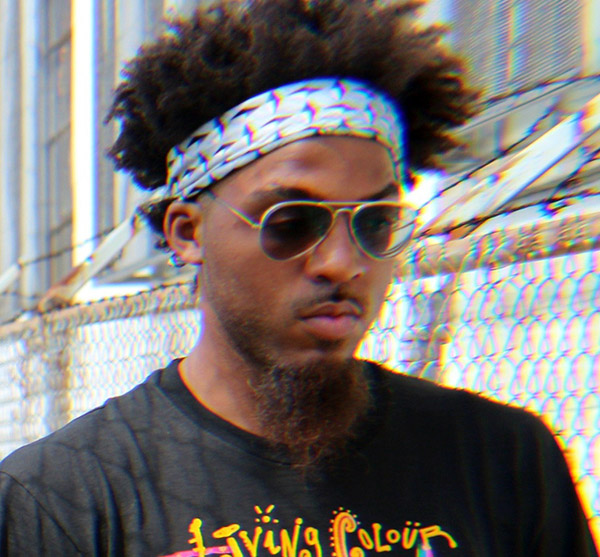
Delivering for Amazon During a Pandemic
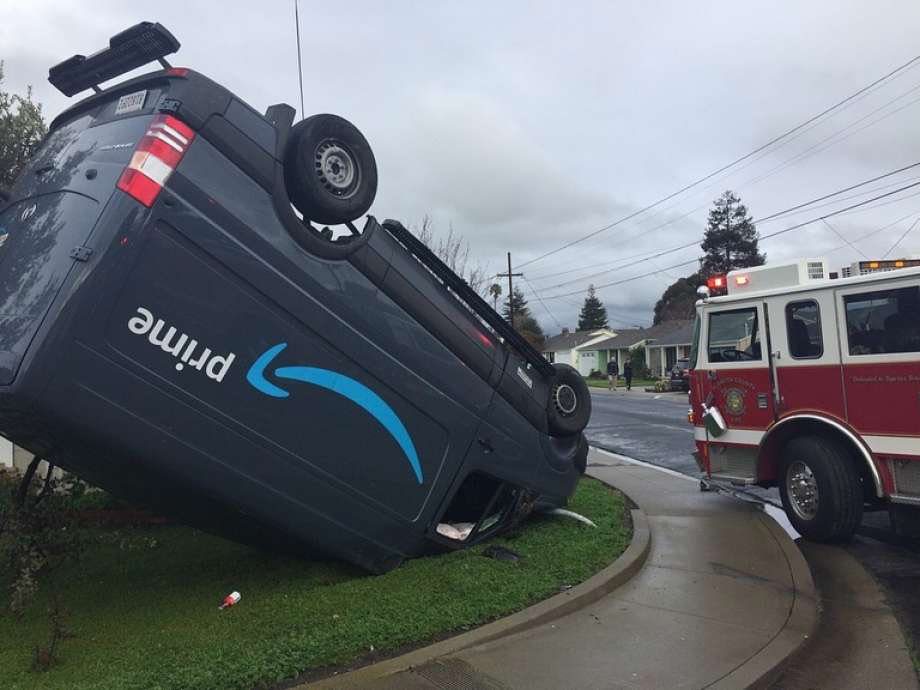
Alameda County Fire Department, March 2, 2019
I’d always prided myself on being reliable. There’s a notoriously low bar for entry into the world of general labor but even given that, I never felt comfortable doing the bare minimum. I was a delivery driver for Amazon, and the most critical part of that job was showing up, literally. The company I worked for, Touchdown Logistics, contracted daily routes from Amazon in the mornings and would then dispatch its fleet of white mid-size cargo vans across Long Island and the outer boroughs of NYC to deliver whatever discrete necessities the consumers of New York desired. A common subject of the boss’s ire was the frequency with which people would call out on days they were supposed to work. In the logistics business the profit is in maintaining the fluidity of the operation and last minute call outs meant Touchdown would have to forfeit the approximately $2,000 they made per route per day. He’d threaten to cut days, fire people, cut hours, basically whatever he could, but people kept calling out and the impotence of his threats became increasingly more pronounced. Guys took the job for what it was, a joke, and understood that the number of responsible people willing to endure the ritual subjugation delivering for Amazon entailed was limited, an understanding clearly shared by the boss. When you’re working as a subcontracted delivery person for the largest retailer in the world even doing the bare minimum was unlikely to have many negative repercussions but still, I had my pride.
This prideful adherence to an absurd capitalist paradigm did not strike me as inherently counterintuitive. In fact, all things considered I was satisfied with my work. Sure, some days were tough but generally my shifts were spent listening to whatever music I wanted as loud as I wanted or soaking up an informative podcast or just quietly reflecting, and considering I didn’t mind the exercise this was an agreeable enough situation. Until Covid hit. Initially we were all pretty uniformly prepared to confront what for all intents and purposes seemed like another media hyped health scare. We had worked through an Ebola scare and a Measles scare, so Covid 19 wasn’t about to hold up the hustle. And indeed it did not, although as blue collar workers we were outliers. As the economy shut down, offices shuttered and people huddled in their homes through March, April and May of 2020, we continued to work as if nothing had happened. The experience of spending all day on the road during April of last year is something I doubt I’ll ever forget, traversing deserted streets alone began to make me feel like Will Smith in I am Legend, every door to which I brought a 24 pack of toilet paper or 4 cases of water potentially separating me from some person infected with the mysterious and nefarious virus.
As I began to acclimate to “the new normal”, making sure to tie my bandana around my face before work every day, using the company provided disinfectant wipes to sanitize every single surface in the van’s cab before entering, ignoring the hazmat workers stationed around the warehouse, the bleakness of my standing in the world began to set in. I had never been preoccupied with notions of social status or generational wealth and so I had, on some level, come to accept what I perceived as a future in the labor field. Working with my hands, solving logistical problems, and relying on my spatial and situational awareness seemed like an agreeable lifestyle.
The pandemic changed that, and made me acutely aware of just how expendable our society views people like me. The patronizing way we were rebranded from “unskilled” to “essential” workers was a particularly insidious piece of propaganda seemingly designed to allow us to hold on to a shred of our dignity as we braved a novel respiratory disease to deliver bored office workers dildos and video games.1
The guy who ran the operation, I’ll call him Sean given the historical nature of this project, had started out as a driver a few months before I had. Being almost double my age and brimming with type-A self-motivation, his status as a coworker of mine at our humble delivery operation struck me as somewhat dissonant. There were rumors that he had retired from a successful career on Wall Street and took up blue collar cosplay in his late 50s for sport and exercise. Though his overbearing insistence that the rest of the staff adhere to whatever new obtuse doctrine corporate Amazon sent down the pipeline that week was annoying, it also explained his rapid ascension from driver to dispatcher to shift manager to station manager. Noa, the Touchdown stakeholder who had established their franchise at Amazon Distribution Center NY 4, saw management material in Sean’s monomaniacal drive to see 100% staff adherence to “the rules”. Amazon paid Touchdown, Touchdown paid us, we should do what Amazon said: simple. This would be dubious calculus under the best of circumstances and the outbreak of Covid 19 certainly was not that. Sean clearly was an individual who maintained a sense of self by projecting adherence to structural norms, that these norms themselves may be detrimental to us, the workers, was of little concern to him. Amazon executives had worked out this bountiful business model, why second guess them in matters of logistical efficiency and personal safety? Noa, a fellow keen observer of human nature, understood Sean’s ridiculous contradictions but as a business owner he also understood that a manager that granularly invested in complete employee conformity was invaluable to his bottom line.
At the onset of a once in a lifetime pandemic, the notion of establishing a new baseline of acceptable workplace norms seemed ornately absurd, especially given the solitary nature of our work. As we lined up 6 feet away from one another one April morning, receiving our van keys and work devices from one of Sean’s subordinate dispatchers who was almost too scared of the virus to make eye contact with us much less risk breathing the same air, I remember a fellow driver muttering to me on the way to his van “Jesus, if you’re scared to die just stay home”. If there was one thing we proved we were not, it was scared to die. Or at least, not so scared as to offset the demands of capitalism. And so we endured, unsure of whether the hundreds of boxes we handled a day, many from China, had Covid on their surfaces. Unsure exactly how much time it would take to catch the virus in close contact with warehouse workers as we loaded vans. If we’re all moving in close quarters breathing hard from exertion, how safe are these masks supposed to make us? I read online that only N95 masks protect against vapors, but we’re in a warehouse with hundreds of people wearing flimsy surgical masks, what’s the point? Dispatchers would humor my queries with varying degrees of patience but the ultimate answer remained the same, nobody knew, we were just following the protocol.
Unsurprisingly (although also somewhat counterintuitively) this protocol did come under some national scrutiny. In late March of 2020 Chris Smalls, an assistant manager at an Amazon fulfillment center in Staten Island, was fired for what Amazon called “multiple safety violations” but which Smalls himself described as “targeted retaliation” for helping to lead a protest against the company’s lack of Covid preparations.2 Smalls, who had worked at Amazon for five years at that point, claims to have witnessed the solubility of his workplace’s safety apparatus and instead of simply toeing the company line, demanded that his corporate overlords take action. Needless to say, Amazon wasn’t going to bend to the whims of some ground level assistant manager, and instead of gearing up to address the glaring issues regarding workplace safety that were being brought to the forefront, their company embarked on an acute campaign of character assassination to delegitimize Smalls and his message. While it would be an overstatement to say that they succeeded in that goal, the subtle messaging was still set firmly in place. Here was a young black man, an individual deemed worthy of the management track in their company, now raising awareness of the the callous nature of their business model, and their response was to describe him as “not smart or articulate” in “leaked” internal corporate memos3 and do their best to ignore the groundswell of support he quickly amassed, both within and outside of the community of Amazon workers and “essential” workers overall.
I met Smalls at a May Day protest outside of Jeff Bezos midtown Manhattan penthouse earlier this year. He was demonstrating with a handful of associates from “The Congress of Essential Workers”, young to middle-aged men, mostly black, several of whom were subordinates of Chris during his tenure as an assistant manager. They were very willing to express their appreciation for Smalls not just as an outspoken leader against Amazon’s campaign of exploitation but also for his support and encouragement as a manager, making sure to convey that he routinely used his position of relative status within the company to help workers feel respected and appreciated. This young organization, which has been campaigning for an Amazon union, first in Bessemer, Alabama and currently at Smalls’ original facility on Staten Island, has gained support, both tactically and structurally, from individuals and groups long politically activated and invested in worker’s rights. That Amazon is employing every dirty trick in the book, (up to and including anything from slick anti-union promotional materials being distributed on warehouse floors to allegations of straight-up voting fraud) and surely some so novel as to have not yet made the latest edition, comes as no surprise and yet seemingly has done little to quell the fighting spirit that underpins this burgeoning movement. The cynic in me continues to overpower the optimist, but it is movements like the Congress of Essential Workers that give the underdog a little more lifeblood in him yet.
It’s been difficult to find the motivation to write this piece. My stint at Amazon is behind me now and were it not for my appreciation for a challenge I may not even have gone through the motions of sifting through past trauma for the sake of “the historical record”. A government stimulus and some resourceful leveraging afforded me the ability to spend most of this year receiving unemployment benefits which are due to reduce sharply next month. I don’t know what I’ll do for work but I’m certain I don’t want to return to Amazon. That they were a gargantuan economic force was a fact I was well aware of before beginning working there in early 2018, but that ultimately made it all the more demoralizing to realize how little this company cared for its workers. Recently, Amazon founder Jeff Bezos, in a move recalling Gil Scott-Heron’s classic poem “Whitey on the Moon” completed a sub-orbital joyride in the first manned flight of his private aerospace company Blue Origin. Upon landing, Bezos made sure to thank all Amazon employees for “paying for all this” which, frankly, I’m still unsure as to whether he meant explicitly as an insult or not.4 Regardless, the man and his ilk continue to rack up victories and “the little guy” is finding less and less room to maneuver between completely buying into his/their vision for the world and total societal ostracization. While it has proven to be a massive boon for the company, this pandemic still is not over. Often it feels as if the state of it being “over” moves further away into the horizon every day. And yet, somehow, the attendants of capital seem to be flourishing in spite of the pandemic, signaling to those of us who don’t deem ambition a virtue that our lives will always matter less than those who strive at all costs. I suppose as neoliberal subjects, we’ve all been conditioned to crave some degree of hierarchical social stratification, something tangible to grasp onto to assure ourselves that we’re better than somebody, anybody. I guess I’ll just try to find a place to work that makes it a little less obvious.
Endnotes
Jordan, Jerilyn. “Dildos Are Non-Essential, Amazon Worker Says, as Romulus Facility Protests Conditions amid Coronavirus Crisis.” Metrotimes.com, Metro Times, 2 Apr. 2020, www.metrotimes.com/news-hits/archives/2020/04/02/dildos-are-non-essential-amazon-worker-says-as-romulus-facility-protests-conditions-amid-coronavirus-crisis.
Ivanova, Irina. “Amazon Fires Worker Who Organized Staten Island Warehouse Walkout.” Cbsnews.com, CBS, 31 Mar. 2020, www.cbsnews.com/news/amazon-fires-chris-smalls-walkout-staten-island-new-york-warehouse/.
Wong, Julia. “Amazon Execs Labeled Fired Worker ‘Not Smart or Articulate’ in Leaked PR Notes.” Theguardian.com, The Guardian, 2 Apr. 2020, www.theguardian.com/technology/2020/apr/02/amazon-chris-smalls-smart-articulate-leaked-memo.
Harwood, William. “Jeff Bezos and Blue Origin Complete Successful Spaceflight.” Cbsnews.com, CBS, 20 July 2021, www.cbsnews.com/live-updates/jeff-bezos-space-flight-date-time-live-stream/.