
2015 Contest
Making Work Visible
City University of New York / Labor Arts

The Colors of Hope
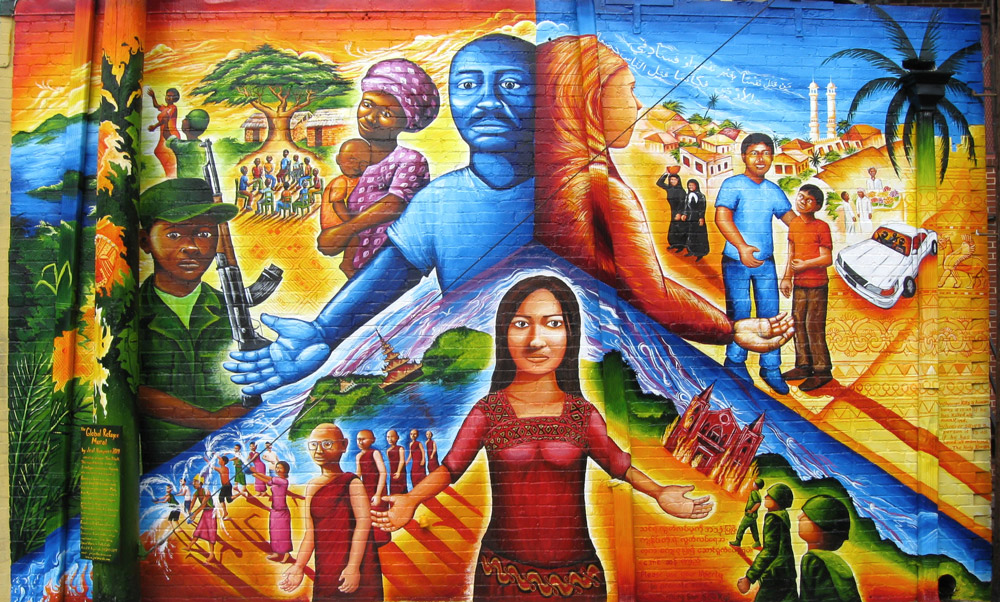
The Global Refugee Mural, Joel Bergner, Silver Spring, MD, 2010
Amarillo. (Yellow)
“Sorry kid, but this is all that we have left.” The clerk hands me back a tube of teal acrylic paint and $3.00 worth of change. “Are you sure you don’t have anything in the back at least closer to royal blue? My mother is really particular about this kind of stuff.” I said stuffing the bills into my back pocket. “Nope, sorry. We won’t get another shipment of paint until Friday, try back again then.” I shake my head in disagreement and take the bag of paint from the counter. “Nah, no thanks man, thanks for your help though.” I begin to head for the door when he calls out to me. “Hey wait a minute, isn’t your mother Rosaria Guevara? The one who painted Los Esperanza right there on 116th street? Man, that mural is freaking amazing!” I begin to smile. “Yeah, that’s my mother’s work out there, thanks.” The clerk smiles and then holds up a portrait of himself which was painted on a small canvas that sat on top of the counter. “She left this in front of my store last week. It meant a lot you know, coming from her, she’s a saint.” I nodded, smiled and walked out of the store, heading down the street toward 116th. It always makes me feel good to hear about my mother’s art. Some may even say that her art changed this community for the better. Ever since she took over the convenient store from her grandfather back in 1986, you can say that her paintings pretty much changed the way our neighborhood looks today. She used to tell me stories about how back in the 80’s, the neighborhood around Spanish Harlem was really bad. Fights broke out almost always, drugs crept in to the neighborhood too which led to more fights, broken families and a loss of the community. My mom told me that one day, she just decided to start painting this random wall right over on 116th and that was the catalyst for change. She painted a loving community, families at the dinner table eating with one another, children in the park playing, musicians in the park performing. She said that once it was done, everyone sorta just, stopped. The mural was right in the center of everything so you couldn’t avoid it even if you tried. People saw it every day and felt a sense of community, hope, love, and started living that way themselves. Los Esperanza is what she named it. I guess you can say that she saved the neighborhood. So now she paints everyday on her lunch break. Inspiring paintings that she leaves around the neighborhood so people can marvel at just like her mural. From the janitor who cleans the school, to the bus driver, to the clerk at the paint shop. My mother takes the time to paint these people in their element, and once she’s done, she leaves them in front of their work places, just to let them know someone is thankful for them.
I arrive to my mother’s store at a quarter past noon as she is wrapping up with her last customer before her lunch break. She leans into a small fan on top of the register and wipes the sweat off her forehead with her apron before she notices me. It seemed to be one of the hottest days in July, perfect timing for the air conditioner in the store to break down. “Hector! your fifteen minutes late.” My mother exclaims placing her hands on her hips behind the register. Her once curly hair now straight and dripping with sweat. “Sorry mom, I really tried to get you the royal blue paint that you asked for but they only had this.” I hand over the tube of teal paint to her. She took it and pursed her lips in a thin line. “Well, at least you tried baby. I won’t be able to get the exact shade of the bus in this painting but I will have to make this work.” My mother says walking to the back of the store where her makeshift art studio stood. We couldn’t afford an actual studio space so my mother used a small storage room in the back of the store as her art sanctuary. A large canvas propped up on cans of corn, beets and just about any inventory she could find served as her easel. An empty rusted can that used to hold green beans now held her paintbrushes. Every day on her lunch break she opted to spend her time in there rather than to eat. She always told me that her paintings nourished her, whatever that meant. I didn’t know about her, but I’d rather a burger and fries over a tube of acrylic any day.
Azul. (Blue)
The teal paint cascades from her paintbrush and on to the canvas to fill in the white spaces of the bus she is painting. Her hands move the way a maestro would during a performance. Her brush controls the movement of the teal paint as she finishes up her painting. I sit and watch my mother through the open door of the storage room as I sit at the register; helping customers as I cover her lunch break. The storage room and the register were directly across from each other, so when there were no customers I would watch my mother paint gracefully until it was time to relinquish my post at the register. The bell chimes as the door opens and my father Sal walks through. He is wearing his uniform; dark blue jeans and a light blue button down shirt with his initials “S.G” over his right pocket. He works a few blocks away on 113th at an auto repair shop and started coming in to the store to check up on my mother ever since she was recently diagnosed with diabetes. My father grew concerned with my mother opting to spend her lunch breaks painting rather than eating to regulate her blood sugar. It always seemed like a constant battle between the two of them for what my father wanted my mother to do, and what my mother felt she needed to do. “Hector, you’re at this register again? Where is your—oh wait, I know where she is.” My father says with an annoyed tone. “Yeah dad, she’s in the storage room painting, but I wouldn’t go in there if I were you. Last time I did she hissed at me, sometimes I don’t know if it’s mom in there or a cat!” I began to laugh but quickly stopped once I noticed the look on my father’s face. His eyes grew low and his eyebrows along with them. “She’s in there every day Hector, I just don’t get it. We have customers to serve and money to make yet she chooses to stuff herself in that old room doing what? Huh? Painting.” My father shook his head and began to walk to the storage room. He closed the door behind him and I could no longer see my mother or her canvas. The fan blows hot air on my face and I watch as the sweat drips from my cheek and lands on the register. I stare at the cold bottles of water and beer across from me in the fridge and begin to wish I was one of them.
“I see you’re in here painting again Rosaria.” My father spoke with a gruff, masculine tone. He takes the paintbrush out of her hand and replaces it with her insulin. Her face draws into the needle and away from her painting. “Sal, you know I don’t need that thing, I’m doing just fine.” She says placing the insulin on the easel. “Your just fine you say? Well explain to me then why the doctor prescribed you with this? You wouldn’t need to take this if you weren’t sick, and yet you still refuse to take it.” My father reaches over for the canvas and stares at it. “The bus driver. You spend all of your time in here painting the bus driver at work when you need to be the one at work!” His voice grows louder and he tosses the canvas to the ground. Splashes of teal paint lie on the floor as the canvas is faced downward, undried. “We’ve spoke about this over and over again. We need money. You know ever since Carlos opened up a shop nearby my business hasn’t been making as much as we used to, we need two incomes now more than ever to pay off the bills that we have. You being back here doesn’t help us Rosaria.” My mother falls to her knees and begins to wipe off the paint now caught between the floorboards and rests the canvas back on to the easel. “Money isn’t everything Sal! Yes we’ve got bills to pay but we don’t need to spend every waking second thinking about it. I paint because the people in this community deserve some recognition. There’s nothing worse than to work 40 hours a week for little pay to keep a company going and no one even knows your name.” My mother’s voice has gotten louder now. “They only see the company as a whole, rather than acknowledging the individuals within it who break their backs every day to make it what it is!” She pauses. “Think about it Sal, you’ve been working at that repair shop for 25 years, making sure everyone in this neighborhood’s car runs smoothly and no one even knows your name.” She places her hand on his chest by the initials over his pocket. “S.G. That’s who they know. You’re more than that name tag.” She says softly. My father takes my mothers hand and pushes it off from his chest. “You don’t know what you’re talking about. Make sure to take your insulin and get back to the register, Hector isn’t an employee here.” He doesn’t say anything to me as he storms past the register and slams the door behind him. The bell above the door has never chimed louder.
Negro. (Black)
Several weeks went past and the tension between my mother and father got worse. She continued to refuse her insulin stating that she felt fine and continued to use her spare time, including her lunch breaks, to paint. My father would come home from work and find her medication partly used although her condition seemed to worsen. She began showing symptoms of hypoglycemia as she was not sleeping well, became fatigued often and her vision began to blur. Her failing health showed within her paintings as I noticed her images more distorted than ever. We later found out that my mother would empty the daily dosages of insulin out into the sink and left the small bottle back in place to make it seem as if she was finally complying with my father; anything to keep him from arguing with her. Her behavior had been going on for a few days before I decided to approach her about it. Her stubbornness was causing my father and I to worry. “Ma!” I called out as I walked up the stairs to my parent’s bedroom one afternoon. I’d just come home from school, searching for my mother at the store but another employee Juan, told me that he did not see her all morning. I figured she was back at home on her day off. “Ma, are you here? I’ve been looking all over—” Just then, I noticed my mother lying on the bed and her chest was not moving up and down. I hurried quickly to the bed and grabbed her hand to feel for a pulse, but none could be found. “Ma!” I yelled, urging her to wake up from her seemingly deep dream. When she did not respond, I grabbed the telephone from the night-stand and dialed 911. I breathed heavily and jumbled my words as I explained to the operator the situation and our address. All I could think of now was splashing drops of paint all over her, I figured the thing that she coveted most would revive her.
I called my father as soon as I got to the emergency room and he arrived moments after straight from work. He didn’t speak, but his face read “Where is she? Is she ok?” I hugged him and told him that we had to wait to see what was going to happen next. About an hour later, the doctor came and informed us that my mother was holding up but she would need to stay in the hospital overnight for further testing. “Mr. Guevara, we’ll have to keep her a little longer. It seems as if she hasn’t been regulating her blood sugar for quite some time now, good thing your son found her in time, she passed out and who knows what could have happened if he didn’t.” My father’s face grew weary. “Thank you doctor, yes I’ll have to get her a few things from the house so she can stay overnight here.” The doctor nodded and went back into my mother’s room. “Hector, will you be alright in here? I’ll have to go home and pack some of your mother’s things.”
“I’ll be alright dad.” With that, he left for our house. My father went straight upstairs to their bedroom and found a small bag which he began to fill. He opened her dresser drawer and placed a night-gown, under-garments and socks. As he lifted up the pair, he noticed something lying on the bottom of the drawer. A small painted canvas.
And it was that moment there where my father finally realized that my mother was right. Life wasn’t about using every waking hour to make money but instead using your precious limited time on earth to appreciate the people around you who work hard everyday to make our communities what they are. The people who aren’t famous, drive fancy cars or attend award shows. These are the people that maintain the flow of the community; the mechanic, the bus driver, the store owner, the janitor, the teacher, nurses, construction workers. Everyone who we come across everyday and seldom stop to think about what life would be without their contributions. My father held the canvas in his hands which had a painting of a man with a teal blue shirt and dark blue pants changing a car tire. The man’s shirt had the initials “S.G” on it. My dad gazed in awe at the thought of my mother hiding away this canvas in her drawer, perhaps my father’s constant disapproval of my mother’s art caused her to keep it hidden; afraid that he would criticize her. But he didn’t, he finally understood what my mother was speaking about. “You’re more than that name tag.” Her voice vibrated through his mind. She had appreciated my father and the contribution he made to the community through his work, no matter how menial it was. He closed the drawer, picked up the small bag of belongings for my mother, left the house and started toward his car to head back to the hospital. He also took the canvas along with him. He drove over to the auto repair shop where he worked and got out of the car to place the canvas my mom painted of him in the front. It leaned on a tire. “Soon.” He said. “Soon you’ll get better Rosaria.” He got into his car and drove past Los Esperanza, making his way to the hospital.