
2015 Contest
Making Work Visible
City University of New York / Labor Arts

Religious Righteousness in the Fight for Labor Rights: The Role of Organized Religion in the 1968 Memphis Sanitation Workers Strike
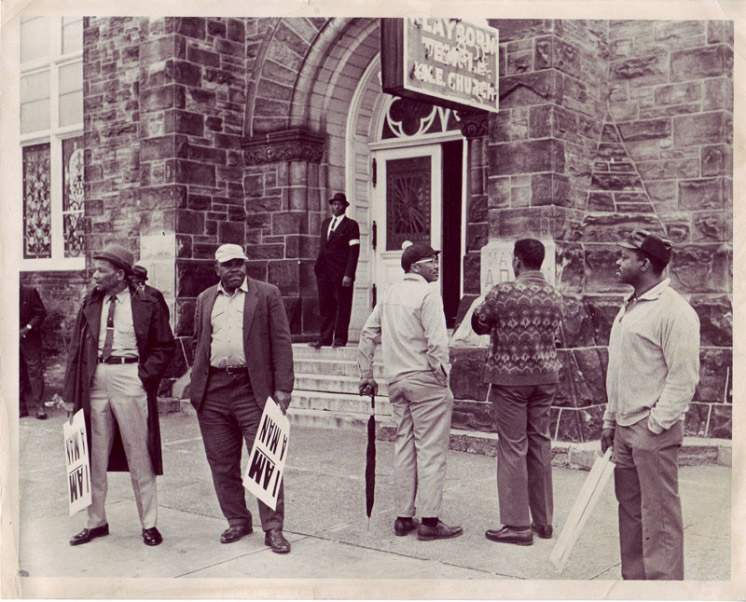
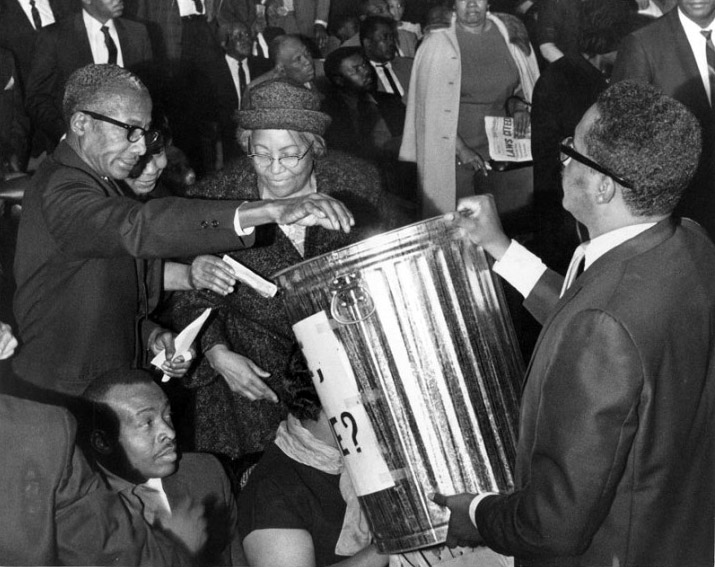
Above: Strikers Outside Clayborn Temple, 1968 Sanitation Workers Strike. Below: Audience, 1968 Sanitation Workers Strike.
 What was the role of organized religion and spirituality in defining the terms of the strike, coordinating the strike, and sustaining the strike in the fight for union recognition and civil rights?
While the 20th Century saw new hope for workers in the United States through rights gained during wartime efforts and movements towards equality, many workers still faced grave challenges in the workplace. Racialized and genderized notions of labor made such challenges worse for minorities. Even amidst the great promise of the breakthrough legislation of the Civil Rights Act of 1964, African Americans continued to face discrimination, poor treatment, and lower wages. This was especially true in the South where Jim Crow laws that were an embodiment of the racism and the racial economic oppression of the region existed for nearly a century. Such grievances resulted in the 1968 Memphis sanitation workers strike. Initially envisioned as a fight for labor rights and union recognition, the strike challenged deeper civil rights issues and thus, became intertwined with the fight for civil rights. Garnering national attention and the eventual involvement of Dr. Martin Luther King Jr., the 1968 Memphis sanitation workers strike illuminated the strong ability of the African American community to unite and successfully fight for labor rights, union recognition, and civil rights. The strikers’ fight strongly benefitted from the aid and influence of organized religion and spirituality. In this essay, I will argue that religion and spirituality played a central role in the 1968 Memphis sanitation workers strike by defining the strike in terms of peaceful and nonviolent protest, coordinating the strike by organizing the strike around the Church and local clergy leaders, and sustaining the strike by acting as a means of support. Throughout this essay, I will distinguish between organized religion which I interpret as the structures, institutions, and clergy leaders from spirituality which I consider as the broader values, feelings, and beliefs that are part of or inspired by religion. Although, there is a distinction between organized religion and spirituality, organized religion and spirituality acted in harmony to profoundly contribute to the success of the Memphis sanitation workers fight for union recognition and civil rights.
Spirituality defined the 1968 Memphis Sanitation Workers Strike in terms of broader Christian values such as peace, nonviolence, brotherhood, charity, and sacrifice. These values were manifested by organized religion in how the Church and clergy leaders defined that the strike take the form of nonviolent protests, peaceful picketing, marches, and boycotts. By keeping the 1968 Memphis Sanitation Worker’s Strike in accordance with Christian spiritual values, religious leaders could acceptably take on leading roles in supporting the movement and call on their congregations to join in fighting for the sanitation workers. Whereas, had the strike been predicated on violence and militancy, it would have been problematic for religious leaders and Church members to support such means that would go against Christian doctrines. In the cases where the strike broke out into violence black ministers were keen on urging restraint from violence and emphasizing that the strike be mediated by peace and nonviolence.
Through common spiritual beliefs it was essential for organized religion to define the strike in terms of pacifism and civil disobedience in order to maintain unity within the African American community. A strong example of the interplay of spirituality and organized religion acting together to define the strike can be found in Dr. Martin Luther King’s “Mountaintop” speech.[1] This prophetic speech came following Reverend James Lawson’s call on the great figure of the civil rights movement to come back to Memphis after some violent protest, arguably instigated by police brutality, had broken out. King’s speech is heavily infused with religious references and his use of the parable the “Good Samaritan” particularly, demonstrates the sense of Christian fraternalism and sacrifice that he insists the strike should be defined by. Drawing from and reformulating the parable, King advances, “The question is, ‘If I do not stop to help the sanitation workers, what will happen to them?’ That’s the question”. Further, in the photo from the Civil Rights Digital Library titled, “Strikers Outside Clayborn Temple”, there is a sense of the peace, brotherhood, and the centrality of the Church that was so important to the eventual success of the strike.[2] African American men are pictured outside of the Clayborn Temple, an African Methodist Episcopal church, and are gathered in support of the strike holding picketing signs with the slogan, “I am a man.” This image reinforces the notion of Christian fraternalism, unity, and the notion of sacrifice to help others, these men are answering the call of Dr. King in his “Mountaintop” speech and are doing so in a manner defined by their spirituality and their commitment to their organized religious institutions.
Drawing from spiritual beliefs that united Church members and the African American community in Memphis, organized religion coordinated the strike using the Church and religious leaders as a foundation for the movement. The Church and religious leaders such as Reverend James Lawson and Reverend Ralph Jackson were a familiar institution and familiar figures in lives of many of those who would come to support the strike. Organized religion coordinated the strike out of churches like the Clayborn Temple and Mason Temple. These religious sites in effect became mass meeting grounds and headquarters for peaceful protests and picketing as well as a starting point for marches to city hall. Preachers took on a huge role in coordinating the strike and could often be found at the forefront of demonstrations; in fighting injustice they were believed to be carrying out “God’s Will”.
In Michael Honey’s oral history book “Black Workers Remember”, sanitation worker Taylor Rodgers expresses the important role of organized religion and religious leaders in coordinating the strike, he says, “With the help of the community and the black leaders and black ministers, that’s when we started to pull everything together. Rev. Ralph Jackson, Reverend James Lawson, a number of other preachers, Reverend Henry Starks, marched with us every day for sixty-eight days”.[3] In addition, Rogers explains how Clayborn Temple acted as a starting point for marches, “We marched every day from Clayborn Temple to the city hall and back”. This leadership of ministers, which was crucial to coordinating the strike, is best captured in the image of “Rev. James Lawson” from the Civil Rights Digital Library.[4] Lawson is walking poised at the center of the image leading a group of African American men. Some of the men appear to be looking to him with an air of confidence confirming that he truly was their leader and this image shows as Taylor Rodgers said that Reverend Lawson played a central role in helping to “pull everything together”.
Spirituality and organized religion offered a support system and a safety net that the Memphis Sanitation Workers desperately needed in a time when they were out of work in order to fight for their struggle. Again, drawing from spiritual beliefs of fraternal charity, organized religion contributed much needed support by providing food, money, and other resources through donations and sacrificing self-interest in support of the larger community. Taylor Rogers clearly recalled the pillar of support that the Church provided him in his time of need, “My church, the Gospel Temple Baptist Church, helped me out. The churches supported everybody. The churches, the community, and everybody pooled their resources to see that we had food and places to stay”. Further, Rogers describes how such donations worked, “Every Sunday…We’d have mass meetings at Mason Temple and then we’d pass garbage cans around. Those garbage cans were just filled with money. It brought the black community together more so than anything I’ve seen. That’s how we survived”. The image from the Civil Rights Digital Library, “Audience”, illustrates the way that Rogers describes donations were collected.[5] Collecting donations in a trashcan symbolized the solidarity of the sanitation workers. The collections of donations were of incredible help to supporting the strike.
The role of the Church and religious leaders as well as spirituality through prayer was something profoundly remembered by sanitation workers. In sustaining the strike Clarence Coe, a unionist and strike supporter, also recalls the support the preachers and the Church provided, “They [preachers] would bring in somebody, and go from church to church raising funds, and so forth, and they weathered that storm”.[6] On a more personal spiritual level, former sanitation worker James Robinson epitomizes the hardships that sanitation workers faced, “You work out there you needed some kind of prayer or somethin’”.[7] Thus, spirituality in the form of prayer also acted as a way to make it through hard work and to keep one’s spirit up. Organized religion and spirituality played an incredibly important role in sustaining the strike and galvanized the African American community to unite in the fight for sanitation workers and for more wide sweeping civil rights issues.
On Wednesday April 3rd, 1968 Dr. Martin Luther King returned to Memphis and delivered his final speech at a rally for the Memphis sanitation workers strike, beautifully put he said, “I just want to do God’s will. And He’s allowed me to go up to the mountain. And I’ve looked over. And I’ve seen the Promised Land. I may not get there with you. But I want you to know tonight, that we, as a people, will get to the Promised Land!” In many ways the 1968 Memphis sanitation workers was marked by “God’s will” through the efforts and influence of organized religion and spirituality. First, I articulated the role of organized religion and spirituality in defining the terms of the strike particularly by embracing Christian beliefs of peace and nonviolence. I then established the ways organized religion, spirituality, and local clergy leaders coordinated the strike and used religious sites, such as the Mason Temple and Clayborn Temple, as mass meeting grounds for supporters of the strike. Finally, I demonstrated how organized religion and spirituality sustained the strike by acting as a support system providing food, money, and other essential resources to the strikers. Ultimately, the strike, with the great help of organized religion and spirituality, came to unite the African American community of Memphis, and again, as sanitation worker Taylor Rodgers remembers it, “It brought the black community together more so than anything I’ve seen.”
—
[1] Martin Luther King, Jr., “Martin Luther King’s Final Speech: ‘I’ve Been to the Mountaintop’—the Full Text,” ABC News, http://abcnews.go.com/Politics/martin-luther-kings-final-speech-ive-mountaintop-full/story?id=18872817 (accessed May 8, 2014).
[2] “Strikers Outside Clayborn Temple,” 1968 Sanitation Workers Strike, PS 90012, University of Memphis Libraries Special Collections, Memphis, Tennessee, http://crdl.usg.edu/cgi/crdl?query=id%3Atnum_sanistrike_000209&_cc=1 (accessed May 8, 2014).
[3] Taylor Rogers, “Taylor Rogers Relives the Memphis Sanitation Strike,” in Black Workers Remember: An Oral History of Segregation, Unionism and the Freedom Struggle, ed. Michael Honey Struggle (Berkeley: University of California Press, 2002), 296.
[4] “Rev. James Lawson,” 1968 Sanitation Workers Strike, PS 90012, University of Memphis Libraries Special Collections, Memphis, Tennessee, http://crdl.usg.edu/cgi/crdl?query=id%3Atnum_sanistrike_000209&_cc=1 (accessed May 8, 2014).
[5] “Audience,” 1968 Sanitation Workers Strike, PS 90012, University of Memphis Libraries Special Collections, Memphis, Tennessee, http://crdl.usg.edu/cgi/crdl?query=id%3Atnum_sanistrike_000209&_cc=1 (accessed May 8, 2014).
[6] Clarence Coe, “Leroy Boyd and Clarence Coe Recall a Strike and the Death of Martin Luther King,” in Black Workers Remember: An Oral History of Segregation, Unionism and the Freedom Struggle, ed. Michael Honey Struggle (Berkeley: University of California Press, 2002), 311.
[7] James Robinson, “James Robinson Describes the Worst Job He Ever Had,” in Black Workers Remember: An Oral History of Segregation, Unionism and the Freedom Struggle, ed. Michael Honey Struggle (Berkeley: University of California Press, 2002), 308.