
2017 Contest
Making Work Visible
City University of New York / Labor Arts

We Grant You Our Time and You Grant Us Travel Stipends
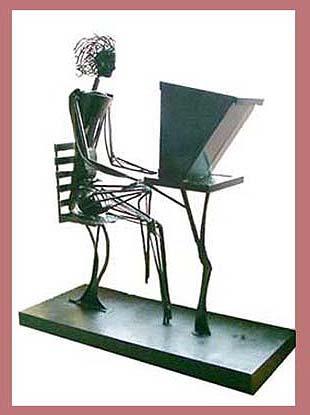
Untitled, Joshua Dylan Brauns for International Association of Machinists & Aerospace Workers, 1990s
Subject: Cubicle
In my awkwardly-heighted cubicle there is a thin film of dust over almost everything. There are unsolicited manuscripts from 2003. In the second drawer of the desk there is a small hammer which I will occasionally open the drawer just to look at, to make sure it is still there and is, in fact, a hammer, placed innocuously next to white-out, a paperclip, and three different boxes of staples, all opened and none emptied. Most unsettling, though, are the post-it notes. There are many of them, all written on with different hands in different colors. They list the responsibilities of an intern checking over production manuscripts: read frontmatter; check TOC, folios, running heads; look for stacks, widows, orphans. These are my responsibilities when I sit in this cubicle, every day, but these are not my post-it notes. They are the ghosts of former interns, who sat where I sit now, doing what I am doing now, who may have paused over the hammer the same as I do now, or who may even have placed it there to begin with. There is no way of knowing and I wonder where in the world they are, if they still are, or if anything still exists in the blurry world outside of this cubicle.
#
Fellow interns and I write these emails back and forth over email, as something like stress relief. We have no union, and no one really cares about our presence one way or another. Our time here is limited and our duties are meager: we are the definition of temporary and unnecessary. We’ve even been told so, at times: the office does not require us to run; we are not needed here. But with the way things work in so many of these yuppie industries now, it’s a necessary step toward (possible, not-guaranteed) employment if you’re not already rich and well-connected—even then, those people just tend to get the better internships, the paying ones, the ones at high-profile companies that might give a human resources hirer pause. This is not our first internship, and in a month-late welcome meeting with the executive (he got his start in the seventies, of course), he expresses surprise at this.
“I didn’t realize you’d all come from other places before here,” he says.
“Of course we did,” we think but don’t say. “There is no other way.” (And, “Please hire us,” we whisper because we can’t stop ourselves. “We would very much like to have a guarantee that we will be able to pay our rent in two months, when our loans run out, or when we graduate, or when our savings run out. We have nightmares about Sally Mae scratching at our windows in the night—do you know, can you hear with us what that sounds like?”)
#
Subject: Bathroom Conversations
I’ve never had great conversational skills, but that doesn’t really matter when the people talking to you don’t really view you as human. It’s rare to be spoken to and looked at at the same time. Even when they look at you, they don’t normally catch your eye-line—it’s more like a hazy glance cast in your general direction. The exception to this is in the bathroom: for whatever reason, this is the place of communion. It is not a large bathroom. There are two urinals (one of which is broken, and when flushed does not stop running water, spilling it onto the floor) and two stalls. If there is more than one other person in there, it’s crowded. And yet, you never know when you’re going to catch an important five-man meeting of senior editors, looking one another in the eyes while their voices echo on the tiled walls and one or two or three of them with their dicks in their hands. No one is ever more interesting in who you are and what you’re up to than when you’re trying to take a piss. There’s something in here about Rabelais’ grotesque: the community of bodies as bodies eating, shitting, fucking together—but does that fit inside the contemporary notions of antiseptic cleanliness signaled by the “Kills 99.99% of Bacteria!” handsoap, and the smell of bleach? Why here, of all places, do you want to know how I’m doing? Why here, where most people are stilled to silence by their collective shames of flesh and excretion, do you want to have a conversation about my future? Why here am I most human— why is it in the bathroom you’re searching for my eyes?
#
“Good morning!”
“Hello,” she says, not looking up from the computer screen. She is my boss today; the interns rotate.
“How are you today?”
“Fine.” She punctuates her answer by pressing the enter key on her keyboard. She turns to me, where I am standing in her doorway, because I do not really know when I am or am not supposed to enter the sanctum of her office, and anyway both of the available chairs are occupied by her purse, her coat, her books.
“I love the view from your window.”
(I do love the view from her window. It’s filled with watertowers at varying heights, and crossed through by fire escapes. It feels like the scenery I came to New York for: the mess of jungle metals and incongruent skyscrapers.)
“Did you have a nice weekend?”
“I did. I don’t have anything for you yet today. Could you come back in maybe twenty minutes?”
“Of course!” I turn to leave, but she starts speaking again.
“I count them, sometimes. When I’m bored.”
“Is that often?” “Sometimes.”
“How many are there?”
“Nine. Most of the time.”
I count seven. But it’s her window. She doesn’t say anything else, so I go back to the cubicle and stare blankly at my email. This is the first internship we’ve had where our emails are actually our names rather than a string of letters and numbers, though it’s something more like a title-change promotion rather than anything that actually reflects worth.
#
Subject: Natural Light
There are no windows. I always thought that was a ridiculous thing people made up about offices like this, that there were no windows. Shut up—there have to be windows. But there aren’t. The offices have windows but their doors are often closed. No natural light comes into the pit: the world is well-lit fluorescence which shows amazingly well just how dirty the walls are: the handprints and scuffs from carried boxes or mail, looking faintly like someone dragging their nails for a grip as they’re being pulled away.
#
Only one of us is a person of color, of six. In a meeting with the executive meant as an informational meeting, a few weeks after the month-late welcome meeting, he opens the floor to questions and gets one about diversity: What are you doing, we ask, to address the serious diversity problem in the industry?
That is a huge problem, he agrees. The industry is eighty percent white. That’s a huge problem; we’re right. And part of the problem is that in order to get hired in the industry we need the experience of an internship, which means we need to be able to work for four months without being paid—which naturally leaves out those of us in the poorer classes. And it’s never been a hugely profitable industry, so those of us looking for more lucrative careers aren’t looking here. It’s a huge problem. We’re right.
(What he doesn’t give us is an answer. What are you doing? Nothing. There’s nothing to be done—the hands have been thrown up. Any other questions?)
#
I wait an hour for my boss to show up (this is not an uncommon occurrence: though we are always here by nine, many real employees arrive pretty much whenever the hell they want—we have to punch in but they, as fulltimers, do not), only to be informed by someone else that she is not coming in. She’s out all week, on vacation.
“Oh.”
Her assistant gives me something to proofread. It’s not real proofreading, though; that job is outsourced to people who are paid better than I am (read: paid, at all). My job is to check over the typesetting and fix minor errors: widows, orphans, stacks. I write poems with these, sometimes, just by taking the first words and last words of lines and seeing what happens:
He
appar-
was
pattern
moved
speech
first
for
here
instead
always
telling
of
“English”
and
outside
the
versed
vilific
all
defiant
was
was
art,
is
and
madness
page?
and
always
such
that
an
madness
resonant,
#
Our supervisor is unreadable. When we ask him for work he gives it, but never makes any comment on what he wants, how we’re doing. It’s becoming a problem, because we all want him to be happy with us—we all want him to hire us. Then, coming in from the elevator, one of us goes to another, the closest one:
“Jon held the elevator for me.”
“Oh, that was nice of him.”
“Yeah, but then I overheard his conversation with the other editor in there: his girlfriend’s an author. She published a book with Knopf last fall.”
“No way. We need—”
“We need to look her up right now.”
And we do, because this is something: this is one thing we can use to humanize our experience, to know that we’re working under a human being—to bring him down to our level. He has a girlfriend. He has sex with her after her poetry readings. This is finally something we can hold on to, at least for a second: our supervisor’s girlfriend’s book, which we all read—passing around a single copy found at the Strand for cheap—and give three-star reviews on Amazon, signaling our feelings that is meanders, that it does not ultimately have anything to say, that it may end up being somewhat pointless.
#
Subject: Happy Happy Joy Joy
I never understood the concept of “happy hour”—not really, I mean. When I was a kid my mother would take me to work with her and we’d often end up there. There was free food— hotwings, peanuts, mini taco things, whatever—that could serve as part of my dinner, and my mother could get two drinks for the price of one. Sometimes three, if the right bartender was working. But nothing about it seemed happy: sticky tables and people talking too loudly about how much they hate their boss and that one fucking guy in accounting who won’t shut up about his brother’s start-up. I don’t know. What I’m trying to say is, does anyone want to get a drink after work?
#
Off the subway, I see one of us walking in the opposite direction of the office, toward me, though he doesn’t see me yet because he needs glasses. I’ve already got them. I hate them, but I stare at a screen reading for eight hours a day, so it was inevitable. I have given my eyes to an industry that has not yet given me anything (and may never).
“Hey, where are you going?”
“Just walking for ten minutes. What time is it?”
“Eight forty-eight.”
“Yeah, I guess it’s about that time. I get off at eighth, and I always walk by the building and think, Oh man, I just don’t want to go in there yet.”
My boss has returned this week from her vacation. I ask her where she went and she says California.
“I’ve always wanted to go to California,” I say.
“You should.”
And I just can’t help it, so I start laughing, and she laughs with me at first but stops, and says that she doesn’t have anything for me just yet, could I come back in ten minutes? and I’m still laughing a little bit by the time I get to my cubicle.
#
reassess-
My
securities
attracted
I’d been
Exit
years
#
We get emails sent to the whole office by the office manager complaining about the state of the kitchenette. There are coffee stains on the counter; there are stacks of dirty bowls and mugs in the sink, and stacks of clean ones on the coffee stains. And please, the sink is right next to the garbage clean, please empty out your cup before you throw it away. We’ve never met this person but we take a special pride in making her life just a little worse—our small impact on the workplace.
#
Subject: Small Noises Down the Hall
I know the man’s voice but not what he looks like. His voice carries over the cubicles but it’s never had cause to be directed at me; I’m not on its radar. But it’s very distinctive: it’s low but without a growl, and it extends the vowels at the ends of sentences. Right now it’s scolding someone. Through the keyboards I can make out something about Barnes and Noble, something about display tables—I can’t believe you would… We ran over this so many times… It’s just Barnes and. The woman’s voice is harder to make out; it’s just a high note constantly interrupted or spoken over, until he says they’re done talking. Then it’s just her, her small note, making these small noises into her hand. She’s crying. Is she crying? She’s—I’m not crying.
#
“How much longer does this last?” A real employee asks me. “When do you leave?”
This question comes often. It’s a reminder that there are no open positions and we will not be hired; it was never in the cards that we might be hired. And a reminder that our presence is tolerated, though not without some complaint. If someone’s lunch goes missing from the fridge, we’re the first to know, because we’re the first to be interrogated; we’re objects of suspicion and we answer your emails, sign your name, insert small typos you won’t notice because if we’re treated like a small annoyance to be swept away we might as well act like it.
“Through the end of April,” I say, taking a bag out of the fridge with a name on it that isn’t mine, that might be yours, that I kind of hope is yours.
#
The
uncere-
had
seemed
time
was:
called
was
coffee
#
After throwing out a full cup of coffee, my phone rings. It’s never happened before and I have no idea who might be calling me. I didn’t even think the phone worked. Do I have an extension? Do I extend?
“Hello?”
“Is Jan there?”
“Uh, no. No, this is—”
“Tell Jan to call me back.”
Then they hang up. We have no idea who Jan is. None of the offices have nameplates.
#
Subject: Jan
Every day now someone calls looking for someone named Jan. That is not my name. And as far as I know, though I admit to knowing little, no one who works here goes by that name. But he keeps calling, no matter how many times I tell him that I think he’s got the wrong number. When he repeats the number back to me I realize I don’t even know the number of the phone I’m sitting with. Does anyone know a Jan?
#
We don’t even particularly like one another, us interns. We smile politely at the floor when we pass by each other; we steal supplies from each other when we’re out on break. We represent threats to one another: if one of us is hired, that’s another job from the pool we can’t have, and there are always more of us than there are jobs. We don’t want to go back to school; our resumes are only good for this one job because it’s impossible to be anything else without five requisite years of experience you can’t have unless you had the job in the first place. Our self-worth is tied to this. We hate each other. We hate ourselves. Even though two of us are fucking. (Especially?)
#
“I’ve been working on this story.”
“I didn’t realize you wrote.”
“I just figured we all do.”
“Fair.”
“So this story: I’m trying to work out this thing where it’s just a long conversation between these two friends, right, but at the very end you realize that the one friend has been planning to kill himself the entire time. … And you can see hints of it throughout the conversation.”
“I’ve decided to take up food writing.”
#
Subject: Lunch
Everyday I eat lunch alone in a cubicle. It’s always leftovers from whatever I could make myself for dinner the night before, provided it wasn’t a twenty-eight cent package of ramen—which is sometimes the case, and then lunch is a peanutbutter sandwich. (Have you seen the price of jelly lately? For christ’s sake.) So I sit alone and eat and listen to the sound of my own chewing, the food dropping down my throat.
#
“Have you heard about this summer fridays thing yet?”
“No, what’s that?”
“So apparently in the summers, the entire industry takes off on Fridays.”
“… What?”
“I’m not even joking. It sounds like a joke, I know. But it’s not.”
“How?”
“Who the hell knows? This is a fake industry.”
#
The executive brings his dog to the office. It’s one of those weird ones with the nose that comes down like an oval, like the skull is seriously misshapen—one of us knows the name of the breed but the rest of us don’t. We just watch it wander, dragging its leash behind it on the floor. If it enters an office or a cubicle, small shrieks of excitement are issued by the inhabitant. The dog is pet; people lord over it as it sits there uselessly, doing nothing. We are not jealous of dogs, we think. But we are. We’re jealous of this dog.
#
“I have a headache, you know? Like behind my eyes?”
“Oh man, that sucks. Do you want aspirin? I have.”
“I think I’m just going to—I can’t tell, right, if it’s because I’m drinking too much coffee or not enough. And usually I diagnose it as not enough.”
“Yeah, it’s probably just not enough.”
“It’s not enough. I’ll just get more coffee.”
#
Subject: Open Mic TONIGHT!
Hey guys, I’m going to be reading some poems at an open mic down the street after work. It would mean the world to me if you came! Let me know!
(Two drink minimum.)
#
A new assistant has been hired, and it is not any of us. Even in our brief time here we have become territorial about our cubicles, but one of us is losing their cubicle to make room for the new assistant. They get a new computer, office supplies we were never given but should have been (a stapler, tape), and the cubicle is being professionally cleaned and repainted. The one of us that has to move now takes up space in the corner of the conference room—provided there is no conference—and has to work off of an IBM laptop that the tech guy handed over while shaking his head. We console ourselves by reminding that the situation is temporary, because we’ll all be gone in a couple of weeks. But then, we’ll all be gone in a couple of weeks.
#
We talk to our bosses, our supervisor. Do you have any practical advice on how to get a job in this industry? And without looking up from their work they answer, in so many words, No.
“It took me a long time to get a job, and I thought I never would.”
“A space opened up right at the end of my internship and my supervisor liked me.”
“My friend had this job before me.”
#
“Is Jan there?”
“I really think you have the—”
“Just tell her I called.”
“You never even said your name.” (But he hung up already.)
#
We ask: Do you like your job? And the answers start, “Well—”
#
Subject: AC
Every few hours there’s this sound that comes from the ceiling, like something being tossed down a long metal shaft. There’s an echo, and movement—irregularly. The first time I heard this I thought it was a bomb about to go off, or someone crawling through the vents. But it’s just the cooling system which, for some reason, sounds out like a hammer. And in each office the repercussions of this all sound a little different: in the production editor’s, there’s a low rumbling that drones out her already meager voice so that her explanations to me are unintelligible growls; in the publisher’s office, there is a light ticking you could almost mistake for a clock if it weren’t for it scratching sounds accompanying, like a small animal trying desperately to escape somewhere; and in the supervisor’s office, there’s just a sound like a heavy metal bat hitting a hollow pipe, which makes me flinch every time but doesn’t bother him at all. I ask, are you just used to that? And he answers, What?
#
It is our last week. A couple of us have interviews for positions we know we won’t get. One of us is going back to school. The rest of us don’t know what we’re doing. We have some meager amount of money saved we could coast on for a month or two, but if we don’t find something, well. This internship was, ostensibly, to prepare us for employment in the industry; at the same time, it prepared us for unemployment—for disemployment in the industry. And god, we hate calling it that—industry—but our supervisor reminds us that our love of literature is largely pointless. It’s not about literature; it’s about publishing. Virginia Woolf is great, but a corpse can’t go on a book tour; nobody reads Tom Hardy anymore. Instead, here is another book that everyone will praise for the summer and forget about in a few months; here is another experimental Norwegian novel that we will sell as “bleak”; here is another depression memoir; here is another book of poetry no one will read or buy but everyone will call brilliant. There’s no love here, we’re convinced—though we’re absolutely sure, and we can feel it in ourselves, that if one of us were hired, if we made our way inside, we would take off every Friday in the summer, and we would count the water towers out our windows, and we would have conversations in the bathrooms, looking one another in the eye.