
2012 Contest
Making Work Visible
City University of New York / Labor Arts

Zora Neale Hurston: Her Work, Politics and Life View
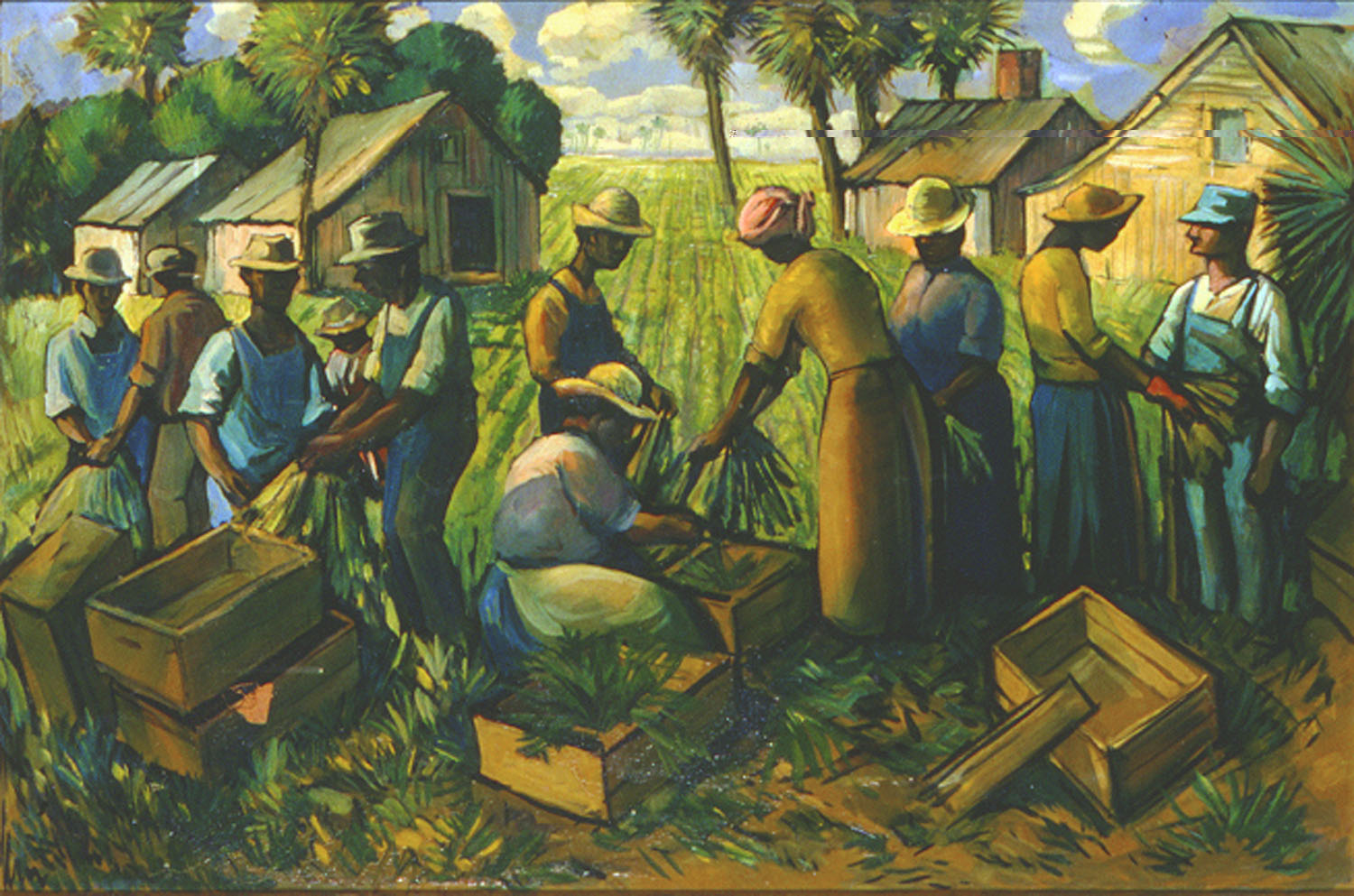
"Harvest" by J. Andre Smith
Zora Neale Hurston worked hard throughout her life for a cause that was largely unappreciated: recording the doings and sayings of rural black Southerners and black Caribbeans. It is sad that she only achieved widespread respect and canonization after her death, rather than during her life. While she has been characterized by some as an enemy of black rights, her vision dug deeper than politics: she was a champion of black humanity. An artist’s job is to tell stories that need to be told, and to explore what life and humanity are. Hurston has succeeded on both counts. By showing her characters to be real people with all the feelings and flaws that real people have, rather than stereotypes that would seek to prove a political point, Hurston accomplished groundbreaking work for humanity in America.
The main reason Hurston’s work was left buried for years after her death was her political estrangement from the black intelligentsia of her time. She felt that the National Association for the Advancement of Colored People (NAACP) and the like showed black life as a “problem” in order to advance their cause; that they consistently showed the worst aspects of black life to force action regarding civil rights. Hurston had two problems with this line of thought: first, that the image of a miserable, poor, struggling sharecropper was not the whole picture of black life in America or even the whole picture of an individual sharecropper’s life; and second, that this approach was not effective because it did not establish the common humanity that blacks share with all other people.
She was an individualist, and strongly so. Thus she favored the individual approach to understanding people. As she says, “Light came to me when I realized that I did not have to consider any racial group as a whole. God made them duck by duck and that was the only way I could see them. I learned that skins were no measure of what was inside people” (I Love Myself When I Am Laughing 171). Hurston’s politics ring of post-racism here, a position that is both admirable and out of sync with the time. Since she was raised in the all-black town of Eatonville, she experienced a life that seemed to be without racist oppression. She did not acknowledge the forces at work preventing other black neighborhoods from becoming incorporated, somewhat self-sufficient towns like her Eatonville. Most black communities could not escape dependence on whites for their livelihoods. Eatonville was a rare exception.
However, the unique quality of her experience is no reason to discount it. Indeed, Hurston did not seek to speak for the group as such; she sought to speak for herself, and to collect many individual voices and characters that were not acknowledged in American discourse at the time. The head of the themes Hurston explored was not the standard subject of how blacks react to white people, but rather how blacks interact with each other. This approach did not present a united front against the whites, but it told the truth as Hurston saw it: that no matter what anyone said, blacks were full human beings and as such, they had all the joys and problems with dealing with each other that all humans had. The writer George Lamming said that “if… silence was the only common language, politics, for Negroes, was the only common ground” (Baldwin 43), which is to say that skin color does not unify people in reality — that it could only unify people in a politically motivated vision of reality, just as Hurston thought.
In fact, Hurston makes the argument that what unifies black people is their inability to agree with each other: “Wait until you see a congregation of more than two dark-complected people. If they can’t agree on a single, solitary thing, then you can go off satisfied. Those are My People. It’s just against nature for us to agree with each other” (I Love Myself When I Am Laughing 217). In this description of blacks, Hurston portrays them foremost as individuals — as people who disagree with each other. Consistent with her literary descriptions of black cultural life in the south, its focus is on the subjects’ personalities. The stereotype constantly referred to by both civil rights champions trying to make a point, and white supremacists trying to make a point — the stereotype of the “poor nigger” — is nowhere to be found. To further civil rights legislation, the NAACP and individual activists consistently paraded the portrait of a poor, disenfranchised sharecropper. To emphasize the point, they would portray this poor black person as having a life ruined by racism. Hurston was offended by this portrayal as she did not feel her life was “ruined” at all; on the contrary, she loved the cultural richness of black folk life. Her stance — contrary to the mood of the times — was based on a defense of this richness, which she felt was attacked by the aspiring-to-be-white black intelligentsia. She found it ironic that the character of the “poor nigger” that activists brought up to demonstrate the effects of racism was the same character white supremacists brought up — in their case to demonstrate the necessity of racism. Blacks, they said, were naturally poor, ignorant criminals, and that was why they should be kept away from power, and from intermingling with white society.
Hurston’s masterpiece, Their Eyes Were Watching God, shows black people not as poor and miserable people waiting for freedom to be granted by the whites so they can live whole lives, but as people whole already, who experience joy, pain, anger, majesty, silliness, and most importantly, romance.
As Hurston explained in her essay “What White Publishers Won’t Print,”
Until [the commonality of feeling] is thoroughly established in respect to Negroes in America, as well as of other minorities, it will remain impossible for the majority to conceive of a Negro experiencing a deep and abiding love and not just the passion of sex. That a great mass of Negroes can be stirred by the pageants of Spring and Fall; the extravaganza of summer, and the majesty of winter. That they can and do experience discovery of the numerous subtle faces as a foundation for a great and selfless love, and the diverse nuances that go to destroy that love as with others. As it is now, this capacity, this evidence of high and complicated emotions, is ruled out. Hence the lack of interest in a romance uncomplicated by the race struggle has no appeal [emphasis mine] (I Love Myself When I Am Laughing 172).
Her artistic reports on the inner life of Florida blacks were ideologically motivated. She saw that no one was telling the story of a romance between black people, so she told it herself. She saw that no one was telling the story of black people’s strength, their culture, and their lives apart and away from white people and oppression, and she told that story too.
A problem, however, is that since Hurston felt others to be telling only the story of black oppression, she avoided that story completely in her work for years in order to balance things out. Thus, she too told a skewed story, of blacks living without oppression and without having to deal with whites. Similarly, in her autobiography, every white character is presented as benevolent, which does not seem plausible.
Perhaps this was done to appease white readers, like her patron, Mrs. “Godmother” Mason (who received a few tributary paragraphs in Hurston’s autobiography). If so, this falseness begs the question: was Zora Neale Hurston an Uncle Tom? As a matter of fact, she thinks it is an integral part of being black! “[I do not] complain of ‘Tomming’ if it’s done right. ‘Tomming’ is not an aggressive act, it is true, but it has its uses like feinting in the prize ring (Dust Tracks 216). In Hurston’s writing, subtle clues like this one shed a light on the fawning compliments she paid to her white patrons and friends, and to white people in general throughout her autobiography. Her later essays like “The ‘Pet’ Negro System,” “Crazy for This Democracy,” and “What White Publishers Won’t Print” show much more incisive criticism than do her earlier works like “How It Feels to Be Colored Me” and her autobiography Dust Tracks on a Road. The evidence of her writing suggests that Hurston consciously told the white folks what they wanted to hear, or “Tommed” with them, so that she could get her work done. Hurston’s was a time that it was generally not considered possible for a black woman to be a writer. It certainly was not easy for a black person of rural, non-affluent beginnings to attend both Howard University and Barnard, and to continue on to become a prolific folklorist and author. Connections are everything when rising to the top (or even simply out of poverty, as Hurston constantly attempted to do throughout her life); it was only through her social connections with the wealthy — a group almost entirely composed of whites at the time — that she managed to achieve a career at all. Sadly, even her extremely active social life (some of which was surely “Tomming”), her scholarships, and later her credentials, experience, and prodigious skills — could not keep her in a pair of shoes. She was strapped for cash her entire life, even during times when she received donations from wealthy white friends. Grants and royalty checks from her books were simply too small and too few.
When we consider the gift Zora Hurston gave to American literature, anthropology, and black art, does it matter that she did not toe the party line? Hurston has been unduly criticized both for her erratic politics and for her private life. As Mary Helen Washington points out, “Langston Hughes, who for years was supported by the same white woman as Hurston, said that ‘In her youth she was always getting scholarships and things from wealthy white people, some of whom simply paid her just to sit around and represent the Negro race for them, she did it in such a racy fashion. . . . To many of her white friends, no doubt, she was a perfect “darkie”‘” (Washington 10). But Hurston used the money she collected to tell black stories that nobody else would tell. As a woman, her private life and personality were subject to greater scrutiny than those of her male contemporaries. Yet another reason she fell out of favor with the black intelligentsia of the time was her literary and personal style — her black style.
The fashion among black intellectuals was to act educated, or in other words, white. There was, among educated blacks, a consensus against Hurston’s dialect-filled books, which they felt made the Race look bad. Hurston, on the other hand, felt it was neither “an honor nor a shame” (Dust Tracks 171) to be black, or to be mixed-blood. It was what it was. She celebrated her culture as she experienced it, and seems to have loved her blackness. It is important that not only was she unembarrassed by uneducated black people, she accepted them for who and what they were. As Alice Walker says, “Zora Neale Hurston . . . rescued and recreated a world which she labored to hand us whole, never underestimating the value of her gift, if at times doubting the good sense of its recipients. She appreciated us, in any case, as we fashioned ourselves” (Walker 4).
Her politics too, were not anti-black (as they were slandered to be). Her arguments having to do with accuracy in politics were often grossly misunderstood. Annette Trefzer points out that “By publicly highlighting racism in the South, many politicians carefully deflected attention from the lack of democratic equality on the national scene at a time when the US was fighting a war for democracy in the international arena” (Trefzer 76). Hurston argued against the hypocrisy and diversionary tactics that were involved in blaming the South for racism. Though Hurston’s writings on white people varied in tone, included among her writings were the selfsame depictions of whites’ racism that Hurston was accused of not presenting. While railing against the hypocrisy of America’s imperialism and simultaneous denunciation of Japan’s, she compares America to Southern white racists:
We are like the southern planter’s bride when he kissed her the first time.
“Darling,” she fretted, “do niggers hug and kiss like this?”
“Why, I reckon they do, honey, Fact is, I’m sure of it. Why do you ask?”
“You go right out and kill the last one of ’em tomorrow morning. Things like this is much too good for niggers” (Dust Tracks 249–250).
This quote was not published during her lifetime, however. It appeared in the manuscript of Dust Tracks on a Road, but we can assume her publishers deemed it too incendiary to print. It is a sad fact that censorship and misrepresentation of Hurston by others have often been regarded as her own doings.
Though, according to her autobiography, her childhood contained no notable instances of racism, the inclusion of one particular incident suggests that she did not entirely edit racism out of her life story. When one of Eatonville’s men was missing one night during Hurston’s childhood, and cries of pain were heard off in the woods, the town’s men went out in a group with their guns while the women stayed home, barred the doors, turned off the lights and kept the children absolutely quiet. But the men found out that it was a fight between white men, with no black men involved. Had Hurston sought to excise racism from her autobiography, she would not have included this episode, complete with the terror felt by her mother who expected a pogrom-style reprise from the whites. Hurston hints at the horror that the adults of Eatonville had experienced elsewhere, but it is clear that she herself does not experience it, and therefore does not give much weight to the very real horror and terror of institutionalized violence. As per her usual take on things, Hurston sees in this episode the relations black people have with each other. For her, it was a clarifying moment regarding the alternating pride and self-mockery that the adults of her town displayed:
They had gone out to rescue a neighbor or die in the attempt, and they were back with their families… The men who spoke of members of their race as monkeys had gone out to die for one. So I could see that what looked like ridicule was really the Negro poking a little fun at himself. At the same time, just like other people, hoping and wishing he was what the orators said he was (Dust Tracks 168).
The yearning to be something admirable and beautiful that she describes in the last sentence is that same yearning for greatness in oneself common to all humanity. Like all of Zora Hurston’s work, this passage draws attention to the humanity of black people, and points out that they are absolutely the same inside as people of all other races.
Political thinking can get in the way of the truth, no matter who is doing the thinking. The black intelligentsia of the Harlem Renaissance, for example, valued “protest literature” over Hurston’s fiction and folklore collections. They had an important political point to prove. The problem with their sublimation of Hurston’s work, however, is that her stories were not only true but essential catalogs of black life, culture, and emotions. She revealed in her books the realities that others ignored for their political quest, and while she may have “tommed” with white folks in order to achieve her work, the work itself was genuine. She did not write black lives for whites. If that was her aim, one-dimensional stereotypes would surely have sufficed. Her complex, utterly human characters were her statement to the world, and more importantly, her gift. Who else would write Janie Stark’s story? Who would give her a happy and fulfilled ending? Who wrote story after story without any monster or boogeyman character to fight against? Zora Neale Hurston did. Her special gift was to portray accurately the humanity of every character she penned. Had she heeded the opinion of the black intelligentsia, ample white boogeymen would have graced her pages, as would their counterparts — downtrodden and deprived black men. Instead, Hurston gave the gift of recording what she saw, heard, and felt — sensations that would otherwise have gone unrecorded, for not a thing had been done for Southern American black women’s literature of the early twentieth century.
More is expected of a black author than of a white author in America. Specifically, a black author is required to be an artist/politician, as Alice Walker says. Hurston characteristically refused to do what was expected or required of her, and instead did whatever was necessary to make things go her way, and to record the stories she knew must be recorded. Therefore she does not tell the same story of disenfranchisement and unfairness that Richard Wright, Ralph Ellison, Langston Hughes, and others of the day told. In her early years, she went so far as to refuse to admit that she was disenfranchised as a black woman. She chose to see herself as a grand gift to the world, both in her personality and in her works. It is this hearty egotism which gave her the power to preserve an entire culture, write some excellent original works, and of course, to survive at all.
In her achievement of the nearly impossible — becoming a successful writer as a black woman in the early twentieth century — Hurston was a powerhouse of energy, intelligence, and skill. But among her remarkable qualities, it was her guts that got her through the difficulty of her life. Her self-promotion and egotism, which go hand-in-hand with guts, gave her the power and resources to produce her work, but they have also proved fodder for criticism from her detractors. In fact, many of her critics neglected to mention her work at all. Hurston’s personality was loud and outrageous enough to provide an excuse for these critics to ignore her work. No real excuse exists of course, as these same critics did not focus on or insult the personal lives or personalities of Hurston’s male literary contemporaries.
Hurston’s will to survive and triumph over the many obstacles she faced, however, was forever shadowed by one great tragedy she refused to complain of or even admit—that of poverty. Despite the occasional contributions she received from rich benefactors, she was forced to beg for a new pair of shoes, to ignore her chronic and painful stomach condition, and to work as a maid in her later years, despite her successful writing career and endless efforts to save money. Sadly, she had to beg publishers to even look at her work when she was already an established writer. She did not live with money, and she did not die with it either. And money, in America, is the measurement of the esteem society has for a person.
Though she was viciously slandered by the black intelligentsia of her own time, she has been embraced by the black intelligentsia of today. Her works have been rediscovered and finally appreciated for the gift that they are: a truthful telling of black lives, black longing, and black love. Champion of black humanity as she was, it was a shame she was not canonized in her own time.
Works Cited
Baldwin, James. Nobody Knows My Name. New York: Random House, 1993. Print.
Hurston, Zora Neale. Dust Tracks On a Road. New York: Harper Collins, 1991. Print.
Hurston, Zora Neale. I Love Myself When I Am Laughing… And Then Again When I Am Looking Mean and Impressive: A Zora Neale Hurston Reader. Ed. Alice Walker. New York: The Feminist Press, 1979. Print.
Trefzer, Annette. “Let Us All Be Kissing-Friends?”: Zora Neale Hurston and Race Politics in Dixie. Journal of American Studies 31.1 (1997): 69–78. Print.
Walker, Alice. “On Refusing to Be Humbled.” Dedication to I Love Myself When I Am Laughing… And Then Again When I Am Looking Mean and Impressive: A Zora Neale Hurston Reader. Ed. Alice Walker. New York: The Feminist Press, 1979. Print.
Washington, Mary Helen. “Zora Neale Hurston: A Woman Half in Shadow.” Introduction to I Love Myself When I Am Laughing… And Then Again When I Am Looking Mean and Impressive: A Zora Neale Hurston Reader. Ed. Alice Walker. New York: The Feminist Press, 1979. Print.