
2012 Contest
Making Work Visible
City University of New York / Labor Arts
Speed is Thrilling: The Impairment of American Intellectual Labor in the Internet Age
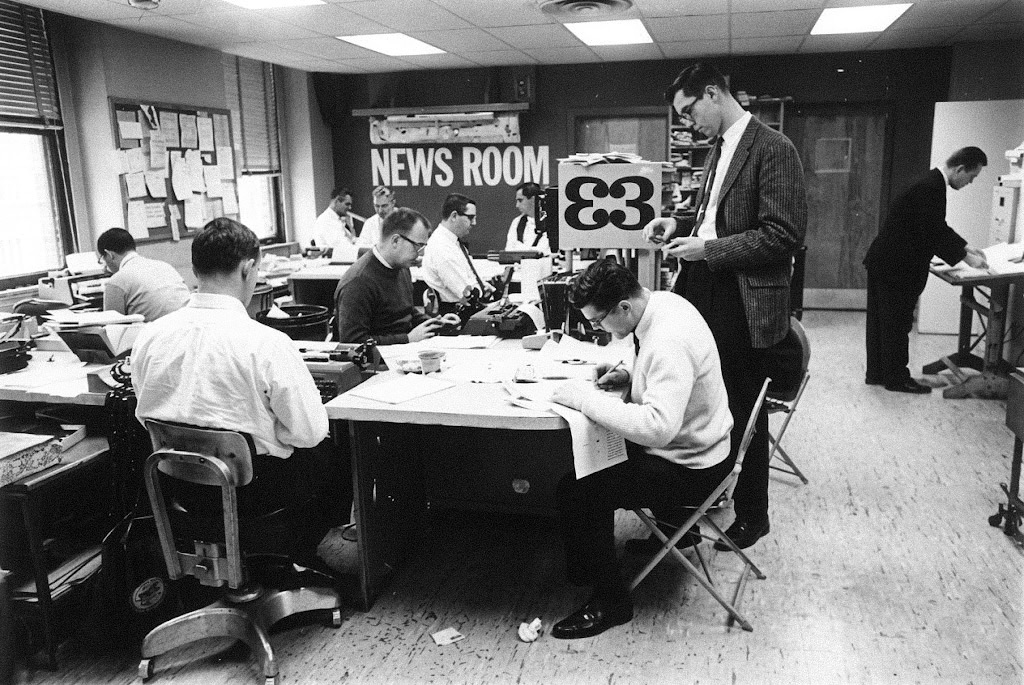
"TV3 Newsroom," Dan Hrvatin, 1962
Former Washington Post editor Ben Bradlee issued a prophetic warning regarding the alarming speed of news generation—and the consequent premature opinion-making of consumers—in his 1996 memoir A Good Life.1 In the years that have elapsed since its publication, the swiftness with which world news is digested has increased at rate unfathomable two decades ago. Bradlee’s news cycle of 1996 was liturgical, and readers’ opinions were formed with greater patience;1 it was inconceivable to read tomorrow’s paper in bed on an electronic device. Because news was slower, feature stories and hard news had a longer shelf life. Computers were cumbersome; the Internet was a fad. Contrast 1996 with today, an era of vast surpluses of e-tablets2 upon which we compulsively consult others’ social media profiles to get a sense of what’s going on in the world. I hold that immediate information and swift news transmission impairs reading habits and is detrimental to quality opinion- and decision-making. It has also allowed us to shallowly steep ourselves in ‘culture’ as we stumble toward the inevitable globalized world.
I concede that technology equips us to pursue a better understanding of world events. However, we—and the political and profit systems to which we belong—are not using this equipment to our full advantage. For instance, comprehensive journalism has yet to mature to the new electronic mediums. Reporters lament the pressures from editors and publishers to design stories which can be broken up into slideshows, or feature captions, to improve page views and advertising revenue. News delivery is being tailored to the aforementioned e-readers—see the promulgation of Internet content on evening news (and even sports) broadcasts—and the manner in which people are reading (not just news, but literary fiction) is changing rapidly. Large paragraphs are discouraged on e-readers. Sadly, consumers of e-media are largely scanners with shortening attention spans. As well, consumers are not roundly enthusiastic about the latest in e-tablet news delivery, as evidenced by the critical debacle of The Daily, Rupert Murdoch’s tablet-only newspaper.3
Who wins? Not newspapers, who are struggling to adapt a broken business model to an e-world. Not manufacturers, who are struggling to slacken Apple’s opiate-like grip on e-consumers. Not consumers, whose actual and world literacy is declining as a result of e-text. We are, in effect, reeling from the impact of fast news. Worse yet, we are not learning our lessons. Harvard professor Henry Louis Gates, an eminent historian, scandalized a police department as he tried to break into his own home. The initial news coverage was abominable in that it was skewed coverage primarily of Gates’ righteous indignation, not objective balanced analysis of the situation.4 (America later, thanks to Andrew Breitbart, suffered a similar imbalance in coverage of the Shirley Sherrod affair.5) Had one only learned of the “break-in” from a friend’s Twitter feed, one would presume that the professor had been racially profiled. This feeling—too new, one hopes, to mature into an opinion—was confirmed by none other than President Obama, who, before consulting the police officer in question, deemed he had “acted stupidly.”6 But Obama’s preface to his judgement of the officer is emblematic of the sort of opinion-making that Bradlee cautioned against: “Now, I don’t know, not having been there and not seeing all the facts…”6 And then we are told—in lieu of ombudsmen criticizing the knee-jerk coverage of the incident—that a few beers at a picnic table on the White House lawn fixes everything.
When Budweiser is the salve to this nation’s racial scars, we’ve already lost.
Internet: The Anti-Culture Mechanism (or, the Bias of Ignorance)
By 2020, the Internet will cease to be a destination, or a salve to boredom. It will (and must) evolve instead into a portal, with access to dimensions of existence (temporal, not supernatural) that we may not presently apprehend. It is evident (see: Jeopardy’s Watson) that we aim to make computers smarter than ourselves for its sheer entertainment value (the classic film “Desk Set” with Hepburn and Tracy establishes, on the contrary, technology’s promise to streamline human operations); and once even the “dumbest” computer eclipses the “smartest” man, technology will have gone farther than men dare. And we will doubtless tune in and laugh like idiots at this, the capitulation of our autonomy.
We are at the behest of the Internet. Oft is the lamentation that our productivity (as people, employees, even as family members) is wholly contingent on the speed of the Internet. A reliable connection is now the litmus test for efficiency. Today, when one is online, s/he is nowhere else. It was sold to us as the “world at our fingertips,” but it turns out that we have confused images of the world for the world. However, the Internet will soon no longer suffice as a frontier. The love affair will, in effect, run its course. Our tolerance for “cool” social media that is actually a publicly traded commodity (Facebook’s destiny) or another 60% eyebrow wax discount at your local spa (the pitfalls of Groupon) will ebb. When it does, there will be an exodus from the Internet, and a scramble to finance that which would save the online “world.” In order to advance, and to inspire us to advance with it, the Internet must not just operate faster—until we can no longer accurately define “fast”—it must radically improve lives. It must make professional, unequivocal diagnoses of people’s ailments, for instance. It must not continue to expand just for its own sake. It is well to ask: how does the Internet mature, or move laterally, or regress? Has the Internet been subject to a proper identity examination? How would it characterize (because it certainly is smart enough to do so) its own virtual identity? History books are rife with instances of idle technologies which, without an aim, are dead-end ventures. Once the steam engine and horseless carriage were perfected (after comprising, during their respective rollouts, a kind of frontier in themselves) folks began to lose fascination in the technology and focused instead on pursuing the limitations that the technology (either expressly or inadvertently) eliminated. I’m not confident the Internet can help us surmount the challenges we face.
It is what is beyond our sight and apprehension that fascinates us. Inevitably the Internet must turn to space and the ocean depths to continue to captivate audiences. Our attention spans will doubtless grow shorter and shorter, and so the Internet must simultaneously improve the depth and the superficiality of its content. What happens, say, if a fit of gardening catches on as a fad? I dispute the Internet’s ability to deal with adversities as complex as a new homestead movement, wherein we become closer to the earth, which, with food cooperatives and farmer’s markets on the rise, is a likely change in the prevailing cultural winds.
While most will likely suggest that we are the cusp of a thrilling era of vision and investment in the Internet, I hold that it is dying and will inevitably fail if it continues, in the next decade, to stay the course of shallow content and fast money.
Journalists as Anti-Culture Standard-Bearers
Literature and media are in a curious place. I’ve studied journalists’ alternating fascination and indifference to our greatest writers, and it’s hard to believe that forty years ago, Robert Lowell was on the cover of Time Magazine, and gossip columns were filled with sordid details about his divorce from Elizabeth Hardwick. And way back to the 1920s, when the Fitzgeralds were tramping about Manhattan with a Lady Gaga-like following. It used to be that the popularity of an author of some promise suggested a shift in larger culture, not just in the narrow purview of the book world. Nowadays, with the advent of the Internet and technology encouraging brevity and economy of words—and perhaps even economy of ideas—journalists are less likely to explore writers as deep people with relevant commentary on world events.
Communications have impacted literature, not the other way around. Literature no longer informs or improves news coverage. We cannot presume any longer that journalists are interested in mining writers for compelling human interest stories. Nor, as the audience has changed, with apathy on the warpath, can we presume that writers are interested in promoting anything except themselves. Out of nowhere, page views became significant. Bloggers were, by virtue of traffic, suddenly touted as the next great American scribblers. The Internet has encouraged young writers to talk cleverly, in short witty repartee, as if they wanted on the Daily Show. We know (from a previous discussion section) that too many of our young people are turning to The Daily Show for their ration of objective political news, but so too is The Daily Show furnishing the young people with hip new books without long shelf-lives, such as Shop Class as Soulcraft (which I have to admit I read at Jon Stewart’s prompting), which is at best the modern-day rehash of Zen and the Art of Motorcycle Maintenance. Online literary weblogs are populated largely with the book reviews that most metropolitan newspapers no longer give any space to. There is a divide between those with works of fiction available exclusively online (full disclosure: I’m one of them) and those who hold to the traditional-publishing-house-as-bosom-and-arbiter-of-good-taste-despite-its-broken-business-model. The divide is alike a civil war in publishing, except nobody knows how to forge ahead. And ultimately the American novel suffers.
How authors communicate is interesting, yes, but subordinate to the content and power of their work. Now it seems that publishing is the message, and that the message is populated with keywords, and adulterated by sociopolitical pressures (see the recent edit job on Mark Twain, wherein racial slurs were omitted, a move whose absurdity is on par with Keith Gessen’s decision to, in one copy of All the Sad Young Literary Men for charity, cross out all references to Harvard and replaced them with Florida State7). If simply putting a book out there is the sole point of writing, then the writing itself becomes irrelevant. Even thinking about this is incredibly distressing.
Conclusion
The young will continue to stand in line for the newest iteration(s) of the fastest, most efficient electronics. The effect of the pursuit and cost of this speed is, ironically, a diminishment of one’s understanding of the world, along with the mechanisms behind the speed itself. Our global world is one in which individuals and institutions communicate rapidly toward ends that stand on constantly shifting ground. Just as the speed of communication may cloud any future concept of “fast,” so too will the quality of our opinions be contingent on well-composed headlines, instead of longer stories with probity. In conclusion, what is disappearing—what has been relegated to the ash-heap of the news liturgy—is the luxury of time we once had to develop informed opinions.
Endnotes
Ben Bradlee. A Good Life. Simon and Schuster, 1996.
Heather Maclean. Smart Gorillas. “Tablet surplus to hit 33 million in 2011.”
Shane Richmond. The Telegraph. “The Daily iPad app review: a complete failure of imagination.”
Boston Globe. July 20, 2009.
Washington Post. “Sherrod vs. Breitbart: Speech Wars.” February 15, 2011.
K. Seelye. New York Times. “Obama Wades Into a Volatile Racial Issue.”
powells.com blog, July 9, 2008.