
2012 Contest
Making Work Visible
City University of New York / Labor Arts
Remington Silent
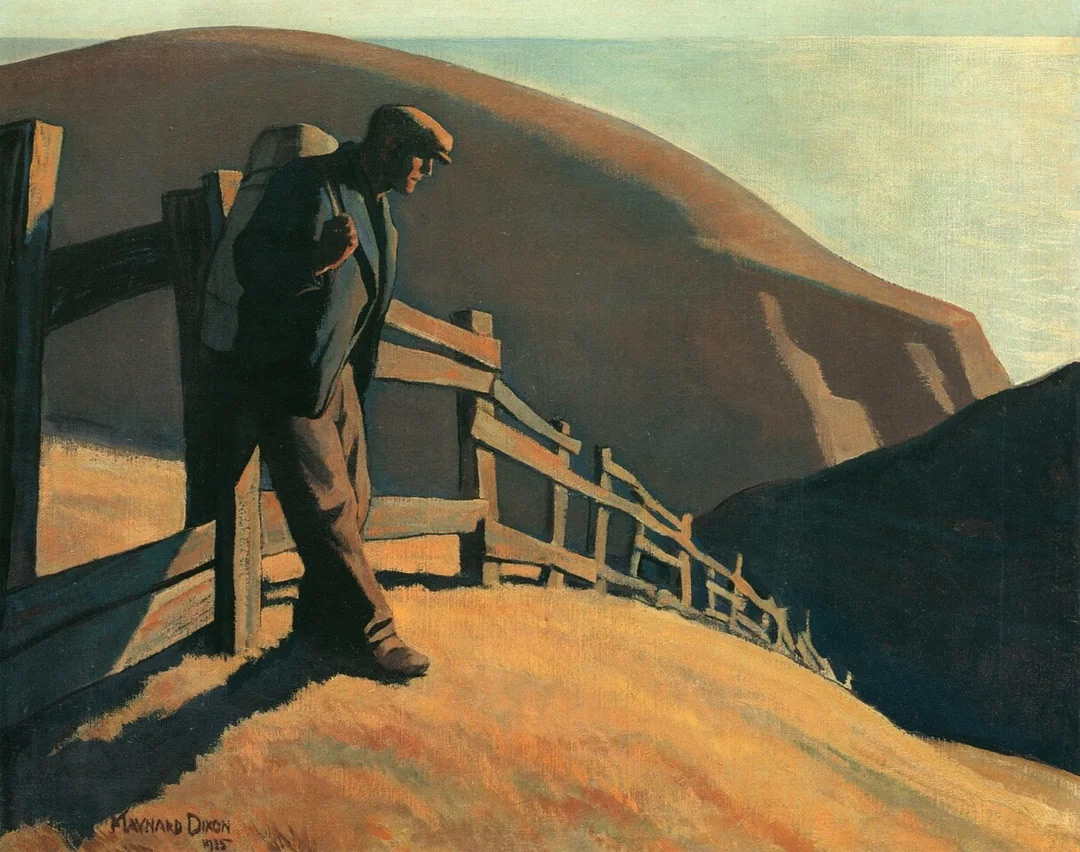
"No Place to Go," 1935, Maynard Dixon
Note: This story is excerpted from a novella of the same name.
Close to the earth, the four of them—four-and-a-half, counting Mirella—wedded to it. A life that is pastoral, freewheeling. Friday nights they fuel up the lanterns and, guzzling Calvados, stumble in the rows, singing. (For our part, we don’t marvel at the stars, because we know what they are, and that we’ll never be among them.) Kerosene. Gaping at the moon and braying. Delia’s hair, unkempt, growing to the middle of her back, long as her daughter’s secondhand dolls’; Stafford’s beard in patches. Liselotte, his betrothed, visiting to relay letters to his parents in Dublin. Loren learning his rhythms on the acoustic steel guitar.
These girls were more motherly than anyone they’d ever known.
Together, they relish the ends of days, the waning light; hands worn, lower backs convulsing, they share the television, the battered paperbacks. Ground rules on the refrigerator that no-one obeys. Coins strewn about the floor, visages of Lincoln. They attend to the chores like peasants, reveling in the backbreak. The dishes are greasy, the coffee cups rims’ from Delia’s gloss.
Armistice Day. In her bunk, Mirella curled beside her—her daughter, tomorrow turning six, learning to bicycle, the convulsions of epic tantrums—Delia listens close to the cadence of Stafford’s footsteps, pacing about in the parlor, loud and postulating. Muffling his curses, for Mirella’s sake. Chain-smoking. His vice grip on oratory: coarse, and coughing to punctuate his points. He and Loren go shooting occasionally in the arroyo that runs behind the house, where the water’s sweet and cool this time of year, trickling. Or, they hunt near the reservoir, jackrabbits congregating under the beached canoes, overturned and rotting, with Stafford’s .22 that’s the same brand, Remington, as Loren’s typewriter—on which he entreats the water authority to please, please send a man out to examine the taps.
Intense, irrational young men, for whom doors always seem to open. They’re farmhands at the conservancy, established last year to buck the trend of fallowing fields, the exodus of yeoman farmers to the Scarsdales, the Lauderdales out east. When this year’s apple yield matured a week late, the boys kept warm in bunks and near bonfires, waiting, then labored for hours unto exhaustion. Fortified by a flask hidden in Loren’s overalls. And, when they were hungry, sneaking several tart ones into their sleeves.
It’s a habit Delia imported from finishing school: from the pace, the gait, the cleat, she can guess with some precision the weight and attitude of the walker in question. (How a man will walk to a lover, for instance: striding, and often on tiptoe.) They took her in two months ago, Loren crushing hard on her, a fondness that has lately cooled. She is just his height, so she can never wear heels when they go out, when they dance. Nor will she tell who Mirella’s father is, much as he implores her to.
Cabot is situated on Highway 278, the historic grade to Chiriaco. Its names are set in its ways—the Rincon Norteno, the Arandas. La Palapa—”a place by the sea.” The grocery, Gerrard’s, with birds nesting in the rafters. Until 1912 it was Cabotville, a Burlington Northern town, dropping the suffix at the magnates’ insistence. While the town has few merits, a lending library, a high water table, it is at least picturesque, outside the reach of trends and, best of all, what is fashionable.
With the bed pushed against the wall she feels less vulnerable, with enough room in the center of the room for Mirella to put her arms out and, if she wishes, twirl. If she wants to be a helicopter, let her. Her mother has stacked Loren’s books around her bed, Wolfe, Breslin, to ward off the malevolent spirits.
Twice a week she bicycles herself home with packages from the bodega, canned food and loaves, with Mirella in tow, pedaling furiously on training wheels that need tightening. She makes the boys thick brown-bag lunches, excessively layered with meat and cheese, the thermoses filled with fresh beer, frothing, or on some days soup, hearty and slicked with butter. If they’re lucky, fresh milk.
Ritually, she staggered down the hallway to kiss them both good-night, Loren first and on the lips, then Stafford behind the ear.
“You smoke too much,” she said. “Try and cut back.”
“I can’t breathe without cigarettes,” Stafford said. It’s how he closed his days—stomping, obliterating the butts into the floor, and collecting into paper bags the bottles they’d emptied for Delia to pedal into town with and redeem. If only Loren had his height. His bravado.
“I saw Joardan in town today,” she said.
In the center of the den are Loren’s boots, a sirocco cactus embroidered up the leg, the soles nailed in and smeared with ash.
“Isn’t that troublesome?” she asked.
“Could be,” Loren said.
“Don’t you think he’ll start something?” she said.
“He won’t dare try,” Stafford said. “Not tomorrow, with all the kids around.”
“Unless he was mounting a gun-rack on his back window,” she said. “But I’m sure it was nothing.”
“Quail are in season,” Stafford said. “The happiest hunting.”
[ II ]
She met Loren three months ago, the middle of his and Stafford’s second week in Cabot. They came as they were—city sophisticates, disaffected by city life—tired of sleeping till noon, carousing no end, walking the promenades of bridges, the morning’s jousting on the subways and trolleys. In August, his interest piqued, Stafford told Loren about a profile of a growers’ conservancy in Cabot, seven hours south and inaccessible by passenger train… that night, after a little deliberation, they bolted in Loren’s Dodge, arriving the next morning at the ranch tousled, unfed, haggard—dressing down, as Cavafy put it, to more effectively beg.
All around, the roads were gravel, pocked by hard weather, disuse. Staggering vistas. River washes, lined with granite boulders and long run dry. Obsolescent farm equipment, idle for decades. The conservancy’s proprietor, Juan Tyler, was forty-seven, Nicaraguan, settled here twenty years and still thickly accented. (To better assimilate, he had taken the surname of a customs agent, and bought language cassettes that inclined him to talk in platitudes.) The boys signed on for a fifty dollar a day stipend, five extra on weekends, and an option to bunk on the premises if they were “keen on farmhanding,” as Tyler put it. Keen. His verbosity, his rotundity endeared him immediately to Loren, whom he called “Lorn”—and later, when he arrived at work one morning hung-over, “Forlorn.” Worse for wine.
At the outset, Tyler let to the boys for two-hundred-a-month a dilapidated shanty crafted out of cob and surplus rail ties, its planked floor torn from the old Air Corps barracks outside of town. It had been vacant for almost a decade—still, there were impressions on the floor where the preceding tenants’ furnishings once were: ornate vases, box-springs, console televisions.
It was not without its drawbacks. The water was brackish. The septic after years of neglect was failing. The circulation was poor. They called it The Ponderosa. With verve in their spare hours they set at makeshift repairs, bailing wire and twine, duct tape, reinforcing the porch and roof where it sagged. Afterwards they would draw a bath and, limbs soaking, tend to tears in the burlap sacks they wore around their waists, for Tyler grew no less than ten acres of strawberries, ten of vineyards, four of alfalfa, four of maize, with the balance halved between apples and pears of experimental lineage, or fallow. And they were to know every inch of it, how it was irrigated, where the problem insects congregated, so forth. Much of the work was unsupervised, though at times Tyler would emerge from under the mulberry (where he, methodically, as if sifting for ore, ground figs and pomegranates for packaging and sale—a business venture that never seemed to pan out) to check their progress on driving the motorized plow he had mortgaged his home to purchase.
“Just touch the brake,” he told Loren. “Whoa, there. Easy.”
“How does one step off it?”
“No stepping. You leap off,” Tyler said.
“It’s dizzying, this work. My body’s not used to the abuse.”
“But soon,” Tyler said. “I see it in your shoulders. You’re filling your shirts, both of you.”
“What’s next,” Stafford said, removing his gloves.
“Spend the next two days razing the vines. ‘Doze them into piles, stakes and all. Watch you don’t run and scrape the bank there.”
“Then what?”
Tyler motioned as if striking a match. “Torch it,” he said. “Don’t worry, the air quality man is miles away.”
[ III ]
Adversaries the first year, inseparables thereafter, seducing the girls in their sessions, leaping the steps of Bancroft two at a time to study hall, buried in Berryman, in Salter, passing the flask between them when the proctors turned away. Confederates. Sometimes, walking, they would even link arms.
In Tyler’s fields, harvesting, Stafford would take the ladder’s top rung, to sit more above his work, so that his hands fell naturally. Whereas Loren liked to reach. It was characteristic of him not to talk about how easily he exhausted, his strains and aches from driving the thresher, scraping the troughs—but he was shirking his chores of late, shut in by the vistas, wondering what Delia Crain was saying to him when she parked next to him at work.
“She parks next to us,” Stafford said. “This jalopy of yours.”
“Junk,” Loren said, kicking the tire. “What was I thinking.”
“I know,” Stafford said. “I know what it was. You were enchanted by its color, where these wheels would carry you.”
“It needs a new filter,” Loren said, running his foot along the floorboard, “some body work. Its days are numbered. I was wary I bought it. I mean, you never know the previous owner’s luck. But Pops was quite certain.”
Loren was, these weeks, tense with the worry, the paranoia, of comporting himself honorably in front of Delia each morning as he punched his and Stafford’s timecards. She collected dues for Tyler, distributing bags of fruit, bindings of celery and homemade wines, the mouths on the bottles waxed shut with an image of Tyler on the label, when he still had his moustache.
The toughest thing, he said to Stafford, was biding his time.
“It’s like this,” Loren said. “She’s collecting for needy families. I go the grocery for diapers, formula, cans of peas. Non-perishables. I drop them off. Slowly, I make the case for myself. What do you think?”
“Okay, but let’s not lose our focus,” Stafford said. “The whole reason for our coming here.”
When the conversation flagged, they discussed world news until, aggrieved, they piled into the Dodge, letting it fire up and warm. (Otherwise the transmission would stick.) Whoever is soberest takes the wheel.
“I hear there’s a new agricultural college going up in Merced,” Loren said, amplifying his voice over the engine.
“You’re thinking of going?”
“Some day, maybe. Go and get some real farming lessons.”
“I know how you can win her,” Stafford said. “Be clever. Ask her if she’d ever consider dating a white man.”
“Only if I can put away my nerves,” Loren said.
“Don’t let your talking do too much of the talking,” Stafford advised. “Tell her with gestures. With your hands. Those eyes.”
Finally he screwed up the courage to ask her over for supper. Beneath her desk were rolls of coins, the week’s revenue, the pleats in her pant-suit. The large accounting ledgers.
She showed that evening a half-hour late, in trousers and a checkered blouse, her hair tied back into braids.
“Stafford thinks all this sunshine is depressing,” Loren said.
“What can I say,” Stafford said. “I like a little cloud cover.”
“Wait until winter sets in,” she said. “It’s even worse.”
The usual at-dinner banter. Weather, politics. Last week’s issue of Metro. The peculiarities of theirs and Delia’s lodging, an apartment across from Arandas, without circulation or sunlight.
“I was irritable an hour ago,” Loren said. “Now, I feel so placid.”
“Your heartstrings are in your stomach,” Delia said.
“We ought to make this a regular thing,” said Loren.
“I have a daughter,” she said, taking up the dishes.
“The more the merrier,” Stafford said. “Hell, you might even want to move in.”
[ IV ]
She had a few bags with her, luggage tied with bungee cords, laundry baskets filled with vinyls, a record collection the size of four estate sales. Mirella, she assured Loren, was quiet ninety percent of the time.
“Not glamorously furnished, I know,” Loren said, flipping on the lights, leaning in the doorsills, narrating. “But there are compensations. The television for amusement, magazines. Here’s your room. The hinges need oiling, but the bed’s good and firm. We really lucked out. We keep our library in here. The electric blanket’s yours.”
“Somehow,” she said, kicking up the rug, “I thought you’d have more books.”
Delia is a fanatic of proportion: the tables at right angles to the lines in the floor, the couches square to the foyer, the placemats just so, the aprons corrected if askew on the pegs. Yet she does several things with inordinate grace. Vacuuming, for one, hinging her wrist, careful to always go under the cord.
What she lacks in intellect she makes up in devotion. It is possible that she does not want Mirella to grow up with the misfortune of poetry. The child is something of a bore, expressionless, bereft of joy. Her teeth are finally starting to come in, her eyes are a little offset, and one nostril is larger than the other. Impertinent, she cheats on the playground—she boasts about it—and steals crayons from class, chalk, glue tins, laying out the plunder on the dinner table and applauding herself, little leaps and claps. Delia’s quite attentive to her, maddeningly conscious of the girl’s posture and maudlin when her mood is low.
Accustomed as they are to one another’s moods—Stafford’s emotional variances, the invisible friends Mirella will bring in like strays, Loren’s vast clear-liquor thirst—Delia cannot overcome her daughter’s aversion to Liselotte on her visits—envy, even at Mirella’s age—evening the score by sidling up against Stafford, plopped on his stomach and squealing.
Every other weekend she will load up her parents’ towncar and, intoxicated by speed, make the five-hour trip in four. Delia has made overtures to befriend her, but Lise is only concerned, it seems, with her wounds and those of her loved ones’: her thin wrists, her brothers’ broken bones. Her wardrobe’s fit for an heiress—in Lafayette she often considered locking her garments in a safe, she prized them so. Stafford’s parents favored her over all other comers, for her table manners and looting of jewelry boxes for evenings out. Still, she’s quite unkempt. Her maxim was to clean her teeth after every meal, and, because she had once punctured a tire on the Interstate, to drive only in daylight.
Defiant of the telephone, her letters, edifying, have overtures, entr’actes—a few flattering words, a wad of $40, forty-seven cents of excess postage. Always she ends them with, “Loaves and fishes, Lise…”
I can hardly stand it, she wrote, this remote, in absentia loving of you. It’s as if nothing good came of your leaving—or nothing but good, because I feel at each visit the old easiness with you—a letting down of my guard, a loosening of my tongue—and then, seeing my weakness for you, in true fashion you pounce.
“Your spelling is much better,” Stafford said between swallows of shredded wheat. “Much improved. But what did the first part of this letter say? The part that you scratched out? I feel like that’s against the rules.”
In the interests of transparency Stafford will share with her excerpts from his—written on Loren’s Remington, its irreparably stuck keys—so she is prepared when her in-laws-to-be pepper her with questions (“Is he in good spirits? Is he keeping his weight up?”), sections such as:
Pa, you’d get a kick out of these mountains—puncturing the sky—how blue it is here—the sunsets are like a poke in the eye with a pencil.
I appreciate your concern for my welfare, and your offer to finance my travels, but I haven’t the faintest notion of when I’ll return, and I’ve sworn off international travel entirely.
Dusk. The boys are in their flannel, institutional wear, slouching in lawn-chairs, eventually rising to assemble Mirella’s tetherball set, a gift of Tyler’s. The transistor’s on, broken crates about them, makeshift ottomans, drinking framboise, sangria, of fruit which they themselves had picked, in the hides of wineskins which Delia skinned and dried, back along the easement where the fencing runs on and on.
“What are these?” Loren asked.
“Gifts from the union men,” said Tyler. “One for each man I employ. They put them in small stockings, gold dollar coins for the workers, cubes of charcoal for the growers.”
“Clever,” Stafford said. “Is it just to antagonize you?”
“Everyone thinks I had something to do with the Joardan place going under.”
“You never told us,”