
2012 Contest
Making Work Visible
City University of New York / Labor Arts

Overworked and Underpaid
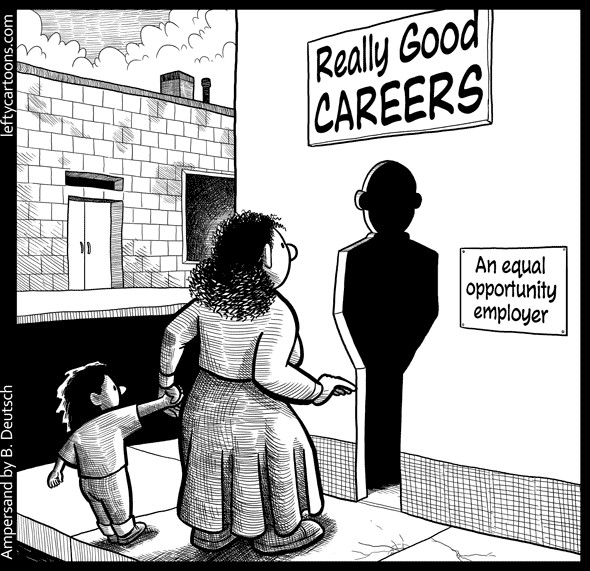
"Really Good Careers," Ampersand by B. Deutsch
Growing up my mother, a single parent of three children, continuously struggled to put a roof over mine and my brother’s heads. She worked long hours, and juggled two jobs. My brother’s and I always wore hand me down clothes, used food stamps to buy milk and bread and holidays weren’t as fruitful for us as it was for our friends. I never understood why it was so hard for my mother to provide for us; she was a beautiful woman with a good heart and just as hard working as people who were financially stable.
It wasn’t until I had my first job, that I realized just how unfairly my paychecks by no means reflected my hard work. Through reading, Changing Contours of Work: Jobs and Opportunities in the New Economy by Stephen Sweet and Peter Meiksins, I was able to gain more knowledge as why the work force isn’t as “fair” as employees would like it to be. Employees are often overworked and underpaid, the way I have been throughout my work history. There were many words in this book that I could relate to pertaining to my past and my present work experience.
I began working at the age of 16 years old to gain experience, responsibilities and financially contribute to the expenses my later high school years required my mother to pay. If I wanted a car, a high school yearbook, a dress for prom etc. I had to come up with the money because my mother was not financially able to do so. I went into a local fast food restaurant called Rally’s to apply for part-time work. I worked approximately 20 hours week for $7.25 on top of going to school full-time, participating in afterschool activities such as Volleyball, Softball, the National Honor Society, the Yearbook Club, the History Club and the Beta Club. In our culture, it is our role to juggle the many responsibilities that we hold as well as work hard for little pay.
According to Sweet and Meiksins, Frederick Winslow Taylor introduced this managerial philosophy, also known as Taylorism, at the beginning of the 20th century to increase the productivity of workers laboring in factories. What Taylor did was place “thought” behind laboring in the hands of managers and employees were only required to execute the manager’s instructions. Taylorism was designed to “increase worker speed and accuracy,” (9). This has remained in the job atmosphere and has become the main structure that many employers follow.
In my first job, Rally’s, I was only to follow the instructions given by my supervisor and/or manager. The position I was working that day such as cashier, food prep, grill etc. was delegated by the supervisor and/or manager on duty. The manager had complete control over the responsibilities that the employees were given to perform. The managers also kept close eye to ensure that you were producing efficiently. I worked at a very busy fast food restaurant so we were constantly being supervised to guarantee we were making the orders correctly, getting the orders out is a timely manner and keeping our area of work neat and stocked.
At the end of the shift, it was our manager’s job to check that we did our closing duties properly. They investigated to make sure we stocked the ketchup, pickles, cups, cleaned out the food prep areas etc. If we were the cashier for the day, the manager counted our drawer to see that all money was accounted for. It was their job to make sure that as employees we did the job that was expected of us to do. Taylorism implies that a worker is not necessarily capable of being efficient so they need someone who has knowledge to supervise them and this will guarantee that the job is done correctly.
With the enforcement of Taylorism, the consequential aftermath is Alienation. Alienation is the process where an employee loses control of labor. Work for an employee becomes meaningless and they are powerless. Taylorism takes away the voice of an employee meaning that we no longer have free will in our place of employment; we are told what to do and when to do it. Alienation is the feeling employees are left with because we have no control over our day to day responsibilities in our place of employment.
At Rally’s I was never given an option on the duties that I was assigned. Every day I was told what position I was working and how efficient I needed to be based on the pace of business. I specifically loved being in the cashier position. I enjoyed interacting with customers and it made me a much happier person at the end of the shift. However I was very good a preparing orders. I was able to get an entire order out to the window in two minutes and this was a skill that my managers often took advantage of. I hated being in the back of the restaurant having no interaction with the outside world and standing next to a hot grill. I was completely powerless over my day to day work and this alienated me from being able to enjoy my day at work.
My job at Rally’s also became very meaningless. It was never a job that I imagined myself progressing in. Most of the managers in this particular restaurant only moved up in position because they were all related in some way. It only became a job that I maintained to guarantee that I would be able to pay for my car insurance and other expenses I had acquired. I went to work every day anxious for the work day to end so that I could leave and enjoy my time with friends. Rally’s was not a job I found satisfaction in; I only worked to receive a paycheck and this alienated me from the productivity of the product and the enjoyment of working with fellow employees.
Having a meaningless job can also stem from not being paid for the amount of work you put into the company. I am currently working as a Hostess in Hard Rock Café Times Square, an increasingly high volume restaurant right in the heart of Manhattan. I give a 100% every time I am on the clock simply because of the high volume and my need to commit completely to any task I perform. I am often exploited in this restaurant, just as I was when working in Rally’s. Exploitation is simply being over worked and not having your pay reflect the responsibilities you have as an employee. Throughout Sweet and Meiksins book, they describe how employees are overworked and underpaid.
I worked at Rally’s for two years, worked every position in the restaurant, passed all “secret shoppers” with 100% scores, always on time, went above and beyond to ensure teamwork and only received a twenty five cent raise. I was making $7.25 when leaving Rally’s and believed that I did just as much work, if not more, than the supervisors and managers in the restaurant. Even though I was in school, I worked long hours and was always dependable. I was very diligent and never the appreciation never reflected in my paycheck.
Hard Rock has become another place of employment where I have been exploited. I had been working at Hard Rock for three years and on each evaluation, I was never given a raise. I was constantly going above and beyond and became very effective at maintaining the entire flow of the restaurant. It is a very high volume restaurant and we often encounter wait times of two hours. It is a restaurant that seats over 600 people and a kitchen only sufficient enough for half that amount.
Hard Rock has a position what is called “Host Rocker,” this is a position also known as a shift leader. The Rocker is responsible for overseeing the entire shift, ensuring the hosts are doing the duties they are assigned, delegated break times, and most importantly keeping the flow of the restaurant and keeping the managers satisfied. Each shift has Rocker and you are obviously given more responsibility than the other host. On a Sunday I came in to check my schedule and under my name it had said I was scheduled as a Rocker. I was a bit confused. I never agreed to this position and more importantly I was given more work but for the same pay. I approached the managers about this and they said “You should be feel lucky, we gave you the position because we know you are capable of doing it, now let’s see if you deserve a raise.” I was beyond furious and more importantly I felt exploited. I had the “ability” to be given the position but yet I didn’t deserve the pay increase that should have coincided with the higher position.
In Sweet and Meiksins text, they use a term called work-poor. According to Sweet and Meiksins, a work-poor labor force is one that lacks sufficient work opportunities and compensation and compels some workers to perform the jobs of two workers (151). By working at Hard Rock, I fit very well into this definition of “work-poor.” In a normal 6 hour shift at the Hard Rock, I often do the job of several employees. I have become a very dependable worker according to my managers. When I am on the shift the managers have gained confidence in me and this results in them slacking off on their duties as managers. On many shifts, I take control of the floor informing host that they can leave early or when to eliminate certain sections of the restaurant if we become slow. I also am very capable of handling guest who are unsatisfied, changing their orders in the kitchen, calming them down if they are getting out of control; these are all duties of the manager.
I have taken on the many duties of a manager in my restaurant however my paycheck still remains the same and I am unable to receive the full-time hours I am qualified to work. The term work-poor addresses the problem that workers aren’t given enough time at their jobs to work. They are faced with increased responsibilities in a short period of work hours. Despite their capability of working more and receiving more money they aren’t given the opportunity to be beneficial to a company. Hard Rock will even write an employee up if they go into over-time and will only schedule an employee no more than three shifts a week. An employee will only get extra shifts if they are given one by another employee and they have to take into consideration that they must not go into over-time or they will be penalized.
My social, family and work life today is arranged by the hours, days, weeks etc. Every hour of mine is accounted for. Sweet and Meiksins addressed a term called time-oriented labor. According to the text, time-oriented labor led to the development of hourly wages and shift work and reoriented the rhythms of work and family lives around clocks and calendars (142). This has become the culture of our society. Our day to day routines and time spent with others is all according to time-oriented labor. I am given a particular wage by the hour. I know that if I work thirty hours a week and with my pay of $12 an hour, I will receive approximately $360 a week. I am able to calculate a general idea of what my paycheck will look like based on how many hours I worked that week. If I need $400 for the week and I was only scheduled thirty hours, I will need to pick up an extra shift from another host. Time-oriented labor gave employers the opportunity to clearly determine what hours we will and how much we will get paid.
Our lives often revolve around our work schedule. We know to schedule social encounters, school, doctor appointments, trips to the grocery store, and even when to sleep all around the times we are scheduled to work. At the beginning of the semester, I knew that I could only register for classes around my work schedule. The lack of employers willingness to be flexible forced me to arrange my class schedule around work. The days that I do work I knew to schedule my classes according to the time it takes me to commute to school after leaving work at 5pm.
My work schedule also plays a big part in the time I am able to spend with my daughter. The days that I am working late, I lose valuable time with her however it is not something I have much control over. I am forced to work to financially support her by myself despite my desire to spend as much free time with her as possible. Due to time-oriented labor, I am forced to schedule her ballet classes and other activities around my work schedule. Time-oriented labor has its pros and cons; I am able to map out the days and times of work however I know that if I want a more fruitful paycheck, I need to work longer hours.
The two terms that fascinated me the most in Sweet and Meiksins text, were human capital and social capital. The human capital theory which is a perspective that focuses on the value of the skills different employees apply to their jobs (98). It is about “what you know” that will determine your worth as an employee and will earn you higher wages and possibly give you opportunity to move up in a company. I picked this term because I am unhappy with the fact that my place of employment finds no value or appreciation in the employee despite their contribution.
As I have explained, I am very knowledgeable and capable of doing the work of a manager. I have worked with this company for five years and have received a dollar raise. I take on the job responsibilities of many others including busing tables, preparing food, assisting guest, cleaning duties etc. During the busiest times of the years, my managers can count on me to keep the restaurant full, keep the kitchen from being too overloaded with food orders, and making sure the other employees in my division are doing their job. However I still continue to get paid the same rate that other employees who aren’t capable of the responsibilities that I am given to perform.
I apply this term to my work experience in a sense that my company lacks the value of human capital. You are exploited and alienated despite your resource of human capital. I have expressed with the company numerous times that I want to be considered for the manager position. I am constantly given the runaround and told to pretty much jump through hoops to even be considered. Even though I have obtained, human capital, the skills and experience to become a manager, I lack the social capital resource that could give me the opportunity for upward mobility.
According to Sweet and Meiksins, social capital is all about “who you know,” and social connections to wealth and opportunity are important to the process of getting a job and moving up in the labor market. In my case my lack of the resource social capital is what is keeping from moving up in the company. It isn’t about the skills and experience that I have obtained throughout the five years at Hard Rock; it is the fact that I don’t “brown nose” the men in the corporate office.
Each of the managers in my company have all come from the corporate restaurant in Orlando, Florida. They have all worked closely with the men in the corporate office and that is why they were given the opportunity to become managers of the busiest Hard Rock Café in the world. Despite the fact that my managers know how hard I work, they are unable to put in a good word for me because the men in corporate could care less about a host wanting to obtain upward mobility. Their employees are not seen as real people just workers. Hard Rock Café does offer great upward mobility and other opportunities such as traveling around the world however your social capital is imperative to receiving these opportunities.
For every worker we believe that we are entitled to receive particular benefits simply because we work hard for them. Sweet and Meiksins address a term called entitlements which are “rights and resources available to all citizens independent of attachment to the labor force,” (122). These entitlements can include unemployment, sickness, family leave, child care etc. Unfortunately, my company lacks to the opportunity to meet the requirements of particular entitlements. In order to receive things such as vacation time, sick days, and even insurance, you are required to work a minimum of thirty hours a week. How can you get these entitlements when your job is a work-poor labor force?
My job doesn’t schedule workers for more than twenty-five hours a week; any additional hours are based upon if you can get a shift from another employer. However everyone is in need of the money so picking up a shift from someone else becomes very difficult. If you don’t work more than thirty hours a week, you lose out on the entitlements you should receive as an employee. It is as if they say “sure we give them entitlements however let’s make it as difficult as possible for them to receive these entitlements.”
In my short period of only nine years of employment, I have become greatly appreciative for the hard work my mother put in just to keep food on the table. I often wondered why it was so hard for her to provide but I see now the barriers people face in the labor force. We are not all given the same opportunity to get paid more. We are often overworked and underpaid and unfortunately my mother was a victim to this. My mother lacked beneficial resources such as human and social capital mostly because she did not advance her education. I work hard every day as a single mother to ensure that I obtain the knowledge and experience that is essential for my daughter to have a better life.
Works Cited
Sweet, Stephen and Meiksins, Peter. Changing Contours of Work: Jobs and Opportunities in the New Economy. Pine Forge, 2007.