
2012 Contest
Making Work Visible
City University of New York / Labor Arts
The Brooklyn Trolley Strike of 1895
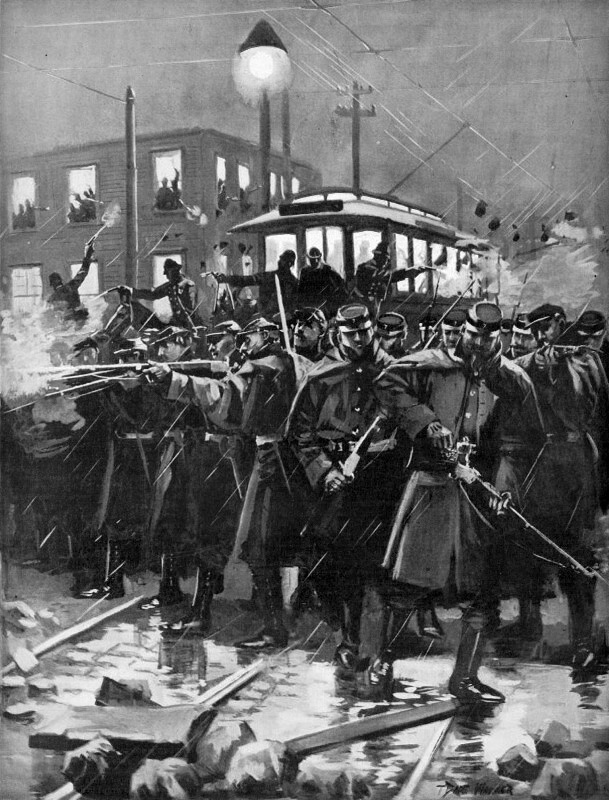
The Strike in Brooklyn—Firing at the Mob," T. Dart Walker, originally published in Harper's Weekly in February 1895.
The Brooklyn Trolley Strike of 1895 was no ordinary strike and concerned no ordinary group of workers. It began on January 14, 1895 when 5000 men walked off their jobs at four separately owned trolley companies, and ended on February 24, 1895. As stated by the committee investigating the causes of the strike, “It was a culmination of negotiations that had been going on between employer and employee for a period of eight years.” The strike was not rashly brought about by a small group of disorganized workers. Rather, the seeds for the strike had been brewing for some time and when the organized union workers (most from the Knights of Labor) walked off, “… operation of the surface railroads… more or less [was] completely paralyzed.” While workers went without pay for the duration of the strike and lost about $350,000 collectively during the period, the railroad companies attempted to ease their own financial pain by advertising for replacements or “scabs” in cities such as Brooklyn, Boston, Pittsburgh, Philadelphia, and Chicago, as well as others. According to the investigating committee, “… as a result, the railroad companies were able to entirely reorganize their working staffs [for after the strike]… “1
While actions familiar to most American strikes took place in Brooklyn, including violence on the part of the workers, police, and militia, and employers attempting to find replacement workers, this again was no ordinary strike. It involved different levels of workers, all of whom came together under one uniformed union name. All decided to use the strike, albeit for different reasons, against four different companies.2 This essay will not only examine the causes of the strike and the actions involved by examining the investigative committee’s report, but will also place the strike in the context of the greater industrial landscape and economy of the country in the last decades of the 19th century in order to gain a better understanding about the positions of both workers and company owners when the strike occurred.
In analyzing this strike, it is first important to understand how it took place and why. Such was the task of the Special Committee Appointed to Investigate the Causes of the Strike of the Surface Railroads in the City of Brooklyn, led by Assemblymen Friday, Donnelly, Tuttle, Stanchfield, and Smith. These men were charged with interviewing different people who were involved in any way with the Brooklyn Trolley Strike, and through these hearings attempted to figure out exactly what the circumstances were that led up to the strike, how it proceeded, and what allowed it to end. The most concise, though hardly detailed summation of how the ordeal began was given to the committee by Andrew Best, one of the executive board members of Brooklyn’s 75th District Assembly of the Knights of Labor (which was the union organization representing most of the trolley workers, but not all, as will be explained later). Best argued that the workers had agreed upon conditions of wages and hours of work, these proposals were given to the different companies, and the companies refused many of the important points. When asked whether all of the men generally desired the strike, he replied that “about 98 percent of all men voted in favor of it.” While so many workers supported going on strike, they did not all have the same reasons for wanting it.3
Before getting into the specific demands of the workers and the opposing arguments of the company owners, and the events that occurred during the strike, it is important to understand a little about the people who operated the trolleys. In Trolley Wars, Scott Molloy describes some of the workers who operated trolleys in post-Civil War Rhode Island. One such worker, Benjamin R. Jepson, had worked for 55 years on the Union Railroad line which passed by his home twenty times a day. On the day he retired in 1927, “… he inadvertently showed up for work, unable to break the habit of a lifetime.” There were thousands of workers like Jepson, who had worked on trolley lines their entire lives and who felt a sense of loyalty to their jobs. One reason for this was that compared to other workers, they were well off. According to Molloy, their “status and salary nudged them ahead of others on the working-class circuit.” Trolley workers were often called “Knights of the Road” in the press, and “were [considered] urban aristocrats in a nation of laborers, farmers, and mill hands.” Not only were these workers better paid and more respected than their peers, but they were also such an important part of the city’s everyday life that any vacation they took would be reported by the local newspapers.4
The Brooklyn Trolley Strike of 1895 occurred during a terrible economic time that not even the slightly better-off trolley workers could avoid. The effects of the Panic of 1893 were still being felt in 1895, and workers were struggling to make ends meet. During December 1893, the President of the American Federation of Labor, Samuel Gompers, figured that there were about 3 million workers unemployed and millions more facing reduced work and wages. He blamed the panic on “production… faster, greater… the thought and motive of the capitalist class,” and claimed that no heed was given to the workers’ long-held demands for shorter working hours. Had employers listened to them, he argued, “it is safe to say that the Panic of 1893 would have been averted, deferred, and certainly less intense.”5 Whatever the cause of this economic depression, its effects were felt across the nation. Governor Flower of New York, talking at the state fair in 1893 claimed that “it is hard to realize that in other parts of our state men and women, deprived of work, see destitution and misery confronting them… This is one of the results of our recent panic. Its effects on the rich are bad enough… But… they… are not to be compared to the effects upon the thousands of persons who have been thrown out of employment… ” Because of this destitution, workers felt compelled to fight for shorter working hours and better wages in order to feed their families.6
Although the working class took the sharpest hit during the Panic of 1893, as Governor Flower had argued, the rich were also affected. While American workers struggled through unemployment, the “wealthy” owners hardly felt secured. According to Melvyn Dubovsky, “Industrialists… scarcely felt omnipotent [during this turbulent time]. The same technological and economic forces that vexed workers, also perplexed employers.” Deciding how much to invest in infrastructure that was always evolving and improving was one such challenge. Figuring out the “proper” pay for workers (one which must be low enough to still make a profit and quell workers’ anger at the same time) amid growing labor unionization was another such problem. Furthermore, the depressions from the 1870s to the 1890s, in which millions of workers’ jobs were lost, “brought business failure to thousands of enterprises.” To say that large business owners had reveled in workers losing jobs would be completely wrong. They suffered economically alongside the working class, and indeed had to find ways to cut costs in order to compete and stay afloat in the market economy.7
Not only did the owners of the four trolley companies have to deal with the economic downturn of the 1890s, but they also had to contend with governmental interference. Trolley companies around the country not only had to provide their customers with reliable and cheap service to beat the competition, but they were also under immense pressure from city governments to keep prices at a certain level. If they did not run their businesses according to government dictates, their leases might not be renewed. In Detroit, for instance, a franchise held by the Detroit Citizens’ Street Railway Company expired in January of 1894. After litigation concerning the legality of a local government deciding on franchising issues of railway lines, the court found in favor of the city. The old company attempted to renew its franchise, but was unable to meet the financial terms of the city, and the franchise was given to a new company. The Detroit government issued certain guidelines for the new company, including rules that limited fare prices to five cents and put limitations on the rate of ticket sales.8 Such limitations and leasing control were not uncommon throughout the rest of the country. In Ohio for instance, a law was passed that stated, “Street railway franchises in Ohio can only be granted for twenty-five years… ” Such a limitation did not exist for most other businesses, and therefore owners of the railways were working under a huge disadvantage.9
Almost every action that the railway companies took had to meet either the approval of the people or the government, and oftentimes both. Another example of this pressure by the government can be seen specifically in Cleveland where, “The city in its early grants to two of the lines had reserved the right to regulate fares, and almost everyone supposed that it still retained this right.”10 Had workers wanted fewer working hours and higher wages, they might have more aptly taken up their anger (and strike) against the governments that placed barriers upon railway companies in actually giving into these demands. In not agreeing to the terms of the Brooklyn trolley workers, the four companies were not just acting greedily to make as much as they could. Again, they were under tremendous pressure from the government to keep prices low, and if they wanted to keep or extend their leases, not to mention profits, they could not afford to acquiesce to all of the workers demands.
Now that we have analyzed the struggles that workers and owners faced at the time, it is time to examine the exact differences that existed between employee and employer which caused the strike. As previously mentioned, the workers from the four companies had different reasons for calling for strike. The workers of the Brooklyn City Railroad Company, specifically, voted for the strike because they disagreed with management over the details of how many hours they must work each day. According to the investigating committee, in previous contracts such as the one that had been valid in 1894, “It had always been understood that a 10-hours day’s work meant 10 hours work while the cars were actually in motion,” and “shall not include any other time, such as stand time [and] meal time.” However, the workers’ demand for the next contract was that their stand time (waiting to be deployed for work) and meal time should be included in the ten hours that they worked. In other words, the workers believed it was fair to be paid for the time they were waiting to be sent to work, and for their lunch breaks, like workers at other types of jobs were. No longer did they want, for instance, to be at their jobs for ten hours, only to be paid for nine because their meal time and stand time had been deducted from those hours of work. The President of the company, Mr. Lewis, would not accept this and believed that “free” time should not be counted as work time.11
The issue that caused the workers of the Atlantic Avenue Railroad Company to call for a strike was the wage proportion and running proportion of regular to tripper cars. Regular cars were trolleys that ran throughout the day, while tripper cars ran at the discretion of the company. While regular cars had a set amount of trips and hours allocated to them (each day), and the workers on these cars earned more money, tripper cars were used at intermittent times and the salaries of these workers depended on how often their cars ran. When there was great demand in some part of the city for more trolleys, than the tripper cars would run more often. However, if this demand decreased, then the tripper cars would not be sent out as frequently. As with most strikes, the workers wanted higher wages for those who worked on both types of cars. However, they demanded something else that proved to be a sticking point to management also. Since the workers on regular cars earned higher wages than those working on tripper cars, all of the workers wanted a greater proportion of regular to tripper cars to be run everyday, so they would have a better chance at being placed on one of the regular cars. This would give all workers an opportunity to make more money, and they therefore demanded that the proportion should be ¾ to ¼ of regular to tripper cars respectively. President Norton, of the Atlantic Company, rejected such demands and deemed it “an abandonment… of the rights of the company to maintain and control and operate its own properties in its own way.” Not only did workers at these companies want fewer hours and more pay (like had been demanded by most labor unions at the time), but many wanted a direct say in how their companies were being run and how company property should be used. Such a demand can be deemed unique (at least for most company owners who never experienced many demands beyond higher pay and less hours), in an unusual and unordinary strike.12 This demand, however, for workers to have a say in how their companies operated did not come out of thin air. Samuel Gompers, former president of the American Federation of Labor, argued that workers had a right to some control in terms of how their places of employment handled business. He believed that, “a wage-worker has some property rights in his employment [because] he has contributed towards the production, or the value of the product… [and that] wages [therefore are] never full payment for work performed.” The worker-employer relationship had changed or needed to change, as Gompers’ argument shows, because no longer was a simple paycheck enough (even one in which the workers won through strikes) to quell the desire of workers to play a larger role in the companies they worked for.13
The President of the Brooklyn, Queens County and Suburban Railroad Company, Mr. Wicker, objected to both the hours issue and the proportion of regular to tripper car issue. However, it was the latter demand that really gave him much pause about coming to any type of agreement with the workers. According to Mr. Wicker, testifying before the investigative committee, had this demand of ¾ to ¼ been followed, “It would have crowded the streets with an unnecessary number of cars during the day when there was little demand for such service, and it would have increased [the company] expenses very materially.” Not only would the workers be given too much control over company policy, like Mr. Norton had argued, but such a change in proportion would have cost the companies money that they could not afford to spend in such horrible economic times. Wicker later agreed to give into the rest of the worker demands, once they came to an agreement of 2/3 regular cars to 1/3 tripper cars, and this specific strike would have ended, according to Wicker, had the striking workers not demanded their jobs back.14 The issue of workers getting their jobs back (in the mind of any outside observer), is one that would seem to have been more anger and resentment based (on the part of Wicker) than anything else. When workers strike it is reasonable to assume, that the owner would be enraged and would not want to give them their jobs back. Rather, according to Wicker, the decision to not bring these old workers back was based on sheer statistics and proper business management. He claimed that in order to get his company’s line of service running again during the strike, his company had hired about 150 new workers. When the proposal to end the strike was sent by Wicker to the Knights of Labor for approval, Wicker claimed that it detailed a plan to keep about 100 of the new workers. If the union would accept to allow these new workers to take about 100 of the old workers’ jobs, then the strike would have been settled. Mr. Connolly, Master Workman, and the presiding officer of District Assembly of the Knights of Labor reported back, according to Wicker that, “he could not accept that condition [of allowing old workers to be replaced and] that all his men must go back or none.” The contract was then given to the new workers, and they agreed to it while the union strike continued on.15
Had only workers in these three companies gone on strike, the strike would not have been totally unusual because they were only stuck on the three main issues of hours, regular and tripper car proportions, and wages. However, when workers of the Brooklyn City and Newton Company entered the strike, their issues complicated the strike and gave it a unique twist. The workers from the Brooklyn City and Newton Company had yet to reach an agreement over certain issues and when the strike started were not members of the Knights of Labor like the workers from the other three companies. According to the investigating committee, the workers from this company “went out sympathetically pending the negotiations for a contract for the year 1895, which had not been concluded.”16 The idea of a sympathetic strike was something that many union officials around the country supported at the time, and according to David Montgomery in Workers’ Control in America, “the practice of sympathetic strikes was actually defended by the AFL in the 1890s.” Even at the AFL’s 1895 convention the executive council was told not to “tie themselves up with contracts so that they cannot help each other when able.” Furthermore, Eugene Debs, president of the Industrial Workers of the World had called such sympathy strikes a “Christ-like virtue.”17 While the workers of the Brooklyn City and Newton Company could find support from many union leaders and workers at the time for leaving their jobs and striking sympathetically with their fellow Brooklyn trolley workers from other companies, these workers still had issues that needed to be worked out. The main sticking point between the Brooklyn City and Newton Company workers and the company was over wages. Brooklyn City and Newton Company workers had demanded to be paid by the day, while the president of the company, Mr. Partridge, argued that “the system of paying by the day was unfair,” because workers might work different amounts of hours each day and accordingly had, “proposed an arrangement by which [the workers] would be paid in proportion of the number of miles run.” Partridge argued that he had tried to convince workers that they would end up receiving more money if they accepted his proposal. The proposal was not fully accepted by all of the old workers, because some feared that if they were paid in proportion to the miles they ran, then on certain days (when there was less need for trolley service) they would not receive ample pay for being at their jobs. Three days after the strike had begun, the Brooklyn City and Newton lines were running again with a combination of new and old workers.18
Although this was no ordinary strike, involving neither ordinary workers, nor ordinary issues, and occurred during a uniquely horrible economic time in which both workers and employers suffered, Brooklyn’s experience included certain standard elements of strikes. One element was violence on the part of both the strikers and the police and militia. As with most other points regarding the causes and actions of the strike, people on each side told very different stories about the violence that took place. James Connelly, intimately involved in the negotiation process as a representative of the Knights of Labor, argued that he saw violence and crimes, “committed by the militia and the police department,” but no one else. He claimed that he had direct knowledge of a situation in which, “the police entered one of the meeting places… and while the [strikers] were sitting there peaceably reading their papers… the police went in and clubbed them.” When asked by the investigating committee whether such acts of violence had intensified and prolonged the strike, Connelly answered, that he did not know, but knew of none large-scale acts of violence, “prior to the militia coming into the city.” Connelly’s story, one given by a prominent union-man, was dispelled entirely by members of the police and militia, some of whom had their own take of the violence during the strike.19
In addition to keeping strikers in line, the police were in charge of safely reopening the trolley lines quickly. According to Leonard Wells, Brooklyn Commissioner of Police, for example, many lines had been successfully reopened almost immediately after the strike began (within the same day in some cases). To get these lines moving, one or two police were put onto each car, and at the terminals, to preserve order. According to Wells, “obstruction of the track and… throwing missiles at the cars and, in some cases, assaulting new motormen and conductors,” made the stationing of police on the trolleys necessary. He also claimed to have seen many trolley cars with broken windows and large gatherings at various locations throughout the city. He estimated that he had seen a crowd of about 5,000 to 10,000 men gathered in East New York alone. While police were worn thin with only about 1000–1100 officers available in Brooklyn, Wells claimed that it was “absolutely necessary” for the militia to be sent to Brooklyn in order to protect the trolleys from further damage and make sure that the picketers were kept in order. He argued that as long as “cars were attacked, imperiling the safety of the public, and the peaceful travel of the public,” the intervention of the police and militia was absolutely vital. Had the workers’ riots really not been large or dangerous, then it would seem unlikely for the Commissioner of Police, someone who most likely takes great pride in his line of duty and in his men’s work, to support being joined and at times supplanted by the militia. Undoubtedly, a man in the position of Commissioner Wells would have been more apt to attempt to quell workers’ violence on his own with his own men in order to gain notoriety and support in the city, if it was at all possible for him to do so without the militia coming in. Obviously, this was not the case as the scale of worker violence must have been too large, and the militia was needed. Finally, as any “good” member of the police force would do, he denied knowing anything about Mr. Connelly’s claim that the police had acted violently to the strikers during peaceful meetings.20
While it may be reasonable to assume that the militia and the strikers shared no personal or “special” bond as employees of the same city, the same cannot be said for the relationship between the police and the strikers. As employees of a city in which they were both relatively ranked higher on the working class social ladder and who oftentimes socialized together, the police and the strikers felt a mutual understanding of each other’s problems. Therefore, it comes as no surprise that according to the Superintendent of police, Patrick Campbell, the police were sympathetic to the workers “to some extent… in not protecting the conductors and drivers of motormen who were on the cars,” and he believed that such actions “must have been [caused by] personal sympathy.” Some of the police officers were accused of neglecting their duties (although the actual number cannot be known) and about 25 of them were tried in court by the commissioner.21 Not only did members of the police force report instances of sympathy to the strikers, but these reports were also told to members of the militia. According to Charles F. Roe, commander of Troop “A” of the National Guard, of the City of New York, who was stationed in Brooklyn during the strike, he had been told of the police acting sympathetically towards the workers. He claimed that it was reported to him that, “undoubtedly the police sympathized with the crowd, and were not doing their duty.” Generally speaking about the work that the policemen did during the duration of the strike, he argued that “they did not do good service.” While the extent of this sympathy of the police force to the workers cannot be determined, there was no doubt an effect on the ability of the militia and police to quell the workers’ violence because of this sympathy.22
Although the workers vandalized the trolley companies’ property by breaking windows and such, the actions they took against the new workers or “scabs” brought in to replace them needs to also be examined. As claimed by both Commissioner Wells and Superintendent Campbell of the police force, striking workers had acted violently towards these new workers, while much of the police force did a sub-par job in protecting them. This violence had not only been noticed by members of the militia and police, but also by trolley company executives. According to Mr. Partridge, president of the Brooklyn City and Newton Company, this violence against new workers in addition to the actions of the “problematic” Knights of Labor executive committee lengthened the strike. Partridge argued that he had “the full belief that the majority of our men were opposed to the strike;… and that they were led into it by the executive committee, and that they were afraid to go to work… the only thing that deterred [many] of them from going to work was the fear of violence.” While the first two points of Partridge’s argument can be debated, the latter argument concerning the dangers of violence that potential scabs or returning workers faced cannot be.23 Furthermore, according to the Brooklyn Daily Eagle, in an article published during the strike, not only were old workers wary of going back to work for fear of being deemed “scabs” and in turn being attacked, but so were new workers that the trolley companies attempted to bring in. In the article entitled, “Recruiting in Washington,” the report claimed it was not very easy to find new workers in other cities around the country for this very same reason. An unnamed trolley company had sent two men (who kept changing their names to the reporter for fear of being found out amongst sympathetic citizens in the surrounding area) to Washington D.C. to scout for potential new employees (who were oftentimes taken from other trolley companies) to bring back to Brooklyn to work on the trolleys. Potential workers had been offered a salary of two dollars per day, protection from the striking mob, and the guarantee that they would keep their jobs after the strike, but such promises were not enough for many of the recruited men. Many men who agreed to the job had planned to get a free ride to New York (which was provided by the secretive men) and then escape without ever working for a trolley company. One recruited worker, who was on such a shuttle to Brooklyn gave his reason for not living up to his agreement with the company scouts when he said, “I’ll be blanked it I go over there to take the place of the strikers. One reason is sympathy with the strikers and another because I am not going to run one of those Brooklyn cars and get my block knocked off.” Not only were some of the police sympathetic to the plight of the striking trolley workers, but so were many people around the country (including those who had worked on trolleys in other states). The fear of violence from striking workers is also evident in the voice of this out of town worker, who would not risk his safety by taking a job in such dangerous conditions. Whether it was because the police sympathized with the strikers or because the police and militia were undermanned, violence definitely occurred, was aimed towards returning or “scab” workers during the strike, and made it more difficult for the trolley companies to recruit new employees.24
While the Brooklyn Trolley Strike of 1895 might not be as well-known as other famous worker-employer battles, it is not because it was ordinary. Rather, the circumstances surrounding the strike, the issues involved, the quantity of workers striking, the number of companies being struck against, and the sympathy of some of the police toward the strikers made this event quite unusual. The economic depression of 1893 had rattled the entire nation, and nobody could escape its wrath. Trolley workers who might have earned more than the average worker were affected equally if not more than large company owners. The “common” man found it difficult to feed his family at times, while the “wealthy” owners found it difficult to keep their companies afloat and remain successful. Amidst these hard times, it is no wonder that workers fought to improve their lot, while owners fought back to make sure that they would not be swallowed up by the market economy, and such were the circumstances surrounding the Brooklyn Trolley Strike of 1895. The trolley workers argued on the three main issues of hours, wages, and regular to tripper car proportions, with variances in demands at each of the four particular companies. The regular to tripper car issue was the most unusual, as workers deemed it appropriate to have some property rights over the trolleys. This demand went far beyond the simple request for less hours and more pay that most other types of workers argued for, and showed the changing nature of workers at the time, as a paycheck was no longer enough for them to feel a true part of the company they worked for. While the four company owners pushed back these demands as long as they could, their refusal to give into worker demands came not only out of their possible financial problems that resulted from the depression, but also from government regulations which they had to abide by. Government regulations forced trolley companies to do such things as keep their prices at certain levels, and the government would not extend their leases if such regulations were not met. Therefore, owners not only had to concentrate on making money, but they had to do so with the government on top of them and regulating how exactly this money could be made. Such circumstances made it very difficult for companies to give into worker demands, and by not giving into these demands they faced much wrath from the workers. The police force was insufficient in putting down worker protests and riots, and the militia had to come in. Not only were the police outnumbered, but their ability to quell worker violence was lessened because some of the police sympathized with the workers and did not do their duty. The Brooklyn Trolley Strike of 1895 should be viewed as an example of what can happen when both worker and employer find it difficult to keep pace in a market economy during tough economic times. While the strike was bred out of the unusual and horrific Depression of 1893, the strike soon became unique and unordinary on its own because of the issues argued over and the events that transpired.
Endnotes
“Proceedings of the Special Committee of the Legislature to Inquire Into the Causes of the Recent Brooklyn Strike, Held at the City Hall, Brooklyn, NY.,” in State of New York, Report of the Special Committee of the Assembly Appointed to Investigate the Causes of the Strike of the Surface Railroads in the City of Brooklyn (Albany, NY: James B. Lyon, State Printer, 1895), 5–10, Box 01, Folder 1A, 1895 Brooklyn Trolley Strike Collection, Brooklyn College Special Collections, Brooklyn, NY. [hereafter “Proceedings,” 1A]
“Proceedings,” 104–105, Box 01, Folder 2A, 1895 Brooklyn Trolley Strike Collection, Brooklyn College Special Collections, Brooklyn, NY. [hereafter “Proceedings,” 2A]
“Proceedings,” 1A, 9–10.
Scott Molloy, Trolley Wars: Streetcar Workers on the Line (Lebanon: University of New Hampshire Press, 2007): 20–26, Box 01, Folder 20A, 1895 Brooklyn Trolley Strike Collection, Brooklyn College Special Collections, Brooklyn, NY.
Samuel Rezneck, “Unemployment, Unrest, and Relief in the United States during the Depression of 1893–97,” The Journal of Political Economy 61:4 (August, 1953): 327, Box 01, Folder 29A, 1895 Brooklyn Trolley Strike Collection, Brooklyn College Special Collections, Brooklyn, NY. [hereafter Rezneck]
Rezneck, 327.
Melvyn Dubovsky, Industrialization and the American Worker (Princeton: Princeton University Press, 1983): 38, Box 01, Folder 23, 1895 Brooklyn Trolley Strike Collection, Brooklyn College Special Collections, Brooklyn, NY.
“Notes on Municipal Government,” Annals of the American Academy of Political and Social Science (July, 1895): 177, Box 01, Folder 30A, 1895 Brooklyn Trolley Strike Collection, Brooklyn College Special Collections, Brooklyn, NY.
E.W. Bemis, “The Street Railway Settlement in Cleveland,” The Quarterly Journal of Economics 22:4 (August, 1908): 543–545, Box 01, Folder 27A, 1895 Brooklyn Trolley Strike Collection, Brooklyn College Special Collections, Brooklyn, NY. [hereafter Bemis]
Bemis, 543–545.
“Proceedings,” 1A, 25–26.
“Proceedings,” 1A, 24–26.
“Proceedings,” 449, Box 01, Folder 11A, 1895 Brooklyn Trolley Strike Collection, Brooklyn College Special Collections, Brooklyn, NY.
“Proceedings,” 1A, 27.
“Proceedings,” 211–212, Box 01, Folder 4A, 1895 Brooklyn Trolley Strike Collection, Brooklyn College Special Collections, Brooklyn NY.
“Proceedings,” 1A, 29.
David Montgomery, Workers’ Control in America (New York: Cambridge University Press, 1980): 22–23, Box 01, Folder 25A, 1895 Brooklyn Trolley Strike Collection, Brooklyn College Special Collections, Brooklyn, NY.
“Proceedings,” 330–334, Box 01, Folder 8A, 1895 Brooklyn Trolley Strike Collection, Brooklyn College Special Collections, Brooklyn, NY. [hereafter “Proceedings,” 8A]
“Proceedings,” 2A, 104–105.
“Proceedings,” 289–293, Box 01, Folder 7A, 1895 Brooklyn Trolley Strike Collection, Brooklyn College Special Collections, Brooklyn, NY. [hereafter “Proceedings,” 7A]
“Proceedings,” 7A, 306.
“Proceedings,” 8A, 344.
“Proceedings,” 8A, 337.
“Recruiting in Washington: Brooklyn Trolley Agents Said to be Causing an Exodus,” Brooklyn Daily Eagle (January 23, 1895): Box 01, Folder 19A, Brooklyn Daily Eagle Clipping File, item 69, 1895 Brooklyn Trolley Strike Collection, Brooklyn College Special Collections, Brooklyn, NY.
Bibliography
Bemis, E.W. “The Street Railway Settlement in Cleveland.” The Quarterly Journal of Economics 22:4 (August, 1908), 543–575, Box 01, Folder 27A, 1895 Brooklyn Trolley Strike Collection, Brooklyn College Special Collections, Brooklyn, NY.
Dubovsky, Melvin. Industrialization and the American Worker. Princeton: Princeton University Press, 1983, Box 01, Folder 23, 1895 Brooklyn Trolley Strike Collection, Brooklyn College Special Collections, Brooklyn, NY.
Molloy, Scott. Trolley Wars: Streetcar Workers on the Line. Lebanon: University of New Hampshire Press, 2007, 20–26, Box 01, Folder 20A, 1895 Brooklyn Trolley Strike Collection, Brooklyn College Special Collections, Brooklyn, NY.
Montgomery, David. Workers’ Control in America. New York: Cambridge University Press, 1980, 22–23, Box 01, Folder 25A, 1895 Brooklyn Trolley Strike Collection, Brooklyn College Special Collections, Brooklyn, NY.
Rezneck, Samuel. “Unemployment, Unrest, and Relief in the United States during the Depression of 1893–97,” The Journal of Political Economy 61:4 (August, 1953): 324–345, Box 01, Folder 29A, 1895 Brooklyn Trolley Strike Collection, Brooklyn College Special Collections, Brooklyn, NY.
“Notes on Municipal Government,” Annals of the American Academy of Political and Social Science (July, 1895), 165–180, Box 01, Folder 30A, 1895 Brooklyn Trolley Strike Collection, Brooklyn College Special Collections, Brooklyn, NY.
“Proceedings of the Special Committee of the Legislature to Inquire Into the Causes of the Recent Brooklyn Strike, Held at the City Hall, Brooklyn, NY.,” in State of New York, Report of the Special Committee of the Assembly Appointed to Investigate the Causes of the Strike of the Surface Railroads in the City of Brooklyn (Albany, NY: James B. Lyon, State Printer, 1895), Box 01, Folders 1A, 2A, 4A, 7A, 8A, 11A, 1895 Brooklyn Trolley Strike Collection, Brooklyn College Special Collections, Brooklyn, NY.
“Recruiting in Washington: Brooklyn Trolley Agents Said to be Causing an Exodus,” Brooklyn Daily Eagle (January 23, 1895): Box 01, Folder 19A, Brooklyn Daily Eagle Clipping File, item 69, 1895 Brooklyn Trolley Strike Collection, Brooklyn College Special Collections, Brooklyn, NY.