
2019 Contest
Making Work Visible
City University of New York / Labor Arts

America Runs on Dunkin’: Analyzing Hierarchies and Customer-Employee Relations in the Coffee Shop Industry
Right now, I’m sitting in a coffee shop in New Paltz, New York. Everything on the menu here is really expensive, but it’s because everything is fair trade, environmentally sustainable, and the employees are paid really well for the food industry. The people working here seem to like their coworkers—they’re constantly talking to each other while making drinks or food for customers. Joni Mitchell’s playing on the soundsystem; the music seems personalized, like one of the people working here picked the playlist or the radio station. When people come here, they understand that the employees are working hard, so they’re polite and gracious when interacting with the staff. Even when the food takes a while, customers are understanding. Customers seem to consistently tip the employees—the tip jar on the front counter is almost always full. Though paying food industry workers a living wage should be the norm, and treating food industry workers with kindness and gratitude should be standard, it’s hard to think of places where the staff are treated and paid this well. This is what the food industry should look like. But, as someone who has worked a lot in the foodservice industry, I can say with complete confidence, places like this are truly the exception. I’ve had some bad jobs over the years, but my job at Dunkin’ Donuts was undoubtedly the worst.
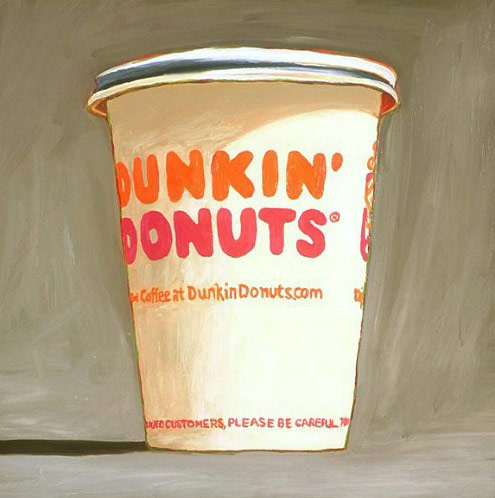
Dunkin’ Donuts is the complete antithesis of the coffee shop I described above. Personality literally isn’t even an option at Dunkin’ Donuts. Corporate protocol requires that every store look identical, regardless of location or the people working there. There’s no opportunity for the staff to show their personal style, because everyone is required to follow the rigid dress code. Managers are required to wear blue polo shirts, cashiers are required to wear white polo shirts, and both cashiers and managers are forced to wear medium wash jeans. Cashiers have to wear Dunkin’ Donuts hats and Dunkin’ Donuts aprons. There’s no music in most locations, and if a store is allowed to play music, it usually has to be a Top 40s radio station. Even though cashiers and managers are supposed to wear name badges, from the first day of work, it becomes apparent that sacrificing individuality is key when working at Dunkin’ Donuts.
From my first day of work at Dunkin’ Donuts, I was immediately taken aback by the way the overwhelming majority of customers treated my coworkers and I. I initially approached customers by asking, “hi, how are you?” but after having my question cut off by the fifth or sixth customer, I realized that customers didn’t want to be asked how they were doing, and they certainly didn’t want to ask me how I was doing. I decided to get more to the point and ask, “hi, what can I get for you?” Customers seemed to prefer that, but still the end of my sentence was usually cut off. I always thanked customers and tried to remain upbeat, but after awhile, being overly polite to these people who barely acknowledged my humanity became increasingly harder. The Dunkin’ Donuts that I worked at was perpetually understaffed, so during peak hours, there was usually a line. Even though customers could see that my coworkers and I were working as fast as we physically could, if their order took a bit longer than usual, they would become visibly annoyed, and often aggressive.
Certain customers were polite enough. They would thank my coworkers and I for their order, but unlike in a lot of other places I’ve worked, there was a rigid division between the customers and the employees. Customers were reluctant to strike up small talk, even if they weren’t in a rush or if there wasn’t a long line. If a customer had a band t-shirt of a band I liked, and I tried to compliment the shirt, customers would usually smile, nod, and/or say an abrupt “thanks,” careful not to give the impression that they planned on pursuing the conversation. Though this seems like a minute detail, the way that customers distanced themselves from my coworkers and I stood out to me because it was unique to Dunkin’ Donuts. I definitely don’t romanticize my other foodservice jobs; many of these jobs were very difficult, and I encountered more than my fair share of rude customers. Still, at Dunkin’ Donuts, the degree of separation between the customers and the employees was unparalleled. Though I haven’t worked in other coffee shops, it seems that customers at independently owned, “cool” coffee shops are more likely to connect with their baristas. What about Dunkin’ Donuts made customers so reluctant to engage with employees?
From working at Dunkin’ Donuts, I’ve come to understand that there is a clear hierarchy within the coffee shop industry. The degree of separation between the employee and the customer depends on where a coffee shop falls on said hierarchy. Coffee shops at the top of this hierarchy are the aforementioned independently owned, cool coffee shops. Coffee shops at the bottom are places like Dunkin’ Donuts. These coffee shops at the bottom are chains, they require uniforms and/or a strict dress code, and though there can be slight differences between stores, in general, every store has a similar layout and organizational system. The food at these places requires little to no preparation and simply needs to be baked upon arriving at a store or it comes to a store completely cooked and only needs to be reheated for service. Similarly, the ingredients for the drinks at these places typically arrive pre-portioned and require a quick mix or stir, if that. The coffee beans arrive pre-ground, but beyond that, the coffee and espresso drinks are made the same way they would be made at most coffee shops. Because Dunkin’ Donuts prioritizes low costs for consumers, it’s fair to say that their food and drink might not be of the same quality as independently owned, artisanal coffee shops. That being said, customers understand this when they go to a coffee shop like Dunkin’ Donuts—customers go to coffee shops like Dunkin’ because they want a quick, affordable drink or bite to eat.
Even though low-level employees at Dunkin’ Donuts have no say in ingredient sourcing or in the food and drink preparation protocol, I wondered if customers looked down at Dunkin’ Donuts employees because they viewed the company’s food sourcing and production practices as inferior. Maybe customers believed that because Dunkin’ employees didn’t have to prepare and cook foods the same way employees at other coffee shops did, they weren’t performing “skilled” labor, and consequently didn’t deserve the same degree of respect as employees at other coffee shops. I think this lack of respect translates into a lack of relatability. If you ask people about their career, most people believe that the work they are doing is skilled and benefits society in some way. This being said, if you ask people if they think Dunkin’ Donuts employees perform skilled labor and/or benefit society, a large percentage of people would argue that they don’t do either of these things. Because so many people regard Dunkin’ Donuts employees in this way, most customers believe that Dunkin’ employees shouldn’t be paid a dime over minimum wage and should actively be searching for more challenging and socially beneficial careers. The idea that people should only work in the fast food industry to build character and/or pull themselves out of poverty is pervasive in our culture. Ironically enough, we are completely dependent on places like Dunkin’ Donuts. Dunkin’ Donuts serves millions of people a day across the globe. Even though Dunkin’ Donuts might not be most people’s favorite food establishment, the truth is, when you’re hungry or thirsty and you don’t have a lot of time or money to spare, Dunkin’ Donuts is there. If every Dunkin’ Donuts employee went on strike tomorrow and halted service indefinitely, a lot of people would panic.
When I was working at Dunkin’ Donuts, I often had to work the opening shift which started at 4 AM. My coworkers and I would have to bake the bagels, donuts, muffins, and croissants, prepare the iced tea, fully stock the beverage fridge, and count the cash register before the store opened at 5 AM. As soon as we opened the doors for the day, there would be a line. At this time of the day, we served nurses (who often work early morning shifts or overnight shifts), construction workers, and folks who worked outside the confines of the formal economy. Not many other coffee shops open their doors at 5 AM. Not to mention, many Dunkin’ Donuts locations are actually open twenty-four hours a day. So, for the aforementioned people, Dunkin’ Donuts was able to cater to their unique lifestyle and fulfill their demand. Even beyond these niche lifestyles, Dunkin’ Donuts’ hours of operations accommodate most people’s schedules. To clarify, Dunkin’ Donuts’ widespread accessibility and ability to accomodate is due to the workers at Dunkin’ Donuts stores. These workers, not the owners or those working at Dunkin’ Donuts’ corporate office, wake up early, work long shifts for minimum wage, deal with impatient customers, prepare food and drinks, sacrifice their weekends, forfeit spending time with family, and work in a perpetual state of being understaffed and undervalued. Without these people, Dunkin’ Donuts, one of the most popular coffee chains, would cease to function. Why are these workers considered unskilled while those working at Dunkin’ Donuts’ corporate office are considered skilled?
In conclusion, I believe that the hierarchy within the coffee shop industry and consequently the varying degrees of separation between the customer and the employee exist because of the concept of skilled versus unskilled labor. The idea that some labor is skilled and therefore deserving of respect and other labor is unskilled and therefore unworthy of respect creates an unnecessary and illegitimate divide in the workforce. Simply put, all labor is skilled labor. Though people might scoff at the idea that Dunkin’ Donuts employees are skilled laborers, Dunkin’ employees perform a function and provide a service to society. As mentioned in a previous paragraph, if every Dunkin’ Donuts employee were to go on strike tomorrow and indefinitely halt service, a lot of people would be distressed. Yet, Dunkin’ Donuts employees are both notoriously mistreated and othered by customers. The food service industry is laden with problems and no doubt needs to be fundamentally changed. If we want to head in a more equitable direction, challenging the notion of unskilled labor and acknowledging the hard work of all food service workers are good ways to start.