
2019 Contest
Making Work Visible
City University of New York / Labor Arts
Finding My Way
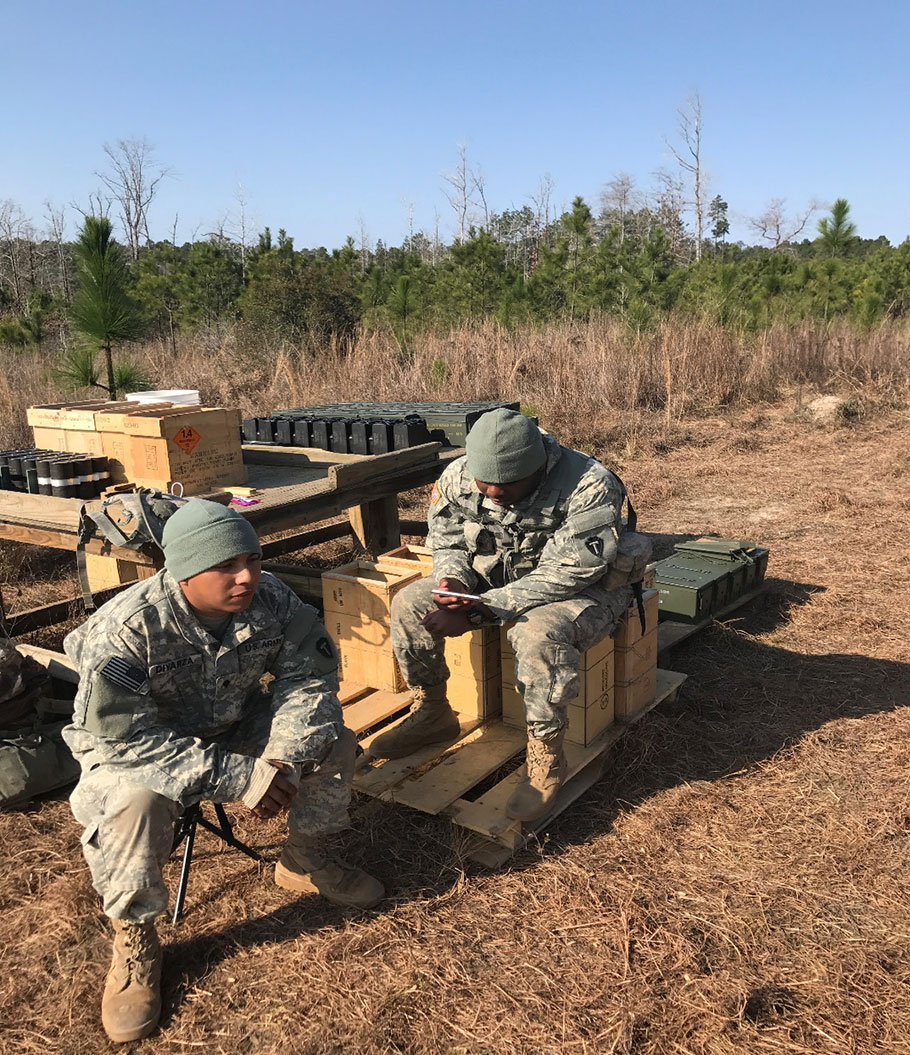
Joseph and Davis, Joseph Diyarza, March 17, 2016
“You better be prepared to get lost,” Sergeant Patt said that morning.
I knew that meant one thing: we were going to do land navigation training. For that, I needed to be prepared and pack enough clothes to spend two days in the field.
Land navigation consists of finding coordinates on the map and navigating unfamiliar terrain. It is a skill that all privates need to learn in order to become soldiers. To pass the training, you must know how to plot coordinates on the map and find them on the field in day time and at night too. Once you find those coordinates, you must write a code that you can find on the field. The code could be attached to a tree or a post; it could be a number or a letter and a number together.
That night I packed my bag for the next day’s training, and my packing list consisted of one uniform, one pair of socks, one t-shirt, my tarp to cover my bag in case of rain, my hygiene kit, and snacks, like beef jerky, sunflower seeds, cookies, and chips, in case I got hungry. Sergeant Stanton, my team leader, inspected my bag and told me that we were leaving at 0600 in the morning. I showed up at 0500 in the morning so we would be at the company early, ready to go.
On June 25, 2015, in Fort Polk, Louisiana, I woke up at 0400 to change, make my bed, shave, and brush my teeth. Then I grabbed my bag and headed to the company. By the time I arrived, it was 0430 in the morning. My team leader inspected my bag again, and then we waited for the truck to take us to the land navigation course.
The truck arrived at 0630 and took us to the course, which was one and a half hours away from any post or man-made place. When we arrived at the course, you could hear the wind whistle, see fallen trees, smell the pine trees. Birds were singing, it was sunny, and everyone thought it would be a good training day. There were some benches next to a gazebo in the middle of the forest, and inside the gazebo, something that I would describe as a desk.
Sergeant Patt stood on top of one of the benches and barked out the instructions: “So here we are at this God-forsaken place where you will conduct your training. Now listen carefully, you stupid idiots, you have four hours to find all 8 points to pass this course.” Sergeant Patt was pacing back and forth on the bench so everyone could hear. He was shouting so loud you could see the birds flying away. “After you find all your points, come back, so we can score your points and tell you if you passed or failed. Soon after everyone is done, we are going straight to nighttime land navigation, so be ready for that.”
After all his yelling, we got our coordinates and started plotting the points on the map.
I was on my way to find all my points. I was running for most of the time, so I was fast to find them. The first coordinate was easy because it was close to where we started the training. Once I got to the point, I checked if the coordinate on the post was the same as the coordinate on my map. Then I put the code in my score sheet and headed to the next one. On the map you can read landmarks, such as hills, valleys, roads, and rivers. You can plan the fastest routes to the next point, but it wasn’t always as easy as it sounds. The second point was two hundred meters away from my first point, and it was on top of a hill. I thought it would be painless just to head straight to the point, but I found out there were a lot of trees and holes, so I kept on falling. When I reached the top of the hill, I found the code and tried to leave it on the side of the hill, but with my luck I tripped and fell, all the way to the bottom of the hill.
After I put myself back together, I looked for an easy route to the third point. It was on the side of an old road, so I just followed the road and reached the post and wrote my code. On my fourth point I tried something different: I pulled out my compass and followed the degrees on the map. It was difficult because you must check your surroundings and the compass at the same time to see if you are going in the same direction. For a new private it would be hard to do and he might get lost, but because I had some experience it was easy for me. I found my fourth coordinate on the side of a small puddle, so I just wrote the code and went my way without checking if I had the correct coordinate. On my way to the fifth point, I encountered one of the new privates and asked him if he had one of the same coordinates. He did, so we exchanged answers and that way I found my fifth coordinate.
On my way to my sixth point, I didn’t notice a beehive. It was wedged between the two pieces of plywood attached atop a post where the code was displayed. As I got closer to the post, two bees stung me. I turned around and ran from that post and never came back to get my code.
I went to look for my last two coordinates and to my luck they were close to each other. Once I found all my points, I turned back and headed to the start of the course. Even though my sergeant told me I passed, I was still pissed because I couldn’t get my last point. I went to talk to Davis to see if he had encountered the beehive. He told me that he got stung four times. However, unlike me, he was so determined to get the code that when he got stung, he didn’t stop. He got the code.
Davis was my best friend. He’s from Jacksonville, Florida. He’s taller than me but everyone is taller than me, so it didn’t bother me much. He has blue eyes and blond hair. We became friends in basic training. Our first duty station was in South Korea at Camp Casey. We were assigned to Fort Polk for our next duty station. I think the main reason we became friends is that he had a similar history as mine. He wanted to go to college, but his family had some problems. His parents were divorced, and he was living with his grandmother. Like me, he couldn’t afford college by himself. It’s not like his parents wouldn’t support him, but he felt that it wasn’t their responsibility anymore to help pay his way. Soon after finishing high school, he joined the army.
He helped me with almost everything, from how to write better English to how to speak properly in English. He advised me on how to buy my first car and how to be a mechanic. Even though everyone believes that Mexicans can work on a car, I was Mexican and I didn’t know what a Mexican is supposed to know or do. I didn’t know how to change a tire, how to change the oil, or even how to check the oil. In exchange for his teachings, he asked me to teach him Spanish and I did. I taught him how to approach Hispanic women. He would say: “Hola, sexy muchacha, te gustaria salir con papi?” or “Te gustaria bailar y besar con papi?” These translate to “Hey, sexy woman, would you like to go out with daddy?” or “Would you like to dance and kiss with daddy?” Of course, he got rejected. It was funny to see how the woman would cuss him out in Spanish—“Hay no, vete de aqui animal” or “Eres un estupido pendejo”—and then storm off.
Sometimes he got lucky because he would score and have a date. I think it was because the women thought it was funny like me. They would go out with him but on the condition that he would learn how to cuss and of course he came to me for some advice.
For his next lesson, he asked me to teach him how to cuss, so I did but only with words—puto, verga, culo, gringo, caca—because he couldn’t say a whole sentence. He would approach other Hispanic soldiers and when they talked dirty about him, he would answer back in Spanish. They would be surprised to hear him cussing. The soldiers never got mad at him. They thought it was funny, but once when we went to a Mexican restaurant, he thought he could be as funny, but he almost got beat up until I intervened and said in Spanish, “Disculpen a este pendejo pero no sabe lo este wey esta diciendo.” This translates to “Excuse this dumb ass, but he really doesn’t know the language and he’s trying out new words.” But what I said to Davis was “Excuse my friend.”
We are connected to this day. I think of Davis as more than my friend. He’s a brother who helped me overcome the obstacles that I forgot I had and reminded me of why I got into college in the first place.
While the second group was waiting for their turn, the rest of us were either eating or going over notes. After everyone was done, nighttime came and Sergeant Patt with his furious voice yelled the instructions for the night training: “Listen here, you pieces of shit, you have three hours and 4 points to complete this training. You’re going with partners, so you morons won’t get lost, so go and find another idiot and get ready.”
I asked Davis if he would like to be my partner. He said yes, so we got our points, plotted them, and we went our way to find them. We are good at land navigation, so finding them for us was fast.
After we got our points, I asked him if he wanted to take a break. I knew a place at the edge of the forest where we could sit.
We got to the place and it was perfect. It was an open area, without trees or bushes, just a patch of grass where you could see the other side of the forest. It was a full moon that night—you could see your shadow because the moon was so bright—and the blades of grass were like they were painted silver. The stars were bright, too, as if someone had painted the sky with small white dots. We sat down and talked about the future ahead of us, about what kind of car I would be buying and how he would help me. Then without warning Davis asked me something that would change my life.
“Diyarza, do you think we did the right thing to join the army?” he said while looking up at the sky.
“I don’t know if we did or not,” I replied, “but we are here now, and we have to make the most of it.”
“But I like to think there’s more to it than the army. I will go to college once I get out of here. What will you do after you get out?”
Before I could answer, I asked myself why I joined the army. When I was in high school, I wanted to go to college in Brooklyn. However, my father didn’t have enough money to support me and my family. He did have some money, but it wasn’t enough for the whole family. My family is not that big, but it is separated. I have two younger siblings: my brother was in high school at the time, and my sister was in Mexico with my mom. My father wanted me to go to college in Mexico because it was cheaper, but I wanted to stay in the United States. I had lived in Mexico for most of my childhood, and then I came to United States when I was 13. It was hard for me to learn the new language and the new culture, but I did.
Now my dad wanted me to go back to Mexico. But if I did, I felt all the struggle, all the effort I had put into learning a new language was just a waste of time. While in high school I heard from a recruiter that you could go to college while being in the military, so I decided to join the United States Army. Soon after that, I went to basic training for four months in Atlanta, Georgia, and then I had my first duty station in South Korea, Camp Casey. There I asked if I could go to college, but because I wasn’t in the United States, I had to wait. Eight months passed, and I received instructions to go to Fort Polk. As soon as I arrived there, I asked my team leader Sargent Stanton if I could go to college, and he said I could. However, I needed the commander’s approval signature giving me permission to go. When I went to talk to him, he refused to give me his signature; he told me that training was more important than going to college.
Hearing those words made me sad. I had faced so many obstacles already, so I just gave up. Then one of my sergeants (whose name I don’t want to say) told me with a serious face that I was too dumb to go to college. I thought that was a signal for me to stop pursuing an education. For me there was no “after the army” anymore; I would just stay in the army. I had lost my way.
Until my best friend Davis changed the way I viewed my life.
“I don’t know if I will go to college. The Commander keeps telling me that the training is more important than college, and the other asshole keeps saying that I’m too dumb.”
Before I could finish my sentence, Davis turned around and with a serious face said, “Look, puto, never let anyone tell you how dumb you are or how you can’t go. Show them that you can and show them they are wrong. You need to find your way back to college, you need to find your way back to your family, you need to get yourself a life other than the army, you better find your way back.”
At that moment I was shocked by what he said. I would never expect him to wake me up to how I was thinking so low of myself, and how I let myself down thinking that anyone can tell me what to do. After that day I started to view my life differently and asked myself what I wanted to do. All these questions were going through my head while we sat there contemplating the stars.
After that talk, we decided it would be a good idea to re-join the rest of the group. It was early when the whole group finished, so the sergeant in charge of the training decided that it was time to head back to base. On the ride back, everyone was happy that we didn’t have to spend the night in the field. Everyone except me. I was still trying to comprehend what my best friend had told me. Only later did I realize why I got into college—it was because of Davis. He got me back on track. He helped me find my way back.